
It is 8:10 on a Saturday and your first dog is already on the table. Your phone buzzes: a client texting “on my way?” for an appointment you confirmed three days ago, except they never got the confirmation. Then two more no-shows roll in before lunch. You sent the reminders. They never landed, because the carriers quietly stopped trusting your number, and nobody told you.
Here is the short version. If you text clients from a normal 10-digit number in the US, and you do, your messages run through a system called A2P 10DLC, and your number has to be registered or carriers filter it. On top of that, the TCPA governs consent, so how you collect a phone number decides whether you can legally text it. And two questions keep coming up in grooming forums: do you even need a license to groom, and is a waiver worth the paper it is printed on. This guide answers all of it, with copy you can lift straight into your booking page and intake form.
Key Takeaways
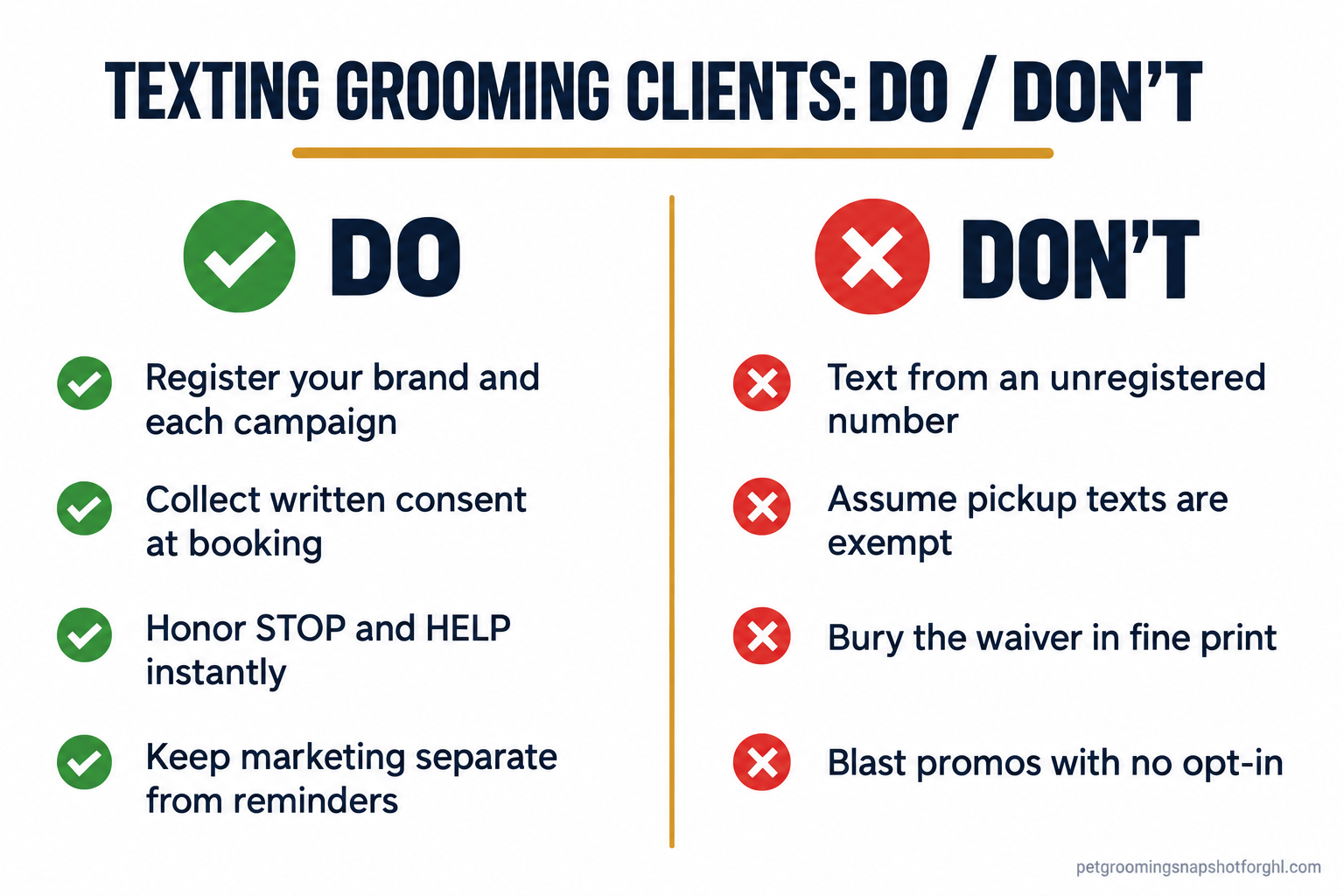
- Every automated text you send runs through A2P 10DLC. Register your business (the “brand”) and each messaging program (the “campaign”), or carriers filter your reminders into the void.
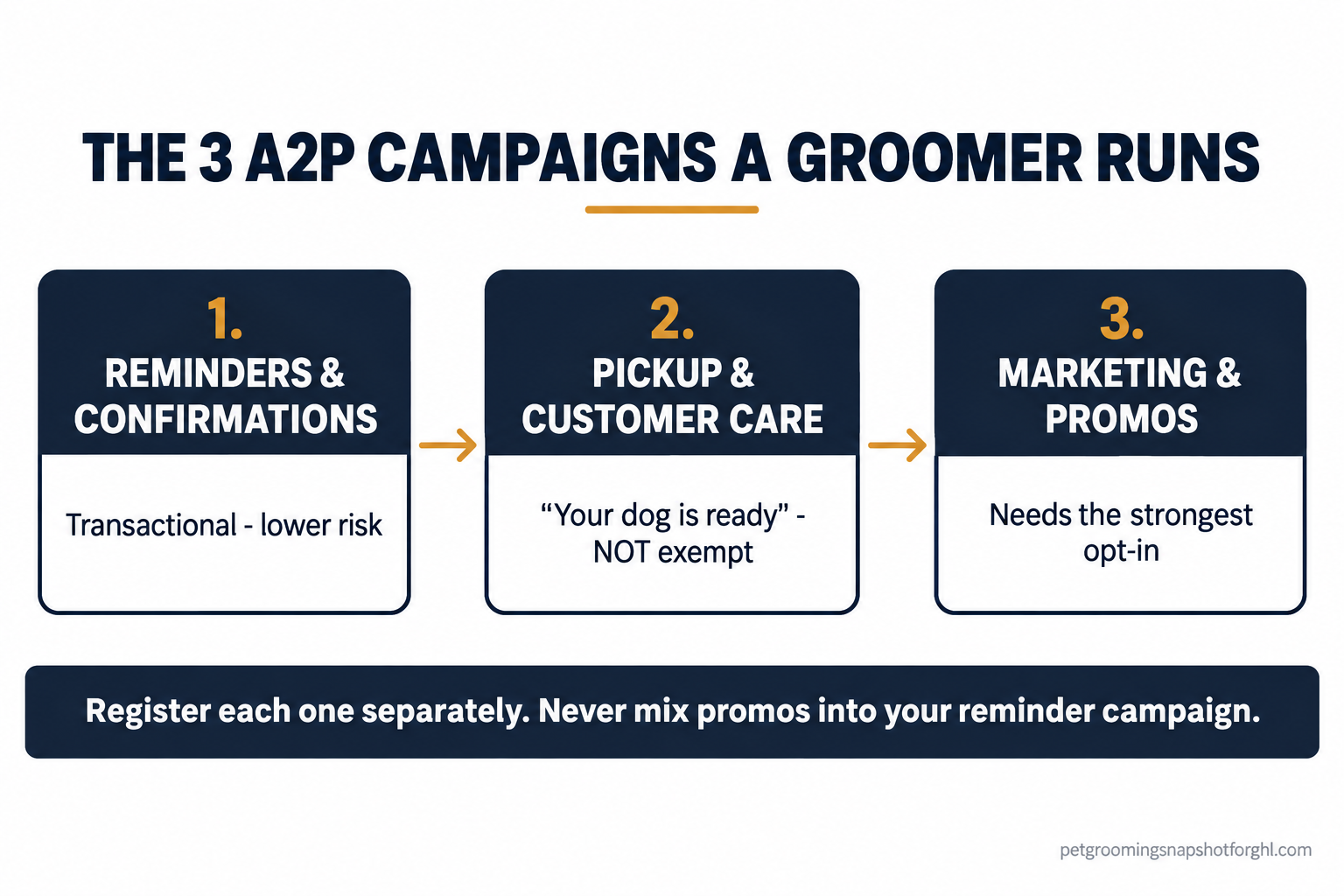
- Reminders, pickup texts, and marketing are different campaigns. Mixing promos into a reminder campaign is a top reason numbers get throttled or suspended.
- “Your dog is ready” texts are not exempt. They are lower risk than marketing, but you still need a registered campaign and a number captured with consent.
- TCPA damages run $500 to $1,500 per text for messages sent without proper consent, and clients can sue directly. Marketing without opt-in is the real exposure, not reminders.
- Almost no state licenses individual groomers. A few (Connecticut, Colorado) license grooming facilities. New Jersey’s individual-licensing bill has never passed.
- A signed, specific waiver helps but does not make you bulletproof. It is consent, not a magic shield, and never excuses gross negligence.
What This Guide Covers
- Why groomers get hit harder than any small shop
- A2P 10DLC in plain English
- The three campaigns you actually run
- TCPA consent, and the copy that collects it
- How texting compliance breaks
- Solo van, salon, and multi-van fleet
- Do you need a license? Bijou’s Law
- Grooming waivers: what actually holds up
- Objections
- FAQ
Why groomers get hit harder than any small shop
Think about how many texts one groom generates. A confirmation. A day-before reminder. A “we’re outside” text from the van. A “ready for pickup” message. A rebooking nudge six weeks later. A review request. A slow-Tuesday promo. One dog, one appointment, and you have touched that phone five to seven times.
Multiply that across a full book and a busy solo groomer sends more automated texts in a week than many retail stores send in a month. That volume is exactly what carrier filtering scrutinizes. You are not a spammer, but to an algorithm watching an unregistered number fire off hundreds of near-identical messages, you look like one. The stakes are real, too. The US pet industry hit $158 billion in 2025, projected to reach $165 billion in 2026, per the American Pet Products Association, and the Bureau of Labor Statistics projects animal care jobs to grow 11 percent from 2024 to 2034, much faster than average. More groomers, more competition for the same chairs. The shops that stay full are the ones whose reminders arrive. When your texts get filtered you do not get an error, you get silence, then no-shows, and you blame the client.
A2P 10DLC in plain English
A2P 10DLC means Application-to-Person messaging over 10-digit long codes. Translated: it is the rulebook US carriers use for any business that sends automated texts from a regular phone number. It exists because carriers got buried in spam and wanted a way to tell legitimate business texts from junk.
You register two things. First, your brand, your business identity: legal name, address, EIN, or your SSN if you are a sole proprietor. This is a one-time verification through The Campaign Registry, the body carriers use to vet business messaging. Second, your campaign, which describes what you send, why, and how people opted in. You submit sample messages and opt-in language, and the campaign gets approved, rejected, or flagged. Registration also earns a trust score that sets how fast you can send, which matters more than groomers expect at rush.
T-Mobile SMS throughput in messages per second by A2P 10DLC brand type and trust score. Source: HighLevel A2P throughput and trust scores.
A sole proprietor brand sends about one message per second. A well-vetted standard brand sends up to 75. On a normal Tuesday you never notice. On the Saturday before a holiday, firing confirmations and pickup texts across a packed book, a one-per-second cap means messages queue and land late, which is its own no-show machine.
The three campaigns you actually run
Here is the part that trips up almost everyone. A2P is organized by use case, and grooming shops run at least three. Carriers treat them differently, and lumping them together gets you throttled. GoHighLevel’s own A2P campaign use case list spells out every category, but for a groomer they boil down to three.
- Appointment reminders and confirmations. Transactional, expected, lower risk. Carriers score this well because recipients want it.
- Customer care and pickup. Also transactional. “Bella is bathed and ready for pickup.” This is the one people wrongly assume is exempt. It is not. It needs a registered campaign and a number you have consent to text.
- Marketing and promotions. Higher risk, stricter consent. “Slow Tuesdays: $10 off a full groom, reply BOOK.” This requires the strongest opt-in and should never be smuggled into your reminder campaign.
TCPA consent, and the copy that collects it
A2P is about carrier trust. The Telephone Consumer Protection Act is about the law. It governs whether you are allowed to text a number at all, and it has teeth: statutory damages of $500 per text, up to $1,500 for a willful one, and individuals can sue directly. No per-day cap.
TCPA statutory damages per text message, in US dollars. Source: 47 U.S.C. 227, Telephone Consumer Protection Act; see also the FCC guidance on unwanted texts.
The good news: the messages that create real TCPA risk are the marketing ones. Confirmations and pickup texts for an appointment the client actively booked sit in much safer territory. The exposure lives in blasting promos to numbers that never agreed to receive them. So the fix is boring and cheap: capture consent at booking, keep a record, and honor opt-outs instantly.
Here is copy you can steal. This is not legal advice, and you should have a local attorney confirm it for your state, but it is the shape of compliant consent.
Booking-page consent checkbox (the express written consent):
By checking this box, I agree that [Your Grooming Business] may send me text messages about my appointments, including confirmations, reminders, and pickup notifications, and occasional offers, at the number provided, using automated technology. Consent is not a condition of purchase. Message and data rates may apply. Reply STOP to opt out or HELP for help.
First message after opt-in (sets expectations, proves consent):
[Your Grooming Business]: You’re subscribed to appointment texts for [Pet Name]. Msg freq varies. Msg & data rates may apply. Reply HELP for help, STOP to cancel.
HELP auto-reply:
[Your Grooming Business] appointment texts. Call us at [phone] or email [email]. Reply STOP to unsubscribe. Msg & data rates may apply.
STOP handling: when a client texts STOP, your system must stop texting that number immediately and confirm once. Most platforms do this automatically. Test it by texting STOP to your own number and watching what happens. If the reminders keep coming, you have a problem that is both a compliance risk and a great way to lose a client.
The “your dog is ready” pickup text (transactional, but still inside a registered campaign):
[Your Grooming Business]: [Pet Name] is all done and looking great! Ready for pickup anytime before [close time]. See you soon.
None of these are clever, and clever is not the goal. Clear, expected, and opted-in is. For a full library, see the SMS templates every grooming salon should steal, and pair this with a real system for cutting no-shows without nagging.
How texting compliance breaks
Setup is the easy part. Knowing how it falls apart is what keeps your book full. Here are the failure modes I see most.
Failure 1: Texting from an unregistered number. It works for a week, then delivery quietly drops. Fix: finish brand and campaign registration before you rely on the number, and treat the approval wait as setup, not downtime.
Failure 2: Sample messages that do not match what you send. You registered “appointment reminders” but your samples were generic, so carriers flag the mismatch. Fix: submit samples nearly identical to your live templates, with your business name and a STOP notice.
Failure 3: Marketing smuggled into a transactional campaign. The number one killer: a promo in your reminder campaign flags the whole thing. Fix: separate campaigns, separate numbers where you can.
Failure 4: No opt-in on the booking form. You collect numbers but never capture consent, so every marketing text is exposure. Fix: add the consent checkbox to every intake and booking point, online and on paper.
Failure 5: The sole-proprietor throttle at rush. Registration is fine, but your cap means Saturday’s confirmations land Sunday. Fix: once you are past a full solo book, register as a standard brand.
Failure 6: Chasing a blocked number with a new one. Buying fresh numbers to dodge filtering is called “snowshoeing,” and it gets flagged fast. Fix: solve the registration problem instead of playing whack-a-mole.
Failure 7: STOP that does not stop. A client opts out, your system keeps sending, and you are now both non-compliant and memorably annoying. Fix: test your STOP flow monthly, especially after a platform change.
Solo van, salon, and multi-van fleet
The rules are the same at every size, but the configuration is not.
The solo mobile groomer, one van. Register as a sole proprietor if you have no EIN, or as a standard brand if you do (standard is better if you can). Run one combined transactional campaign for confirmations, reminders, and pickup, plus a separate marketing campaign only if you actually promote. Collect consent on your booking page and keep one waiver per client. Your risk is low, but the sole-proprietor send rate can bite on busy days, so upgrade when you feel the squeeze.
The 1-to-3 chair salon, 2 to 4 staff. Register as a standard brand for a real trust score and throughput headroom. Run separate reminder and marketing campaigns from day one, because at this size you will promote and cannot afford a promo flagging your reminders. Train everyone who touches the phone on what STOP means, and never let anyone text a client from a personal cell for business, which sidesteps all your consent records. Keep consent and waiver records centralized, not in one person’s head.
The multi-van fleet, 2 to 6 vans. You are now a high-volume sender and throughput is a daily concern. Register as a standard brand and do the secondary vetting to push your trust score up, because the gap between 4 and 75 messages per second decides whether a fleet’s worth of morning confirmations goes out on time. Use separate numbers per campaign type, centralize consent so a client who books with any van is logged once, and standardize your waiver across every market. This is also where one owned system beats renting per-van seats, a tradeoff worth reading in the MoeGo vs Gingr vs PetExec pricing breakdown.
Do you need a license? Bijou’s Law
This comes up constantly, and the internet is full of wrong answers, so let me be precise.
Almost no US state licenses individual pet groomers as a profession. You do not sit an exam and get a groomer’s license the way a cosmetologist or an electrician does. What a few states do instead is license the facility.
- Connecticut licenses commercial grooming facilities through its Department of Agriculture under state statute section 22-344. The commercial license covers the business and its premises, carries a fee, and renews every two years. It is about the shop, not a personal credential.
- Colorado licenses grooming facilities under the Pet Animal Care and Facilities Act (PACFA), run by the Colorado Department of Agriculture. Facilities that keep animals for grooming must be inspected and licensed, renewing annually.
The most cited attempt to license individuals is Bijou’s Law in New Jersey, named after a dog that died during grooming. It would create a state board and require every groomer to hold a personal license. It has been introduced repeatedly since 2014, and as of 2026 it has never been enacted. Even the flagship individual-licensing effort is not law.
Grooming waivers: what actually holds up
A liability waiver is not a force field. It is documented, informed consent, and that is why it is worth having. When a senior dog with a heart condition stresses on the table, or a heavily matted coat has to come off short and reveals skin problems underneath, a clear signed waiver shows the client understood and agreed to the risks and to reasonable professional judgment.
What makes a waiver more likely to hold up: it is specific, signed before the service, names the real risks of grooming difficult animals, and does not try to waive gross negligence, which courts generally will not enforce anyway. Enforceability varies by state, so this is the one place you want a local attorney to bless your exact wording.
Here is a plain sample clause to bring to that attorney, not copy blindly:
I understand that grooming a matted, senior, anxious, or aggressive animal carries inherent risks, including stress, minor nicks, or the discovery of pre-existing skin or health conditions. I authorize [Your Grooming Business] to use reasonable professional judgment for the safety and comfort of my pet, including humane removal of severe matting. I confirm the health and vaccination information I have provided is accurate. This does not waive liability for gross negligence.
Two things to remember. First, we are a marketing and operations product, not a legal provider, and this is not legal advice. Second, your waiver is also a data-capture moment: it is the natural place to collect the texting consent from earlier, so the client signs once and you are covered on both fronts. The same discipline that gets your reminders delivered gets your review requests built on real consent delivered too.
Objections
“My reminders are just service texts. I don’t need to register.” The most expensive myth in grooming. A2P still applies to transactional texts, and unregistered traffic gets filtered no matter how harmless it is. Carriers are not reading your messages to decide they are friendly, they are checking whether your number is registered. Register, and your service texts sail through.
“I already pay for MoeGo or Gingr. Aren’t they handling this?” They handle the sending, not your identity. Registration is tied to your business and your consent records, and every serious platform makes you complete it. If a tool let you text with no registration, that is a red flag, not a feature.
“Do I need to be technical to get this right?” No. You need three things: a booking form with a real consent checkbox, campaign registrations that match what you send, and a STOP flow you have tested. That is a checklist, not a coding project, and a pre-built system does most of it.
“Aren’t waivers pointless because people sue anyway?” People can always file. A waiver does not stop a lawsuit, but a specific, signed one documents that the client understood and consented to the risks. That is the difference between a defensible position and no position, and it is worth ten minutes at intake.
FAQ
Do appointment reminder texts need A2P 10DLC registration?
Yes. Any automated text to a US mobile number over a 10-digit number goes through A2P 10DLC, and unregistered traffic gets filtered even when it is a harmless reminder.
Are "your dog is ready" pickup texts exempt from consent rules?
No. They are transactional and lower risk than marketing, but not exempt from registration, and you still need a number captured with consent.
What happens if I text clients without registering?
Carriers filter or block your traffic, so reminders and pickup texts silently fail to deliver. There is no carrier fine, but the deliverability loss is immediate.
How much can a TCPA violation cost?
Statutory damages of $500 per text for a standard violation, up to $1,500 for a willful one, and individuals can sue directly. Per message, with no cap.
Do I need a license to work as a pet groomer?
In almost every state, no. A few license grooming facilities, not individuals: Connecticut through its Department of Agriculture, and Colorado under PACFA. New Jersey's Bijou's Law has been introduced since 2014 and never enacted. Check local rules too.
Does a grooming liability waiver actually hold up?
A signed, specific waiver can, but enforceability varies by state and none excuses gross negligence. It is documented consent, not a shield. Have a local attorney review it.