
It is 1:50pm on a Saturday and your 2 o’clock just texted: “So sorry, something came up, can we move it?” The slot is dead. You cannot refill a two-hour full groom on ten minutes’ notice, so that chair sits empty while you lose sixty-plus dollars. No deposit, no card on file, no policy with teeth, just a shrug and a “no worries.”
Here is the answer up front. A deposit and cancellation policy clients actually follow has four parts: a deposit or card on file that makes a no-show cost something, a clear cancellation window (24 to 48 hours is standard), the policy agreed to in writing at booking, and automated reminders that make the window fair. Get those four right and the policy enforces itself, with no money fight at the desk. This guide builds it stage by stage, with the wording to steal.
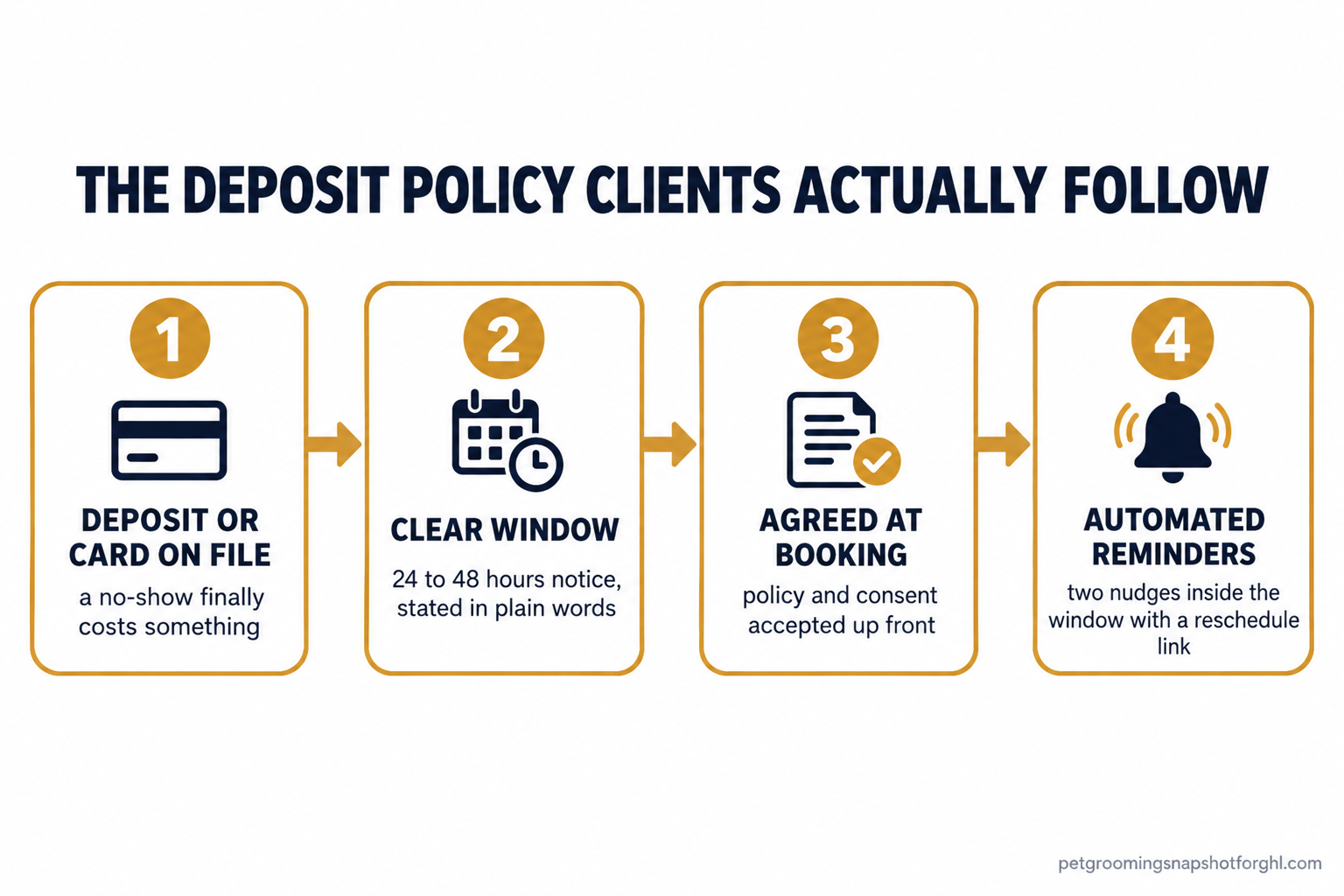
Key Takeaways
- A free booking costs the client nothing to skip. The fix is commitment: a deposit that rolls into the groom, or a card on file you can charge for a no-show.
- The window is the fair part. Pick 24 or 48 hours’ notice, say it in plain English, and remind people inside it so nobody can claim they forgot.
- Get consent in writing, at booking. A surprise charge feels like a trap; a policy they agreed to feels like a pro.
- Reminder and marketing texts differ under the law. Appointment and deposit texts are transactional, but consent and STOP still matter. Keep the gate clean.
- The policy is a tool, not a weapon. Waive it for real emergencies; enforce it on the repeat offenders costing you a chair a week.
What This Guide Covers
- What a soft policy costs you
- The three tools
- Stage 1: The deposit amount
- Stage 2: The cancellation window
- Stage 3: The policy language
- Stage 4: Consent and card at booking
- Stage 5: The reminders
- Stage 6: Charging the fee
- Stage 7: Refunds and the win-back
- Steal this: the full copy
- Solo, salon, and fleet
- Objections
- FAQ
What a soft policy actually costs you
Grooming runs on time, not product. The hour is gone the moment it passes.
The math is ugly. Say you average a 60 dollar groom and run a 12 percent no-show or late-cancel rate, inside the 15 to 25 percent range most service businesses see. On 40 booked grooms a week that is roughly five dead slots, about 290 dollars gone every week, more than 15,000 dollars a year.
It is a crowded market, about 193,000 pet grooming and boarding businesses in the US as of 2026 per IBISWorld, and more than half of dog owners now groom at home per the APPA. The clients who still book a pro value your time; a policy teaches them it has a price.
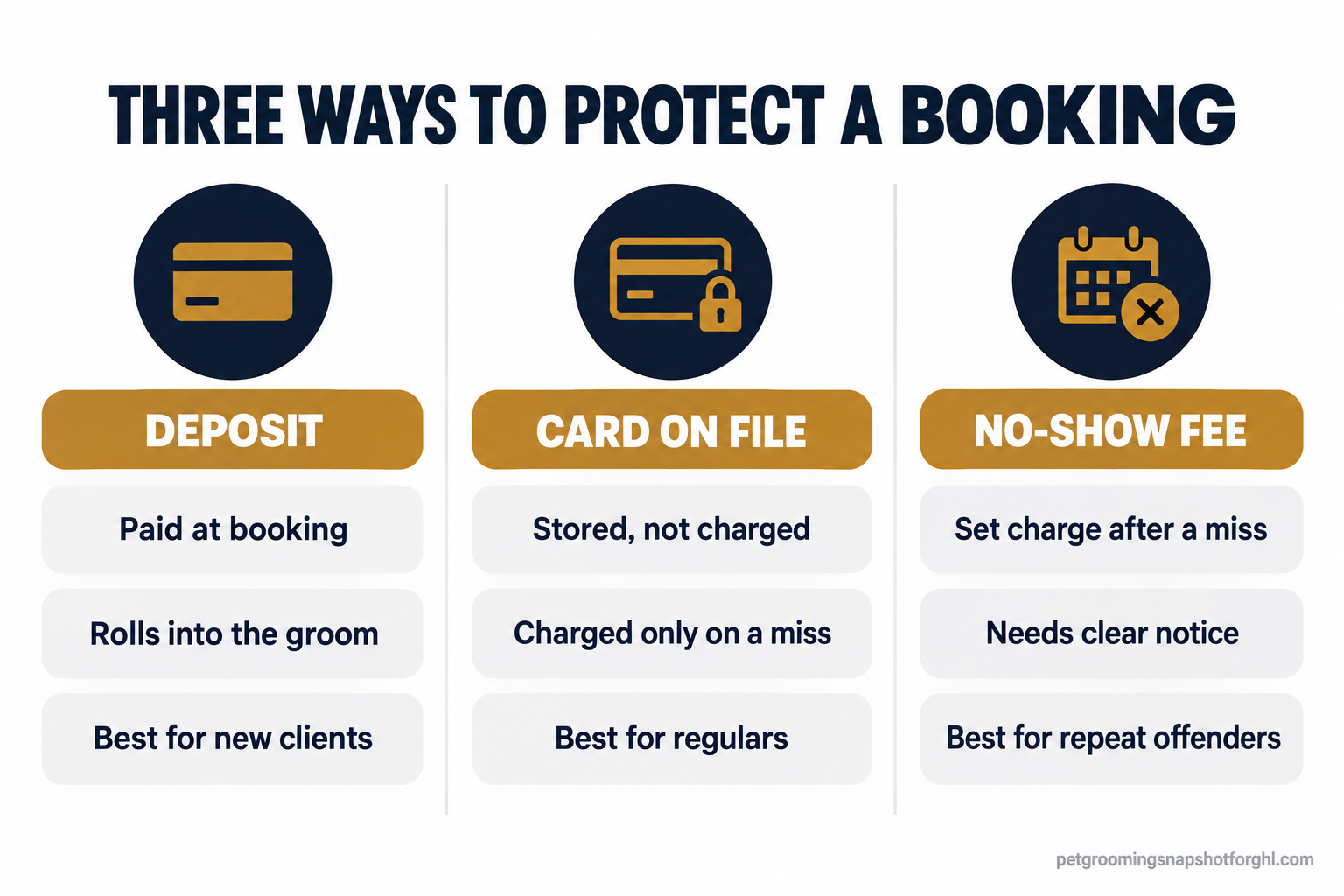
The three tools: deposit, card on file, no-show fee
You are choosing between, or combining, three mechanisms.
| Tool | How it works | Client feel | Best for |
|---|---|---|---|
| Deposit | Collected at booking, rolls into the price | They pay now, lose it only if they flake | First-timers, long grooms, prime slots |
| Card on file | Stored at booking, charged only on a no-show | Nothing paid upfront, consequence is clear | Trusted regulars, whole-book coverage |
| No-show / late-cancel fee | A set charge applied to the card after a miss | A penalty, so it needs clear notice | Repeat offenders, enforcing the window |
A deposit is the strongest commitment because the money already left the account; a card on file is the gentler cousin, nothing paid to book but a clear cost on a miss. MoeGo Pay supports all three, including a documented no-show fee flow, so this is standard practice. Most salons blend them.
Stage 1: Set the deposit amount
The deposit has one job: big enough to matter, small enough that nobody balks at booking.
For most grooms, a flat 20 to 30 dollar deposit that rolls into the final price works. Because it comes off the total, the client is not paying extra, they are pre-paying their own groom. For long or high-value jobs, full de-matting, hand-stripping, a giant double-coat, scale it to 25 to 50 percent of the quote. Skip it for loyal regulars on a standing schedule, and use deposits surgically on the bookings that carry risk.
How it breaks, and the fix. One flat deposit either scares off casual first bookings or fails to protect your three-hour jobs. Tier it in the booking form so each dog lands in the right band automatically.
Stage 2: Set the cancellation window
The window is the promise you make back. You are not charging for life’s surprises, you are charging for notice too short to refill the slot.
For most operations, 24 to 48 hours is the standard and the fair number. Give that much notice and you keep your deposit or dodge the fee; miss it, and the deposit holds or the fee applies. Mobile groomers often set 48 hours, because a cancellation blows up the day’s route, not just one slot. State the window in hours, tied to a specific consequence. A vague “please give reasonable notice” gives you nothing to stand on; a number does.
How it breaks, and the fix. A window nobody was reminded about is a gotcha. Pair it with a reminder that fires just before it closes (Stage 5), so everyone gets one clear chance to move the appointment for free.
Stage 3: Write the policy language
Most salons keep the policy in their head and nothing on paper, so every enforcement is a debate. Written, plain, and agreed in advance, it stops being your opinion and becomes the deal you both made.
Keep it to four short lines a human reads in ten seconds: the deposit, the window, what happens on a miss, and the promise that you will always remind them. The full wording is in the steal-this section below; drop it into your booking page, confirmation, and intake form.
How it breaks, and the fix. An unwritten policy turns every no-show into a judgment call. Write the four lines once, put them everywhere booking happens, and enforce the same words for everyone.
Stage 4: Capture consent and card at booking
Everything upstream is words until you can actually hold the deposit or charge the card. Two things get captured at booking: the card, with the client’s recorded agreement to your no-show terms, and SMS consent. The recorded agreement is what lets you charge a no-show fee later without chasing anyone for a card number.
On texting, know the line. Confirmations, reminders, “your dog is ready” pickups, and deposit receipts are transactional, tied to a service the client requested. Promotional blasts are marketing, and under the TCPA, marketing texts require express written consent while transactional texts ride on the prior express consent a client gives by booking. Keep the streams separate, honor STOP on both, and capture a consent checkbox at booking. More in the groomer texting compliance guide.
How it breaks, and the fix. Collect the card but never record the agreement, and a disputed charge becomes a chargeback you lose. Capture the authorization and the SMS consent in the same step as the card, timestamped.
Stage 5: Automate the reminders that make it fair
Reminders are what makes the policy defensible. If a client gets two clear reminders inside the window and still no-shows, nobody can honestly say they forgot.
A clean sequence: an instant confirmation at booking that states the policy; a reminder 48 hours out, right at the edge of the window, with one-tap reschedule; a morning-of nudge; and, only on a miss, a recovery message. Every reminder carries a self-serve reschedule link, because half of no-shows are failed reschedules by clients who would have moved the slot if calling during business hours had not felt impossible. Give them a link and a miss quietly becomes a reschedule, the backbone covered in how to cut grooming no-shows. The deposit is the stick; the reminder is the fairness that earns you the right to use it.
Illustrative no-show rate as commitment is added, in percent, based on reported ranges where deposits and card-on-file cut missed appointments by roughly half. Source: aggregated service-business no-show data.
How it breaks, and the fix. Charge a fee on a client who never got a reminder and you deserve the angry review. Automate at least two reminders inside the window, with a reschedule link in each.
Stage 6: Charge the fee without the fight
Here is where nerve fails most owners. They build the whole policy, then cannot bring themselves to charge it, so word spreads that it is a bluff. Done right, enforcement is quiet.
Let the system charge the fee against the card on file the moment the window is broken and the groom is marked a no-show, then send a plain, non-apologetic message. The agreement they signed at booking did the arguing for you. Your only live judgment is the exception, a genuine emergency or a first honest mistake, which you waive warmly and on the spot.
How it breaks, and the fix. Enforce inconsistently, hitting one client and waiving another, and it feels like favoritism. Automate the charge so it applies the same to everyone, then use human judgment only to waive, never to selectively punish.
Stage 7: Refunds, reschedules, and the win-back
A deposit policy is not just about keeping money, it is about keeping the client. What you do after the charge decides whether a no-show becomes a lost customer or a one-fee lesson.
Spell out three things in advance. Reschedules inside the window move the deposit to the new slot, no penalty, because that is the behavior you want. Cancellations inside the window refund the deposit, rewarding good notice. A no-show forfeits the deposit or triggers the fee, full stop. Then do not go silent: send a win-back a few days later, because most people who miss are embarrassed, not hostile, and a warm “let’s get [Pet] back on the books” turns an awkward charge into a continued relationship. Same logic behind a standing rebooking system.
How it breaks, and the fix. Charge the fee and never follow up and you have taught the client that missing ends the relationship. Always pair enforcement with a win-back invite.
Steal this: the full policy and message copy
Lift these and change the bracketed parts.
The policy itself (booking page, confirmation, and intake form):
Booking & Cancellation Policy. We hold your spot with a [$25] deposit that comes straight off your groom. Need to change your appointment? Just give us at least [48 hours’] notice and we’ll move your deposit to the new time. Cancel or miss with less than [48 hours’] notice and the deposit is kept to cover the slot. We’ll always text a reminder with a one-tap reschedule link, so you have plenty of chances to move it for free.
The booking confirmation text (states the policy, transactional):
You’re booked! [Pet]’s groom is [Sat, Oct 11 at 10am]. Your [$25] deposit is applied to the total. Need a different time? Tap here to reschedule free up to [48 hrs] before: [link]. Reply STOP to opt out.
The in-window reminder (48 hours out):
Hi [Name], [Pet]’s spa day is in 2 days, [Sat at 10am]. All set? Need a new time? Tap here and we’ll move your deposit over, no charge: [link]. After tomorrow we can’t guarantee a free move.
The no-show / late-cancel charge notice (plain, no apology):
Hi [Name], we missed [Pet] today and couldn’t fill the slot on short notice, so per the policy you agreed to at booking, the [$25] deposit was applied. No hard feelings, and we’d love to get [Pet] back in: [link].
The goodwill waiver (first miss from a good client):
Hi [Name], life happens! Since this is a first for you, we’ve waived the fee this time. Just a heads up the [48-hour] policy applies going forward. Want to grab [Pet]’s next spot? [link]
The front-desk / phone script (when you explain it live):
Absolutely, I can book [Pet] for [day]. We take a small [$25] deposit to hold the spot and it comes right off the groom. If anything comes up, give us [48 hours’] notice and we’ll move it, no charge. Can I grab a card to lock in that time?
Pair these with the library of grooming SMS templates so the client conversation runs without you.
Solo van, salon, and multi-van fleet
The four parts are identical at every size. What changes is keeping the policy consistent when more than you is running it.
The solo mobile groomer, one van. You are the policy, and your risk is going soft because you are right there, face to face. Automate the deposit and the charge so the system is the “bad guy,” not you. Mobile cancellations kill your route, not just a slot, so run a 48-hour window and lean on deposits harder than a salon would. Same logic behind route-smart mobile booking.
The 1-to-3 chair salon, 2 to 4 staff. Consistency is the whole game. If one groomer enforces and another waives everything, clients learn to book with the soft one. Put the policy and fee rules into the booking system, not each person’s discretion, so the deposit and charge follow the appointment whoever is at the desk.
The multi-van fleet, 2 to 6 vans. Your enemy is drift. One van forgets deposits, another never charges the fee, and you cannot see it until the numbers come in soft. Lock the rules into the booking flow so every van operates identically, and review no-show rate by van monthly. A policy you cannot measure is one you cannot defend, and this separates a booked-solid-but-broke shop from a profitable one.
Objections
“Won’t a deposit policy scare clients off?” A small, well-framed deposit filters out the clients who were never going to show. Frame it as a held spot that comes off the groom, and good clients barely notice.
“I already pay for MoeGo or Gingr.” Then you likely have the plumbing already, MoeGo Pay does deposits, card on file, and no-show fees. The question is whether the whole sequence is built and running, because most operators have the buttons and never wired them into one flow.
“It feels harsh, that’s not my vibe.” The harsh move is having no policy. Without one, every no-show quietly taxes your reliable clients, who subsidize the flakes. A fair, well-reminded policy is the kinder choice.
“What about genuine emergencies?” You waive them, on the spot, and tell the client you did. The deposit stops the casual flake, not the client whose kid got sick.
“Do I need to be technical to run this?” No. Deposit capture, consent, reminders, the automatic charge, and the win-back can all be pre-built and switched on, so you never touch it.
FAQ
How much should a dog grooming deposit be?
A flat $20 to $30 deposit that rolls into the final groom price works for most appointments: real enough to create commitment, small enough not to add booking friction. For long or high-value grooms like de-matting or large double-coats, scale it to 25 to 50 percent of the quote. Loyal regulars usually need none.
What is a fair cancellation window for a grooming salon?
24 to 48 hours' notice is the standard and the fair number, because it gives you a realistic chance to fill the slot from a waitlist. Mobile groomers often set 48 hours, since a late cancellation blows up the whole route. State the window in hours, tied to a consequence.
Can I legally charge a no-show fee in grooming?
Generally yes, as long as the client agreed to the policy in advance, which is why the deposit and no-show terms must be accepted at booking, with the card stored under that authorization. Disputes are won by the business that can show the client agreed before the appointment, so keep it documented and timestamped.
Do appointment and deposit texts need the same consent as marketing texts?
Not quite. Confirmations, reminders, pickup texts, and deposit receipts are transactional, so they ride on the prior express consent a client gives by booking and sharing their number. Promotional blasts are marketing and need express written consent under the TCPA. Keep the streams separate and honor STOP on both.
How do I introduce a cancellation policy to existing clients without upsetting them?
Announce it once, warmly, with a date, framed around fairness and the reminders they'll get. Tell regulars their standing slots are unchanged and that you'll always text a reminder with a free reschedule link. Most accept a clear, well-reminded policy without a blink.
Should I keep the deposit if a client reschedules?
No. If they reschedule inside your cancellation window, move the deposit to the new appointment with no penalty, because rescheduling with notice is the behavior you want to reward. You only keep the deposit or charge the fee when the window is broken or the client no-shows.
Related Reading
- How to Cut Grooming No-Shows (Without Nagging Pet Parents)
- Texting Grooming Clients in 2026: A2P 10DLC, Consent, and Waivers
- 12 SMS Templates Every Grooming Salon Should Steal
- The Rebooking System That Keeps Your Chairs Full
- Booked Solid but Broke: Why a Full Grooming Schedule Isn’t Making You Money