
It is Friday night and you just finished your ninth dog. Next week is packed, there is a waitlist, and you turned two people away today. By every measure you can see, business is good. Then you open your bank app and the number does not match the exhaustion. Rent, the van payment, the software bill, the card fees, the shampoo order, and a fully booked week left you with a few hundred dollars and a sore back.
Here is the short answer. A full book is not the same as a profitable one. Being busy tells you demand is fine. It says nothing about whether each groom actually pays. Most grooming businesses that feel “booked solid but broke” are losing money in seven predictable places, and every one is fixable without working more hours. This guide walks through all seven, shows you how to spot which are draining you, and hands you the exact scripts to plug them.
Key Takeaways
- Busy is a demand signal, not a profit signal. A packed calendar can still lose money if the price, no-show rate, and fixed costs are wrong.
- Your revenue has a hard ceiling. A groomer can finish only so many dogs a day, so once the calendar is full, only price and cost can grow your take-home.
- No-shows and gaps are pure loss. A chair you already staffed and drove to is 100% margin gone, and it is the easiest leak to close.
- Underpricing is the quietest leak. Flat pricing for every coat, no matting fee, and years without a raise slowly bury your margin.
- Small recurring costs compound. Per-van seats and card processing add up against a thin net margin.
- Demand is softening at the paid end. With 51% of dog owners now grooming at home, per the APPA, filling the book on price cuts is the wrong move. Fix the leaks instead.
What This Guide Covers
- Why full and profitable are two different things
- What “booked solid but broke” is really costing you
- The seven profit leaks
- Leak 1: No-shows and last-minute cancels
- Leak 2: Flat pricing for every coat
- Leak 3: The discount habit
- Leak 4: The gap between grooms
- Leak 5: Unbilled time
- Leak 6: Software and card-fee creep
- Leak 7: Grooming the wrong dogs
- Steal this: the copy that plugs the leaks
- Solo van, salon, and multi-van fleet
- Objections
- FAQ
Why full and profitable are two different things
A full calendar proves people want their dogs groomed and they picked you. It does not prove the price covers your time, that people show up, or that what is left after costs is worth the day.
The trap is that busy feels like winning, so you assume the money is following the motion. But grooming has a ceiling most trades do not: you can only finish so many dogs in a day. National price data puts a full dog groom around $85 to $104 on average, per Thumbtack’s 2025 cost figures, and a single groomer can handle only a handful of dogs before quality and safety slip. Multiply those two numbers and you get your revenue ceiling. Once your book is full, working harder cannot raise it. The only levers left are the price of each groom and the cost of delivering it.
The wider market backs this up. The US pet industry reached $158 billion in 2025 and is projected near $165 billion in 2026, per the American Pet Products Association, so the money is out there. But the same group reports that more than half of dog owners now groom at home and that salon and mobile grooming spend declined in 2025 as owners looked to save. The category is growing while paid grooming softens, which punishes anyone competing on price and rewards anyone who protects margin. A full book on cut-rate prices is the most dangerous place to be.
What “booked solid but broke” is really costing you
Take a groom that bills at $95. Industry rules of thumb for grooming salons suggest keeping labor under roughly 40% of revenue, with net margins around 10% to 20% once rent, supplies, insurance, and software are paid. Card processing skims another slice: most small businesses pay an effective 1.5% to 3.5% per transaction, commonly around 2.9% plus 30 cents, per Motley Fool Money.
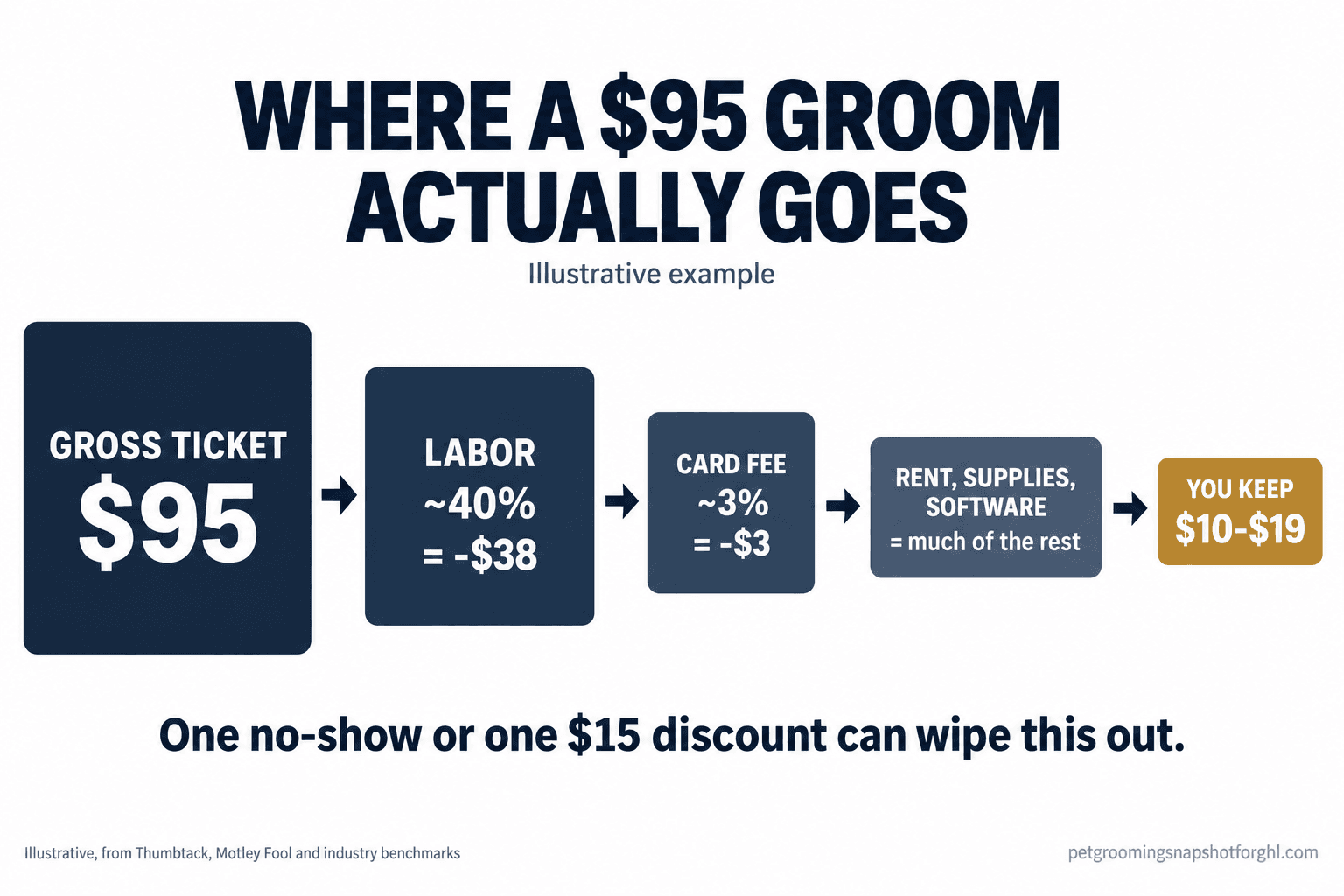
The lesson is not “grooming is a bad business.” It is that the margin is thin enough that small leaks decide whether you take home real money or just cover costs. When the net on each groom is a handful of dollars, a 20% no-show rate does not trim your profit, it can erase it. That is why a full week can feel like running to stand still. The money is escaping through cracks you cannot see while you are up to your elbows in a golden retriever.
The seven profit leaks
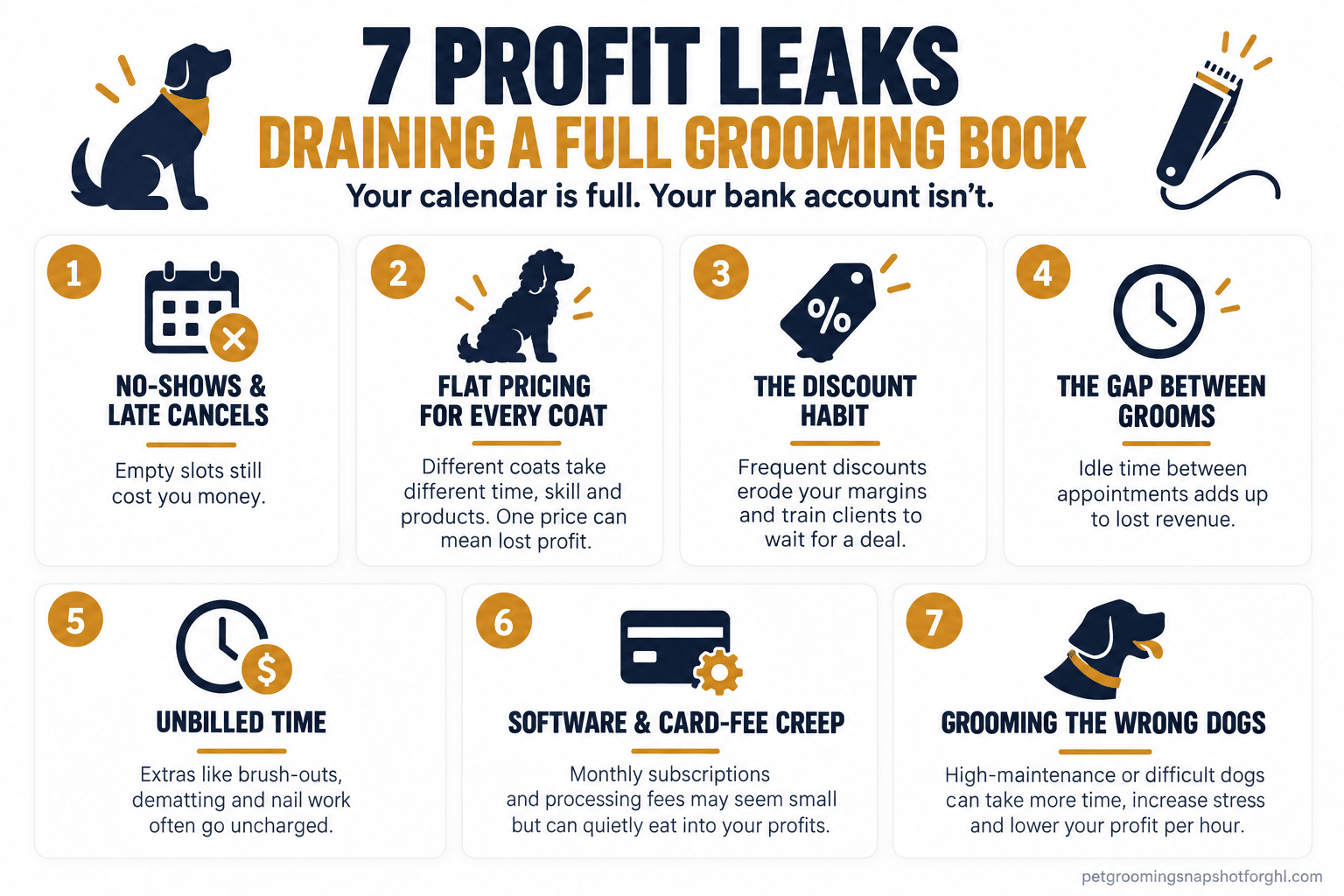
Here are the seven places the money goes: no-shows and last-minute cancels, flat pricing for every coat, the discount habit, the gap between grooms, unbilled time, software and card-fee creep, and grooming the wrong dogs. Most shops have three or four running at once. Be honest about which apply to you.
Leak 1: No-shows and last-minute cancels
This leak hurts most because the loss is total. A no-show costs you the groom price, a slot you cannot resell on short notice, and for a mobile groomer the fuel and time already spent driving to the stop. There is no cost of goods to subtract. It is pure margin, gone.
How it breaks. You rely on memory or one reminder that lands days early and gets forgotten. You have no deposit, so a cancel costs the client nothing. “Flexible” hours train people to treat your time as free.
The fix. Two things that work together. A reminder sequence timed to stick: confirmation at booking, a reminder the day before, and a nudge the morning of. And a small deposit that comes off the groom total, with a clear 24-hour reschedule window. The deposit is not about the money, it is about making the appointment feel real. For the full flow, see our guide on cutting grooming no-shows without nagging, and the deposit language is in the steal-this section below.
Leak 2: Flat pricing for every coat
Charging the same price for a smooth-coat beagle and a matted doodle is the most common way skilled groomers underpay themselves. The doodle takes twice the time, product, and physical toll, but the ticket is identical. You are subsidizing your hardest work with your easiest.
How it breaks. You quote by breed alone, or worse, one “full groom” price for everything. You have no matting or de-shed add-on, so severe condition eats your schedule for free. You have not raised prices in years while rent and supplies climbed.
The fix. Price on the three things that actually drive your time: size, coat type, and condition. Add a clear matting fee you quote before you start, never as a surprise at pickup. And raise your base price on a schedule, not when you finally snap. Increases land fine when you give notice and frame them around standing clients keeping their slots. The spread below shows how much room shops leave on the table by flattening everything to one number.
Typical average full-groom price by dog size, in US dollars. Source: HomeGuide dog grooming prices, 2026; national averages via Thumbtack.
Leak 3: The discount habit
Discounts feel generous and read as growth, but each one comes off the thinnest part of your margin. A $15 “just for you” on a groom that nets $15 means you did that dog for free. Do it a few times a week and you have worked a full day for nothing.
How it breaks. You discount to fill a slow slot instead of fixing why it is empty. You have a “cash friend” rate that quietly became half your book. You run promos that pull in bargain hunters who never rebook.
The fix. Stop using price to solve a booking problem. An empty Tuesday is a rebooking and reminder problem, not a coupon problem. If you must run an offer, tie it to behavior that pays you back: a credit for booking the next appointment at pickup, or a referral reward, so the discount buys retention. And retire the standing friend rate: grandfather the people who truly matter and move everyone else to real pricing with notice.
Leak 4: The gap between grooms
Every dog that leaves without the next appointment booked is a client you now have to win back from scratch. That gap is where clients drift to the cheaper shop, forget you, or stretch a 6-week dog to 12 weeks. You feel it as a book that looks full this week and thin in two months, so you scramble to refill it, often with a discount, which loops back to Leak 3.
How it breaks. You wait for clients to come back on their own. You have no idea which dogs are overdue. Rebooking depends on you remembering to ask while cleaning clippers and greeting the next pickup.
The fix. Book the next groom before the dog leaves, and back it with an automated reminder tied to each dog’s cycle. Most coats want attention every 6 to 8 weeks, so a client who leaves with a date on the calendar does not drift. A proper rebooking system that keeps chairs full turns existing clients into a predictable base, worth far more than chasing new ones. Filling from your own book costs nothing. Filling from ads costs money you do not have to spend.
Leak 5: Unbilled time
Every minute on the phone, texting back and forth to schedule, chasing a deposit, or driving an inefficient route is time you cannot bill. For a solo operator this is brutal, because your calendar’s true capacity is grooming hours, and admin steals them one text at a time.
How it breaks. Booking happens by phone tag, so one appointment takes four messages and two callbacks. You drive across town and back instead of clustering stops. You do intake paperwork by hand at the start of every groom.
The fix. Move booking onto a link that shows real openings, so a client self-schedules in one step. Capture intake and consent once, digitally, before the dog arrives. And for mobile work, book by area and day so you stop crisscrossing town, which is what route-smart booking for mobile groomers is built to do. Every admin hour you automate is an hour you can bill or actually rest.
Leak 6: Software and card-fee creep
The tools meant to help you can become a leak of their own, especially when they charge per van or per staff member. A fleet paying per-van seats can spend more on software every month than a single owned system costs, and card processing skims a little off every ticket on top.
How it breaks. You pay per-van or per-staff seats that scale with your team instead of a flat cost. You are on a mid-tier plan for features you never use. Your processor’s rate crept up and you never renegotiated.
The fix. Know your monthly software number and what it is per groom. Per-seat pricing punishes exactly the growth you are working for. As the chart shows, popular grooming platforms bill by tier and by van or location, so a growing shop’s bill climbs with it. Compare that against a system you buy once and own: we break down the numbers in the MoeGo vs Gingr vs PetExec pricing teardown, and our own one-time pricing for contrast. And ask your processor for a card-fee rate review once a year.
Advertised monthly grooming software cost, US dollars per location, salon tiers. Gingr also adds roughly $10 to $30 per staff member per month. Source: MoeGo pricing via G2; Gingr base per review aggregators. Prices change, so confirm current rates.
Leak 7: Grooming the wrong dogs
Not every appointment is worth the same money, and some cost more than they pay: the senior dog that needs three hours of careful, stop-start work at your standard rate, the aggressive dog that needs two people, the one-time bargain-chaser who books the cheapest service and never returns. When your calendar fills with low-margin, high-effort dogs, you are busier than ever and poorer for it.
How it breaks. You accept every booking at a flat rate regardless of effort or risk. You do not track which clients rebook and refer versus which ones cost you time and vanish. You let deal-seekers set the tone of your book.
The fix. You do not have to turn dogs away, you have to price them correctly and know your numbers. Charge for the extra time and handling that difficult grooms genuinely need, and track which clients come back so you can protect your profitable regulars’ slots. Aim for a book weighted toward clients who value the work, pay a fair price, and return on a cycle, not one stuffed with discounts and unpaid difficulty.
Steal this: the copy that plugs the leaks
Here is the language to lift straight into your booking page, reminders, and pickup routine. Adjust the bracketed parts and the dollar figures to your shop.
Deposit and cancellation policy (booking page and first confirmation):
To hold your spot we take a $[25] deposit that comes straight off your groom total. Life happens, so you can reschedule free with 24 hours’ notice. Cancel or no-show inside 24 hours and the deposit covers the chair we held for you.
Price-increase notice (text or email, 2 to 3 weeks ahead):
Hi [Name], quick heads up: starting [date] our full-groom price for [Pet] moves to $[X]. Your standing [day/time] slot stays exactly the same, and anything booked before [date] is at the old rate. Thanks for trusting us with [Pet]. Reply here any time to lock in your next few visits.
Rebooking text (at pickup):
[Pet] looks amazing! Most [coat type] dogs are due again in [6 to 8] weeks. Want me to pencil in [specific date and time] now so you keep your favorite slot? Reply YES and it’s booked.
Breed and coat pricing script (front desk or booking form):
Grooming price depends on size, coat type, and condition, not just breed. A matted double coat takes real extra time, so severe matting is a $[X] add-on. We’ll always tell you the exact price before we start, never a surprise at pickup.
No-show follow-up (day of, warm not scolding):
Hi [Name], we missed you and [Pet] today. No worries, want to grab the next open slot? Here’s the link: [link]. (Heads up, the deposit from today covers the chair we held.)
None of these are clever, and clever is not the point. Clear, calm, and consistent protects your margin. Pair them with a full library of grooming SMS templates you can steal so every touchpoint sounds like you and lands on time.
Solo van, salon, and multi-van fleet
The seven leaks are the same at every size. Which ones hurt most changes with your setup.
The solo mobile groomer, one van. Your scarcest resource is your own hours, so Leaks 1, 4, and 5 hit hardest. A single no-show or a cross-town drive is a huge share of your day. Prioritize the deposit gate, self-scheduling by area, and booking the next groom at pickup. Watch Leak 6 too: pay for what one van uses, not a plan built for a fleet. Your overhead is low, so protect the margin by pricing difficult dogs correctly and never discounting to fill a slow day you could refill with a reminder.
The 1-to-3 chair salon, 2 to 4 staff. Now labor is your biggest line, so Leaks 2 and 3 decide your profit, and flat pricing or a discount culture across several groomers multiplies fast. Standardize your price-by-condition rules, kill freelance “friend rates,” and put rebooking on autopilot so nobody relies on memory. Centralize your numbers, because at this size the leaks hide in the gap between what each groomer does and what the front desk tracks.
The multi-van fleet, 2 to 6 vans. Leak 6 becomes a monthly decision worth real money: per-van seats scale your bill the wrong way, so compare renting many seats against owning one system. Route efficiency across several vans is now a fuel-and-hours question with a fleet-sized answer. Standardize pricing, deposits, and rebooking across every van, and centralize the data so you can see which vans, services, and clients are profitable. At this scale, one owned system usually beats a stack of per-seat subscriptions, a tradeoff worth reading in the pricing teardown.
Objections
“I’m fully booked, so my pricing is fine.” A full book at a low price just means you found the level where cheap sells out. It tells you nothing about profit. The real test is what you take home per groom after labor, fees, and overhead. If that is thin, raising your price costs you a few price-shoppers and keeps the clients who value the work, so your take-home goes up even with a slightly emptier calendar.
“Won’t a deposit and a price rise scare clients away?” A few, mostly the ones who were never going to be loyal or profitable. Clients who value their dog and their time do not blink at a small deposit or a fair, well-communicated increase. What loses good clients is unreliable reminders, surprise pickup charges, and a shop that feels chaotic. Plugging the leaks makes you look more professional, not less.
“I don’t have time to set this up, I’m grooming all day.” That is the point. The leaks that steal your money are the same ones that steal your time: phone tag, chasing rebookings, manual reminders. You do not add these systems by working more hours, you install them once so they run while you groom. A pre-built setup does the heavy lifting so you are not building automations between dogs.
“I already pay for grooming software. Isn’t this handled?” Your booking software sends texts and takes payments. It does not set your pricing rules, protect your rebooking cycle, or stop you discounting out of habit. Those leaks live in how you run the shop, not in the tool. The right system enforces the policies. You still have to set them.
FAQ
Why is my grooming business busy but not profitable?
Being fully booked proves demand, not profit. Most busy grooming shops lose money to no-shows, flat pricing that ignores coat and condition, habitual discounts, weak rebooking, unbilled admin time, per-seat software costs, and low-margin dogs. Fixing those raises take-home without adding hours.
How much does a no-show actually cost a groomer?
More than the groom price. A no-show is a slot you usually cannot resell on short notice, plus wasted fuel and drive time for mobile groomers, with no cost of goods to offset it. Because grooming margins are thin, a 20% no-show rate can erase most of a shop's profit.
Should I raise my grooming prices if I'm already fully booked?
Usually yes. A full calendar at a low price means you sold out at that level, not that the price is right. Raising prices with notice loses a few price-shoppers and keeps the clients who value the work, so your take-home goes up even if the book is slightly less packed.
How do I price grooming fairly without losing clients?
Price on size, coat type, and condition rather than breed alone, and add a clear matting fee quoted before you start. Give 2 to 3 weeks' notice on any base increase and frame it around loyal clients keeping their slots. Done fairly, this reads as professional, not greedy.
Is grooming software worth the monthly cost?
It depends how it charges. Per-van or per-staff seats scale your bill with your growth, so a fleet can pay more each month than a one-time owned system costs. Know your software cost per groom, pay only for the tier you use, and compare renting seats against owning one system.
What's the fastest way to make my grooming shop more profitable?
Close the two easiest leaks first: add a deposit with timed reminders to kill no-shows, and book the next groom at every pickup with automated rebooking. Both protect revenue you already earned and cost almost nothing to run.