
It is 7:10am. Your first client is at 8. You turn the key and the van cranks, coughs, and goes quiet. Or the engine is fine but the generator that runs your tub, dryer, and clippers will not start, which means the van rolls but cannot groom a single dog. Either way you are standing in a driveway with six or seven appointments booked and no way to do one of them.
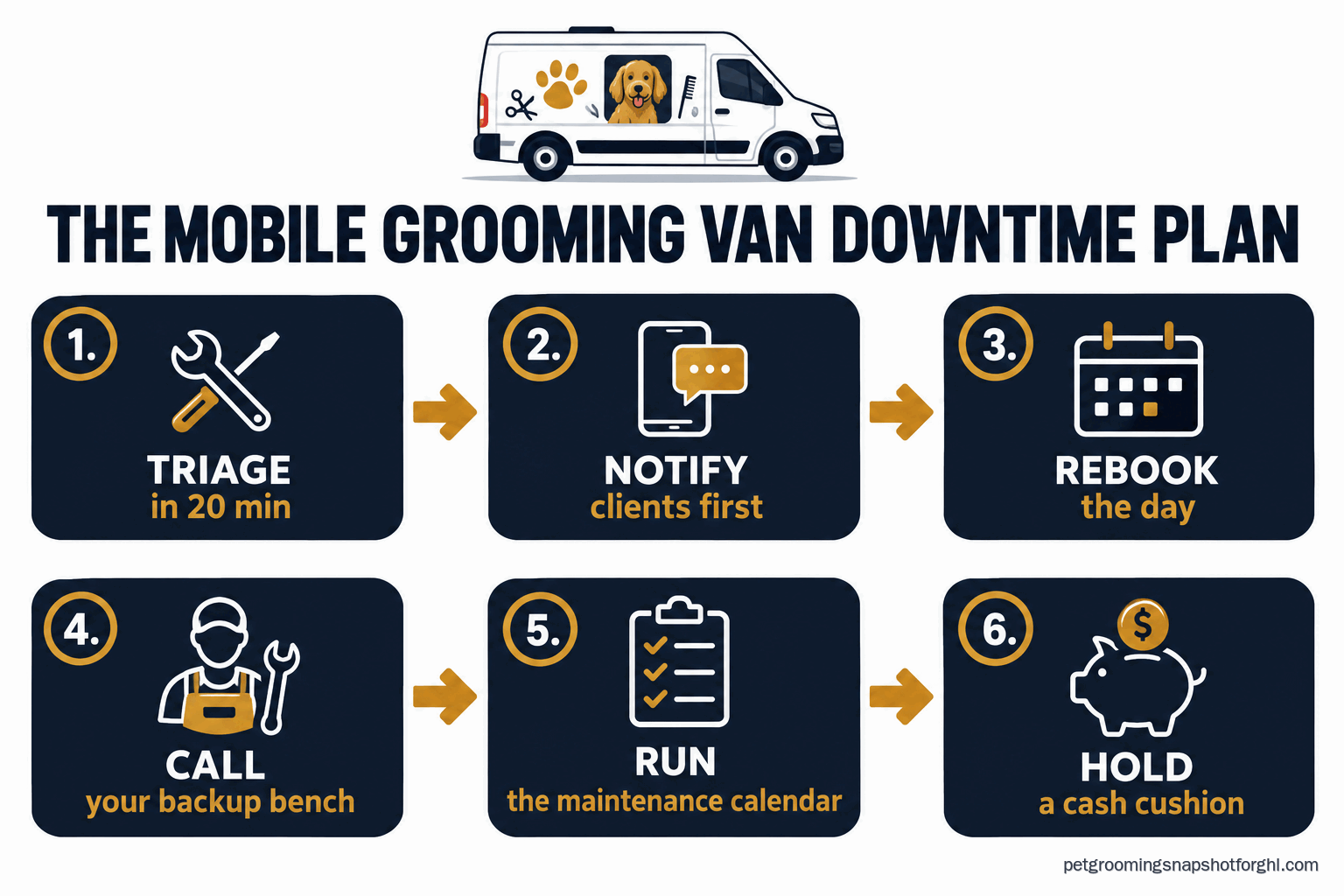
Here is the short answer, because you do not have time this morning. A breakdown is not a crisis if you have already decided what happens next. The crisis is scrambling. This guide gives you a six-stage plan: triage the problem fast, tell today’s clients before they call you, rebook the day so it becomes delayed money instead of lost money, lean on a backup bench you built in advance, run a maintenance calendar that prevents most breakdowns, and hold a cash cushion so one dead week does not end the business. Build it once and your worst morning becomes a bad afternoon.
Key Takeaways
- The scramble costs more than the breakdown. A dead van for a day is lost grooms you can mostly recover. A day of silent no-shows is clients who book elsewhere and never come back.
- Notify before they call you. A “running into a van issue, here’s your new time” text at 7:15am keeps the client. Going quiet until 8:05am loses them.
- Build the backup bench before you need it. A mobile mechanic who answers, a generator you can rent same-day, and a nearby groomer you trade with beat any tool in your van.
- Most breakdowns are skipped maintenance. Generac advises changing generator oil after the first 20 to 30 hours, then every 100 run-hours or annually. A full-week van blows past 100 hours fast.
- Cash is the real safety net. About 39% of small businesses hold under a month of operating expenses in cash, per a 2025 Bluevine survey.
What This Guide Covers
- What a dead van actually costs you
- The six-stage downtime plan
- Stage 1: Triage in 20 minutes
- Stage 2: Tell clients before they call you
- Stage 3: Rebook the day
- Stage 4: Build a backup bench
- Stage 5: Run the maintenance calendar
- Stage 6: Hold a cash cushion
- Steal this: the breakdown message pack
- Solo, two-to-three vans, and a fleet
- Objections
- FAQ
What a dead van actually costs you
A mobile groomer sells time on wheels. You cannot stockpile grooms or pull a spare chair from the back, so if the van cannot run, the day is gone. That part owners feel. The part they underprice is the second cost: the clients who go elsewhere while you are dark.
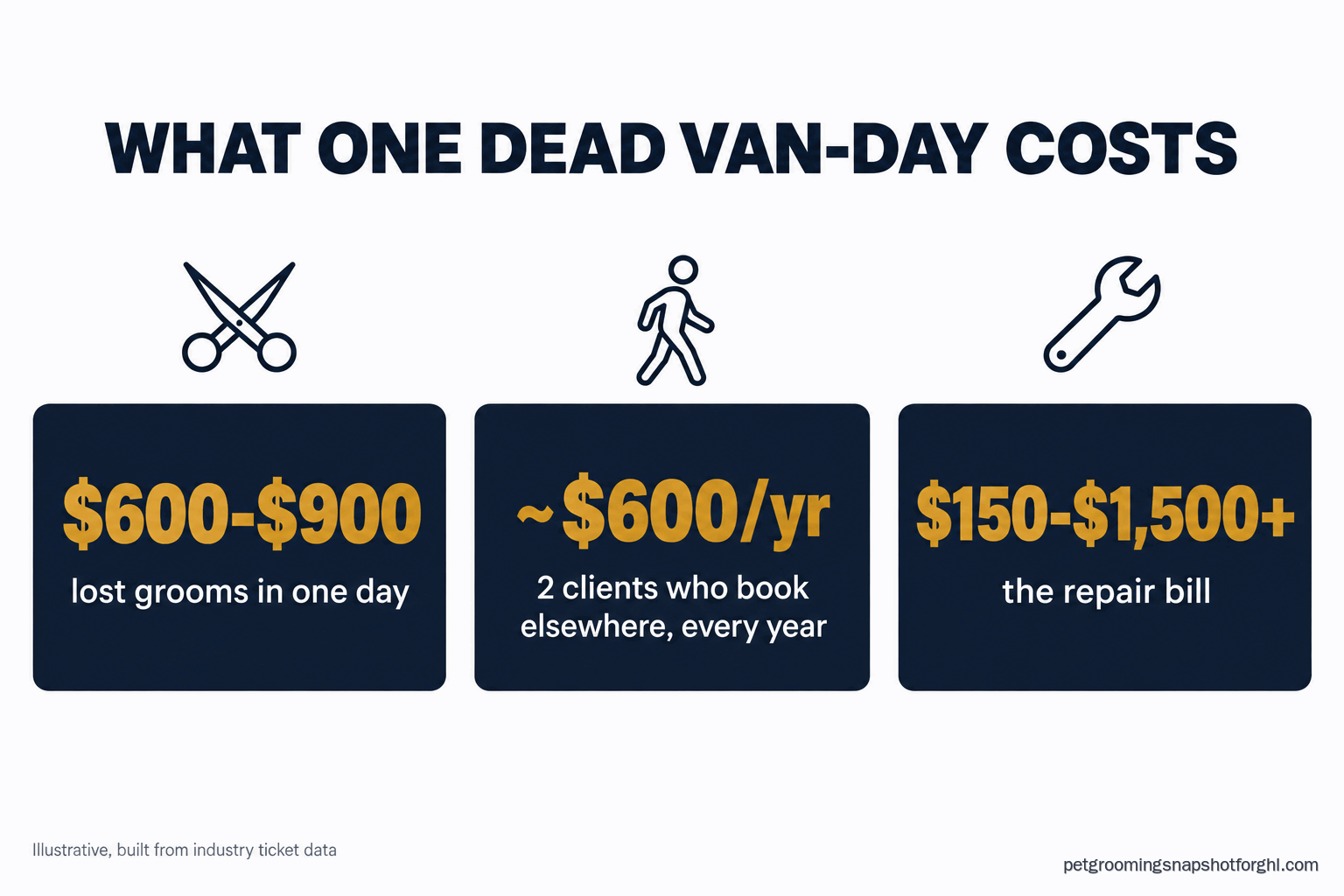
Start with the grooms. A solo van doing six to eight dogs a day at a $90 to $120 ticket is looking at roughly $600 to $900 in grooms that do not happen on a dead day. Miss two days waiting on a part and you are out well over a thousand dollars in a business that already runs thin. And your clients have options. Pet owners keep spending, with the US pet industry reaching $158 billion in 2025 and projected near $165 billion in 2026 per the American Pet Products Association, while IBISWorld counts US pet grooming and boarding at about $11.3 billion in 2026 across nearly 198,600 businesses. It is a crowded, growing field, with the BLS projecting animal care and service work to grow 11% from 2025 to 2035. A quiet morning from you is an easy excuse to try the van down the road.
The second cost compounds. A client whose dog is matting and gets silence at 8am does not wait. They call the next van, and if that groomer does a nice job, your spot is gone. You did not lose one groom. You lost a client worth a few hundred dollars a year, plus their referrals.
The six-stage downtime plan
Downtime is not bad luck you absorb. It is an event you rehearse. The stages that save you are the boring ones you set up before anything breaks. Most groomers run only stage one and stage three on the fly, which is why a breakdown feels like a disaster every time.
Stage 1: Triage in 20 minutes
Before you panic-text anyone, spend 20 minutes finding out what you are dealing with. The whole plan branches on one question: is this a “fixed by lunch” problem or a “down for days” problem?
Run a fast checklist. Does the van start and drive, or is it the engine? If it drives but cannot groom, it is almost always power or water: generator won’t start, inverter tripped, water pump dead, tank empty or frozen. Check the obvious killers first: fuel in the generator, oil level (low-oil auto-shutdown is the most common no-start), a tripped breaker, a loose battery terminal, a frozen line in winter. Keep a one-page triage card taped inside the door so you are not diagnosing from memory at 7am.
How it breaks. You assume the worst, cancel the whole day, then find out at noon it was a tripped breaker you could have reset in two minutes. Now you have eaten a day for nothing and spooked seven clients.
The fix. Triage first, decide second. A quick fix might only push the morning back an hour. A tow or a part on order means you treat the day as lost, not maybe-lost. The worst move is the middle: telling clients “give me a bit” five times while you guess.
Stage 2: Tell clients before they call you
This stage decides whether you keep the client, and it is the one groomers get most wrong. The instinct is to go quiet and fix the van first. Do the opposite. The moment triage says the day is affected, your clients hear from you, in order of appointment time, before a single one calls.
A proactive “running into a van problem, here is your new time” reads as a pro who has their act together. Silence until the client is on the porch reads as someone who forgot them. Same breakdown, opposite outcome. People forgive the problem. They do not forgive being left hanging.
Send one clear text per client: the real reason in a line, a specific new option, a one-tap way to confirm. If you already run reminders through an automated system, this is where it earns its keep: one broadcast to today’s affected clients instead of thumb-typing seven texts. The SMS templates every grooming salon should keep on hand are worth adapting into a breakdown set now, while it is calm.
How it breaks. You text three clients, get pulled into the repair, and forget the last four. Two show up to an empty curb. That is the group that leaves.
The fix. Work the list top to bottom and do not touch the van until every client on today’s book has a message and a new time. The repair can wait 15 minutes. The relationship cannot.
Stage 3: Rebook the day
A canceled groom is lost money. A rebooked groom is delayed money. The goal of a breakdown day is to turn as many of the first into the second as you can, before the client’s problem gets solved by someone else.
Offer the soonest real slot, not a vague “I’ll call you.” If the week is already full, overflow slots and a short waitlist save you: open an hour earlier for three days, add a Saturday morning, batch displaced clients into the gaps. For any dog that genuinely cannot wait, this is where your backup bench matters. You would rather hand a client to a trusted groomer for one visit than lose them to a random one forever. Sweeten it just enough to hold them: a few dollars off or a free nail trim costs far less than winning a new client to replace one who drifted.
How it breaks. You tell everyone “I’ll get back to you once the van’s sorted,” then spend three days on the repair. By the time you resurface, half the book has gone elsewhere and the matted dogs got shaved down by a competitor.
The fix. Rebook in the same message that delivers the bad news. Never separate “here’s the problem” from “here’s your new time.” The gap between them is where clients leak out. If leakage is a theme even on normal weeks, your no-show and reminder system needs tightening regardless of the van.
Stage 4: Build a backup bench
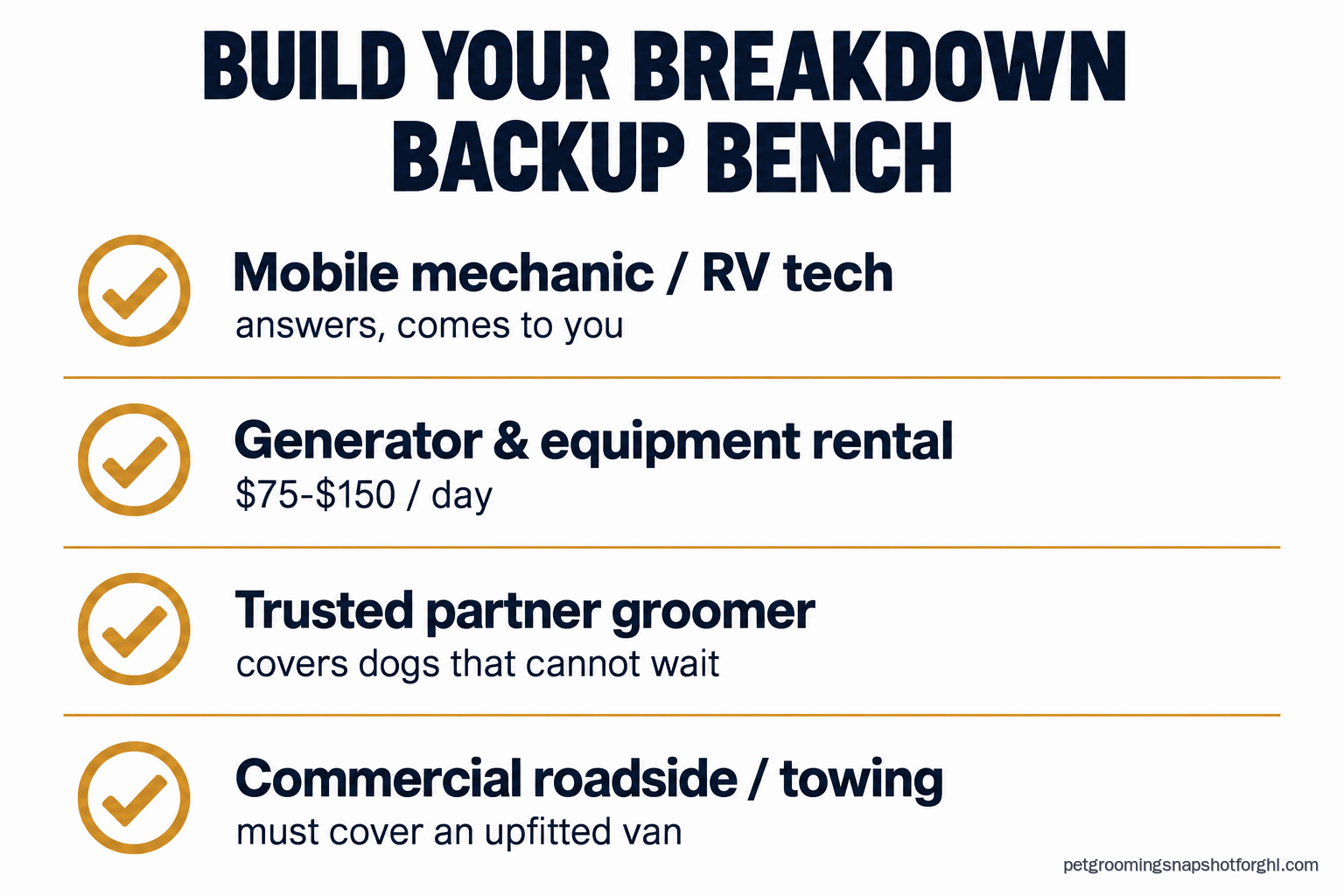
The difference between a groomer who shrugs off a breakdown and one who melts down is rarely the problem. It is whether they already have numbers to call. Build this bench on a calm Tuesday and tape it next to the triage card. You want four things lined up: a mobile mechanic who answers and will come to you; a same-day generator and equipment rental source; one or two trusted local groomers you have a standing “cover each other’s emergencies” deal with; and a roadside or towing plan that covers a commercial build-out van (many consumer plans will not touch a heavy upfitted vehicle, so check before you need it).
| Backup | What it solves | Set up in advance | Cost when used |
|---|---|---|---|
| Mobile mechanic / RV tech | Engine, electrical, no-start | Save 2 numbers, ask about same-day | $100-$250 call-out |
| Generator / equipment rental | Dead power unit, blown inverter | Find local rental, confirm same-day | $75-$150 / day |
| Trusted partner groomer | Dogs that truly cannot wait | Standing trade deal, agreed handoff | A one-time split or favor |
| Commercial roadside / towing | Van will not drive | Confirm it covers an upfitted van | Plan fee + mileage |
How it breaks. The generator dies and you spend the morning Googling “generator rental near me,” calling places that are closed or empty. By afternoon you have found one, but the day is gone.
The fix. Pre-qualify the bench. One real conversation with each, now, so that on the bad morning you are calling someone who expects it. Keep the spares that fail most (generator oil, a spare battery, fuses, a water-line fitting) in the van so fast fixes stay fast.
Stage 5: Run the maintenance calendar
Here is the uncomfortable truth: most “breakdowns” are maintenance you kept meaning to do. A grooming van has two engines that matter, the one that drives it and the generator that powers it, plus a water system that freezes, clogs, and runs dry. All three fail in predictable ways on predictable timelines.
The generator is the one groomers neglect most, because it looks fine until the morning it won’t start. Generac advises changing the oil after the first 20 to 30 hours of run time, then every 100 hours or annually, whichever comes first, and more often in hot or dusty conditions. Honda’s portable schedule is similar: first change around 20 hours, then roughly every 100 hours or six months. Groom five or six days a week and you hit 100 run-hours in weeks, not a year. A cheap hour meter turns “I think it’s due” into a number.
Build a simple calendar and treat it like an appointment you cannot cancel:
- Weekly: check generator oil, inspect water lines and the pump, top off and clean tanks, eyeball belts and fluids.
- Monthly / by run-hours: change generator oil on schedule, test the inverter and battery, check tires, clean filters.
- Seasonal: winterize the water system before the first freeze (a split line is a classic winter dead-van), service the van engine, deep-clean the power system. The season-by-season grooming checklist folds this into your year.
How it breaks. You run the generator until it dies because nothing told you it was overdue. Low oil triggers the auto-shutdown, you keep cranking a dry engine, and a $30 oil change becomes a $1,200 rebuild.
The fix. Put maintenance on the same calendar as your grooms, with reminders. The 20 minutes a week is the cheapest insurance in the business, and the biggest lever on how often stages one through four ever get used.
Stage 6: Hold a cash cushion
Every stage above buys time and keeps clients. This one keeps the lights on. A breakdown is a revenue gap and a surprise bill in the same week, and mobile operators are especially exposed because the asset that breaks is also the asset that earns.
In a 2025 Bluevine survey of US small business owners, about 39% held less than a month of operating expenses in cash, and over half said they would tap emergency funds within 48 hours to make payroll. Younger firms were thinnest: only about one in five businesses five years or younger carried three to twelve months of cash, versus roughly two in five of older firms. (It is a vendor survey of self-selected owners, so read it as directional.) The pattern is long-standing: a JPMorgan Chase Institute study found the median small business holds just 27 days of cash buffer, the number of days it could cover outflows with no money coming in.
Share of US small businesses carrying three to twelve months of operating cash, by business age. Source: Bluevine Small Business Cash Flow Survey, 2025.
You do not need a fortune, just a named, separate account with enough for a few weeks of fixed costs plus one big repair. A realistic solo-van target is one month of fixed costs plus $1,500 to $2,000 for a worst case. Fund it the boring way: a small automatic transfer every time a groom gets paid. When the generator dies you pull from the repair fund and keep grooming, instead of putting the fix on a 24% card and starting a slow bleed. If the business is busy but the account never grows, the problem is usually pricing or no-shows, a full-book-but-broke problem worth fixing on its own.
Steal this: the breakdown message pack
Write these once, save them where you can fire them fast, and you will never again compose a panicked text with a mechanic talking in your ear. Keep names and times as merge fields so a broadcast fills them in. This is copy to adapt, not legal language.
That last one matters more than it looks. The clients you bumped are the most likely to drift, so a warm, specific “you’re back on the schedule” closes the loop instead of leaving a gap a competitor fills. It is the same muscle behind your rebooking system that keeps chairs full on a normal week.
Solo, two-to-three vans, and a fleet
The plan is the same shape at every size, but each stage changes with scale.
Solo operator, one van. You are the whole bench, so your single point of failure is total: van down, business down. Your edge is speed and relationships. Keep the triage card and message pack ready, pre-qualify one mechanic and one partner groomer, and over-fund the cash cushion because there is no second van to carry you. Plan around surviving two or three dead days, and let a done-for-you mobile grooming system run the reminders and rebooking broadcasts so the one van you have loses as few clients as possible.
Two to three vans. Now you have internal backup, your biggest advantage, but only if the schedule is flexible enough to use it. When one van dies, the others absorb the highest-priority dogs and the most at-risk clients. That takes a booking system that sees the whole operation and can reshuffle it, not three separate calendars in three heads. Route-smart booking for mobile vans is what makes a one-van failure a reshuffle instead of a lost day.
A fleet of four to six vans. Here a breakdown is routine, so it has to be systematized, not improvised. Track preventive maintenance per van with run-hours logged, set a dispatch rule for which van covers which gap, and ideally keep one spare or loaner build so a down van does not mean a down route. At this size the money is made or lost on whether stage five runs like clockwork across every vehicle.
Objections
“I’m too busy grooming to think about this.” That is the trap. The plan exists so you spend 20 minutes on a calm day instead of a frantic, revenue-losing morning later. The busiest groomers most need the breakdown to be a quick broadcast and a few calls, not an improvised crisis that eats the week.
“Breakdowns are rare, this is overkill.” Rare per van per year, catastrophic to a one-van business when they happen. You insure the van against a crash you hope never comes. Same logic for the far more likely event: a generator or pump that quits.
“Won’t clients be annoyed by a last-minute change?” Clients are annoyed by being ignored, not by being told. A specific, early, this-is-your-new-time message reads as competence. The groomers who lose clients over a breakdown are the ones who went silent.
“I already pay for grooming software, doesn’t it handle this?” Most apps handle normal booking and reminders fine. Few give you a one-tap “message everyone affected today and offer a new time” broadcast, which is the stage that saves clients. If yours does, build your breakdown texts in today. If not, that gap is worth closing before you need it.
FAQ
What's the first thing to do when my grooming van breaks down?
Spend about 20 minutes on triage before you tell anyone. Find out whether it's a fast fix (a tripped breaker, low generator oil, a dead battery terminal) or a down-for-days problem (a tow or a part on order). Everything else branches on that answer.
Should I tell clients right away or wait until I know more?
Reach out the moment triage confirms the day is affected, before they call you. One clear text per client, in appointment order, with the reason in a line and a specific new time to confirm. Silence until the client is on the porch is what loses them.
How do I rebook a full day when my book is already packed?
Turn lost grooms into delayed grooms. Open an hour earlier for a few days, add a weekend morning, and batch bumped clients into the gaps. Offer the soonest real slot in the same message that delivers the bad news, and hand any dog that truly can't wait to a trusted partner groomer.
How often should I service my grooming van's generator?
Generac recommends changing the oil after the first 20 to 30 hours of run time, then every 100 hours or annually, whichever comes first, and more often in hot or dusty conditions. A full-week van hits 100 run-hours in weeks, so log hours and service on schedule.
How much cash should a mobile groomer keep for emergencies?
A realistic solo-van target is about one month of fixed costs plus $1,500 to $2,000 for a worst-case repair, in a separate account funded by a small automatic transfer from every paid groom. A 2025 Bluevine survey found about 39% of small businesses hold less than a month of cash.
Does regular maintenance really prevent most breakdowns?
Most dead-van mornings trace to skipped upkeep: an overdue oil change, a frozen line, an untested battery. A weekly 20-minute check plus on-schedule oil changes and seasonal winterizing remove most surprise failures.
It is 7:12am. The generator will not start. But this time you are not panicking. You check the oil, see it is low from a change you let slide, and know in two minutes this is a loaner-generator day, not a lost week. You fire one broadcast to today’s seven clients with a new time each, reply YES rolls in, you call the rental place that is expecting you, and you are grooming your first dog by 9:30 in a borrowed unit. The van gets its oil change that night. Nobody canceled. The breakdown cost two hours and a rental fee instead of a thousand dollars and two clients. The problem did not change, your plan did.