
It is the second week of January. Your December was a blur, you turned people away for three straight weeks, and now the phone has gone quiet. You are standing in a clean, empty salon at 10am wondering if you imagined last month. By March the shed is on and you are back to turning people away. This is not a broken business. This is the grooming year, and most owners ride it blind, feast to famine.
Here is the answer up front. Grooming demand is seasonal and predictable, so plan for the whole year instead of reacting to this week. There is one move per season: fill winter’s slow weeks with maintenance baths and a win-back, cash in on the spring and fall shed with deshedding packages and a rebooking blast, protect pets and your van through summer heat, and open December booking early so the rush fills on your terms. Build the calendar once, automate the four pushes, and the famine months stop scaring you. This checklist walks all four seasons, the copy for each, how each breaks, and how it changes for a solo van, a salon, and a fleet.
Key Takeaways
- The year has a shape, so stop being surprised by it. January and February are slow, spring and fall bring the coat blow, summer is heat and travel, and mid-November through December is a flat-out rush. Plan each one before it lands.
- The slow season is a cash-flow problem, not a demand problem. Dogs still grow coat in January. Fill the weeks with maintenance baths, a deposit-backed win-back, and gift-card revenue banked in December.
- Shedding is your busiest, most profitable window. Dogs blow their coat twice a year, in spring and fall, per the AKC, driven by daylight, not weather. Package the deshed and raise the ticket.
- Summer is a safety season. A vehicle can hit 110 degrees inside on a 70-degree day, per the AVMA, so mobile vans live and die on cooling and water.
- December is won in October. Most salons are booked out for December by Thanksgiving, so open holiday booking early and take deposits.
What This Checklist Covers
- What the seasonal swing actually costs you
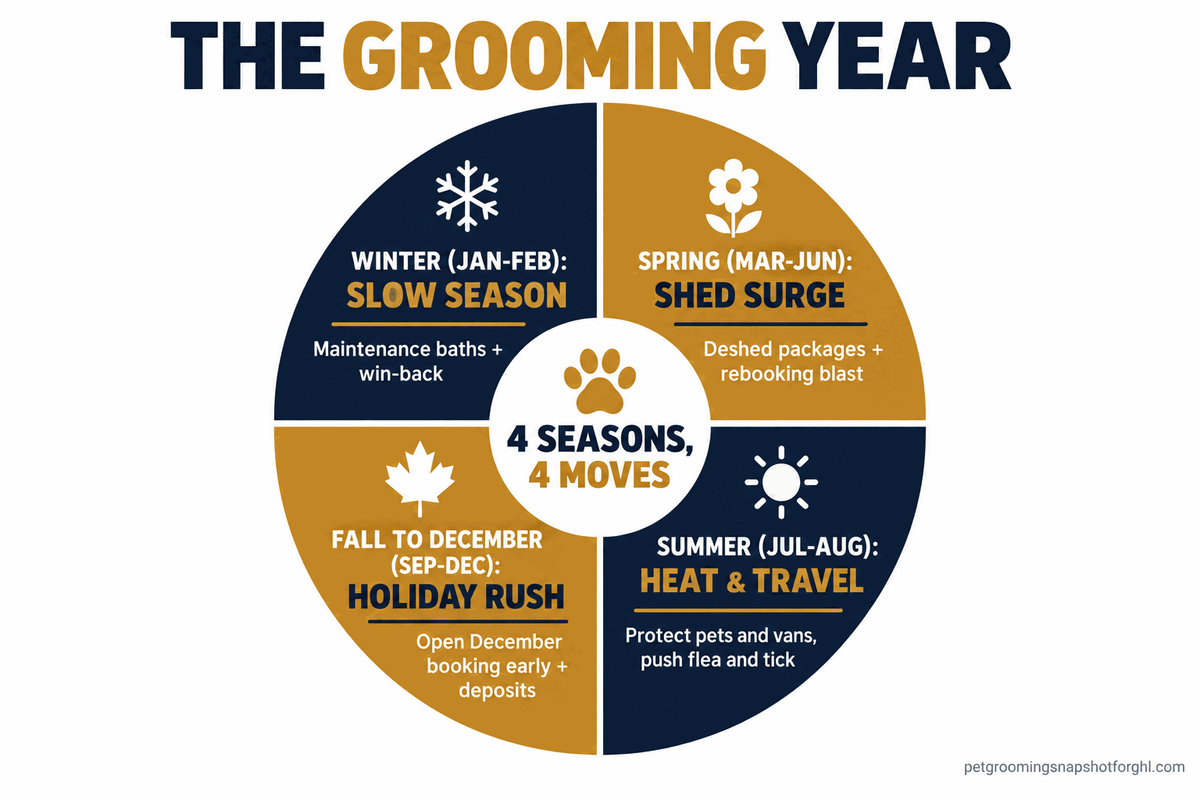
- The grooming year at a glance
- Winter: the slow-season checklist
- Spring: the shed-surge checklist
- Summer: the heat-and-travel checklist
- Fall and December: the holiday-rush checklist
- Steal this: the four seasonal messages
- Solo van, salon, and multi-van fleet
- Seasonal marketing and the A2P 10DLC catch
- Objections
- FAQ
What the seasonal swing actually costs you
The demand is there all year. Americans spent $158 billion on their pets in 2025, with spending projected to reach $165 billion in 2026, per the APPA, and grooming, boarding and training services made up about $14.3 billion of that. In a $15.4 billion grooming and boarding market of roughly 193,000 US businesses, per IBISWorld’s 2026 data, the money does not disappear in January. It just moves around the calendar.
The cost of ignoring the pattern is empty weeks you never get back. The numbers below are illustrative and yours will differ, but they show why a quiet stretch stings.
Illustrative gross revenue removed by one idle week, at mid-range full-groom prices (solo van 6 grooms/day, salon and fleet 24/day, 5 days). Price inputs from HomeGuide’s 2026 dog grooming prices, a marketplace estimate. Your numbers will differ.
The grooming year at a glance
Demand is driven by biology and the calendar, not luck. Dogs shed heaviest in spring and fall as daylight changes, and pet parents book around their own lives: slow after the holidays, busy before them.
- ❄Jan to Feb
The slow season
Post-holiday quiet. Fill weeks with maintenance baths, a win-back push, and gift-card cash banked in December.
- 🌸Mar to Jun
The spring shed surge
Coats blow hard. Sell deshedding packages, add slot time, and blast a rebooking to every double-coated dog.
- ☀Jul to Aug
Heat and travel
Protect pets and vans from heat, push flea-and-tick and sanitary trims, take travel bookings early.
- 🎄Sep to Dec
Fall shed into the holiday rush
Second coat blow, then the year's busiest stretch. Open December booking in October and take deposits.
Four seasons, four moves. Here is the checklist for each.
Winter: the slow-season checklist
January and February are the quiet months. Appointment books go light after the holidays because owners feel a dog does not need grooming when it is cold out. That instinct is wrong, and your winter job is to correct it kindly and plan around it.
The checklist:
- Sell the winter bath-and-brush as a maintenance service between full grooms, so coats stay mat-free under sweaters.
- Run a dated win-back to every client who missed their holiday groom or has not booked since fall.
- Bank cash in December: sell gift cards and prepaid packages that get redeemed in the quiet weeks.
- Use the downtime to deep-clean, service the van and dryers, and fix your pricing and booking forms for the year.
How it breaks, and the fix. The classic mistake is slashing prices in a panic, training your best clients to wait for a sale and gutting your margin in your most expensive months. Instead, sell a low-labor service (the maintenance bath) at a fair price and push rebooking, not discounts. Winter is also when a weak cash position becomes a crisis, the real story behind a full schedule that still leaves you broke. Stop treating December cash as spendable and treat it as the float that carries January.
Spring: the shed-surge checklist
This is the window you wait all year for. As daylight stretches out, dogs blow their winter undercoat, and double-coated breeds like huskies, shepherds and retrievers release it in clumps for two to four weeks, per the AKC. Spring is usually the heavier shed. Owners who ignored grooming all winter suddenly have fur on every surface and call in a hurry.
The checklist:
- Build and name a deshedding package: bath with a deshedding shampoo, high-velocity blow-out, and a deep undercoat brush. Price it as its own service, not a free add-on.
- Add real time to the schedule for double coats. A blowing coat is slower, so book longer slots and do not stack them back to back.
- Send a rebooking blast to every double-coated dog on file timed to the start of the shed.
- Upsell the deshed at pickup for every dog that clearly needs it, and set the next appointment before they leave.
- Watch your groomers’ bodies and wrists. This is the burnout window, so pace the heavy coats across the day.
How it breaks, and the fix. The break is underpricing the exact weeks demand peaks: you take shed-season dogs at your normal bath price in your normal slot length, blow your schedule to pieces, and make less per hour in your busiest month. Fix it with a named, properly priced package and longer slots, and let your rebooking system do the outreach so you are not texting clients one by one while elbow-deep in a golden retriever.
Summer: the heat-and-travel checklist
Summer changes the job. Grooming slows a touch in some markets after the spring rush, but two things spike: heat risk and travel. Families go away, so boarding and pre-trip grooming climb, and heat becomes a genuine safety issue for mobile operators. The heat math is worth repeating to clients: per the AVMA, a vehicle can rise almost 20 degrees in 10 minutes, and on a 70-degree day the inside can hit 110. Your van is a workplace and a waiting room, so cooling and water are not optional.
The checklist:
- Mobile vans: confirm the AC and generator are serviced, carry enough water for back-to-back jobs, and never let a dog sit in a hot vehicle. Build cooling breaks into the route.
- Push flea-and-tick baths and sanitary and paw-pad trims, which are genuine summer needs and lift the average ticket.
- Steer owners away from a full shave-down on double coats, since that coat insulates against heat and sunburn too. Offer a deshed and a tidy instead.
- Open holiday-travel boarding and grooming booking early, gated on vaccination records, and give the thickest coats and oldest dogs your earliest, coolest slots.
How it breaks, and the fix. The dangerous break is a heat incident: a dog left in a warm van, or a thick-coated senior overheated on a long route. That is a welfare failure and a liability nightmare. The fix is a hard rule that no dog waits in a non-running, non-cooled vehicle, built into how your mobile route booking spaces jobs so you are never tempted to stack dogs to save time.
Fall and December: the holiday-rush checklist
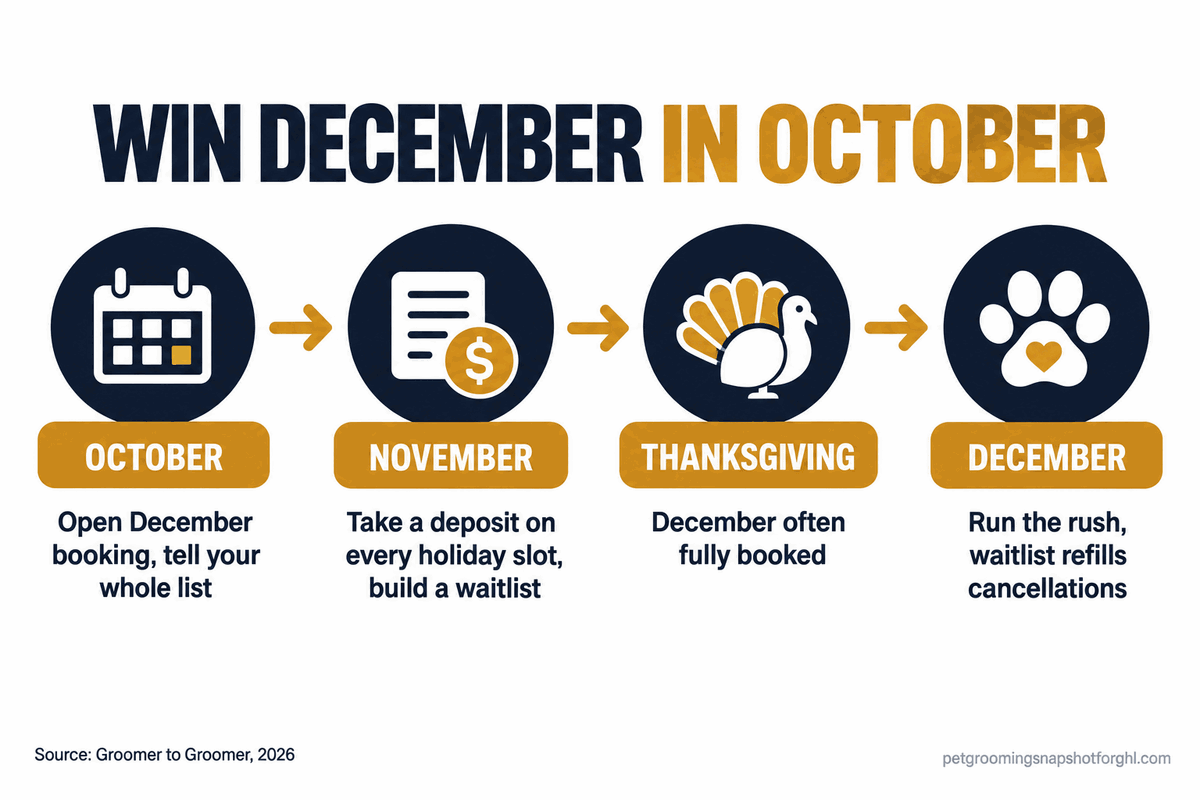
Fall brings the second coat blow, lighter than spring but real, as dogs grow in a heavier winter coat, then rolls straight into the biggest stretch of the year. The holiday rush starts a week or two before Thanksgiving, and many salons have December fully booked by the time Thanksgiving arrives. A client calling on December 5th for a pre-Christmas groom is usually too late.
The checklist:
- Open December booking in October and tell your whole list it is open. First come, first served.
- Take a deposit to hold every holiday slot, because a no-show in December is a slot you could have sold ten times.
- Build a waitlist so cancellations refill themselves instead of leaving a gap in your busiest week.
- Sell gift cards hard in November and December. This is the cash that floats you through January.
- Set staff and hours before the rush, not during it, and brief everyone on the deposit policy.
How it breaks, and the fix. The break is taking holiday bookings with no deposit and no waitlist, so a single December cancellation becomes dead chair-time in the one month you cannot afford it. Fix it by requiring a deposit on holiday slots and running a waitlist that texts the next person the moment a spot opens, paired with a firm no-show and deposit policy.
Steal this: the four seasonal messages
Lift these and change the bracketed parts. One message per season, each STOP-aware.
The January win-back (warm, specific, no desperation):
Hi [Name], we have missed [Pet]. Coats still grow in winter, and a quick bath-and-brush keeps [Pet] mat-free under that sweater. We have openings this [week], tap to book: [link]. Reply STOP to opt out.
The spring shed-season blast (to double-coated dogs):
Hi [Name], [Pet] is about to blow that winter coat. Our deshedding groom pulls the loose undercoat before it ends up all over your house. Spring slots fill fast, grab one here: [link]. Reply STOP to opt out.
The summer heat note (safety that builds trust):
Hi [Name], a summer heads-up: we never recommend a full shave on [Pet]’s coat, since it guards against heat and sunburn too. A deshed and tidy keeps [Pet] cooler. Book one before the next heat wave? [link]. Reply STOP to opt out.
The holiday booking-open text (October, urgency that is real):
Hi [Name], December books are OPEN and go fast every year. Want [Pet] sharp for the holidays? Grab a slot before they are gone, a small deposit holds your time: [link]. Reply STOP to opt out.
Pair these with a full library of SMS templates every grooming salon should steal so the rest of the client conversation runs without you typing it live.
Solo van, salon, and multi-van fleet
The four seasons are the same for everyone. What changes is where the pressure lands.
The solo mobile groomer, one van. You feel the swing hardest, with no one to absorb a slow week and no spare chair in the rush. Winter cash flow is your top risk, so bank December gift-card money and never spend it before January. In the shed surge, cap how many heavy coats you take per day, because you cannot call in help. Summer heat is a direct safety risk in your van, so route-smart booking that spaces jobs and builds in cooling breaks is how you work safely.
The 1-to-3 chair salon, 2 to 4 staff. Your game is staffing to the calendar. The shed surge and December need more hands and longer hours, January needs fewer, so plan time off and training for the slow weeks and all-hands for the peaks. Get the deposit and waitlist right once and it carries every peak. Your risk is a team burned out by December because nobody paced the fall shed.
The multi-van fleet, 2 to 6 vans. Your risk is drift. One van overbooks the shed surge while another sits half-empty, and you cannot see it until the week is gone. Lock the packages and deposit rules into one booking system so every van runs the same playbook, and review bookings by van weekly through the peaks. That visibility separates a booked-solid-but-broke operation from a profitable one.
Seasonal marketing and the A2P 10DLC catch
One compliance note that bites groomers specifically. The seasonal pushes above are marketing messages, and in the US, marketing texts are a different animal from appointment reminders under A2P 10DLC, the carrier registration system for business texting. Groomers text more than almost any small business, and a mass promotional blast to your whole list is exactly the kind of campaign carriers scrutinize.
You need prior express written consent to send marketing texts, every message needs a clear opt-out, and your promotional campaign should be registered and worded as marketing, not slipped in under your reminder traffic. This is not a reason to skip the seasonal blast, it is a reason to do it right so your messages get delivered instead of filtered. The full breakdown, including the consent language and how reminders and marketing differ, is in our guide to texting grooming clients and A2P 10DLC.
Objections
“My area does not really have seasons.” Even mild and Sun Belt markets have the two shed cycles, driven by daylight rather than temperature, plus the January slump and December rush that follow the human calendar. The shape is smaller where winters are soft, but it is still there, and in hot markets summer heat and near year-round flea-and-tick season just become a bigger slice of the year.
“I am too busy in the rush to set up the slow-season stuff.” That is the whole point. You build the four pushes as automations in the quiet weeks of January, when you actually have time, and they fire on their own all year. The alternative is writing a holiday booking blast by hand in the middle of your busiest December, which never happens.
“Won’t clients get annoyed by seasonal texts?” Not when each one is useful and easy to decline. A shed-season heads-up and a holiday booking reminder are services, not spam, as long as they are timed right, relevant to that dog, and carry a clear opt-out. Tie the message to the pet and the season and it reads as a groomer who pays attention.
“I would rather just discount when it is slow.” A discount trains your best clients to wait for the next one and shrinks your margin in your most expensive months. A maintenance service and a win-back fill the same slots at a fair price. Save discounts for a dated, limited push, not a standing crutch.
FAQ
When is the slow season for a dog grooming business?
January and February are the quietest months for most US grooming salons and mobile groomers, right after the holiday rush, because owners feel a dog does not need grooming in cold weather. Demand does not vanish, though: coats still grow, so maintenance baths, a win-back push, and gift-card revenue banked in December carry the quiet weeks.
What months are busiest for groomers?
Two windows: the spring and fall shedding seasons, when double-coated dogs blow their undercoat as daylight changes, and the holiday stretch from mid-November through December. Many salons have December fully booked by Thanksgiving, so opening holiday booking in October and taking deposits is how you fill it on your terms.
How do I keep a grooming business busy year-round?
Plan for four seasons instead of reacting weekly. Fill the January slow season with maintenance baths and a win-back, cash in on the spring and fall shed with priced deshedding packages and a rebooking blast, protect pets and your van through summer heat, and open December booking early with deposits. Automate the four pushes once so they run on the calendar.
Is it safe to shave a double-coated dog in summer?
Usually no. A double coat insulates against heat and sunburn as well as cold, so shaving it down can leave a dog more exposed, not cooler. The better summer service is a thorough deshed and tidy. We are not a veterinary provider, so defer to the owner's vet on any individual dog's health needs.
How early should I open holiday grooming bookings?
Open December booking in October and tell your whole list. The holiday rush starts a week or two before Thanksgiving, and salons routinely fill December before it arrives. Take a deposit on every holiday slot and run a waitlist so cancellations refill themselves, because a no-show in December is the most expensive gap in your year.
Related Reading
- Booked Solid but Broke: Why a Full Grooming Schedule Isn’t Making You Money
- How to Cut Grooming No-Shows (Without Nagging Pet Parents)
- The Rebooking System That Keeps Your Chairs Full
- 12 SMS Templates Every Grooming Salon Should Steal
- Texting Grooming Clients in 2026: A2P 10DLC, Consent, and Waivers