
You are looking at next week’s book and it has gaps. Not a disaster, just two or three open slots a day that used to be full. So you do what every groomer does: you think about marketing, Instagram, a Groupon, maybe boosting a post. Meanwhile, sitting in your phone and your software right now, are forty or fifty people who already loved you. They booked with you, paid you, let you handle their dog, and then quietly stopped coming. Nobody fired you. They just drifted.
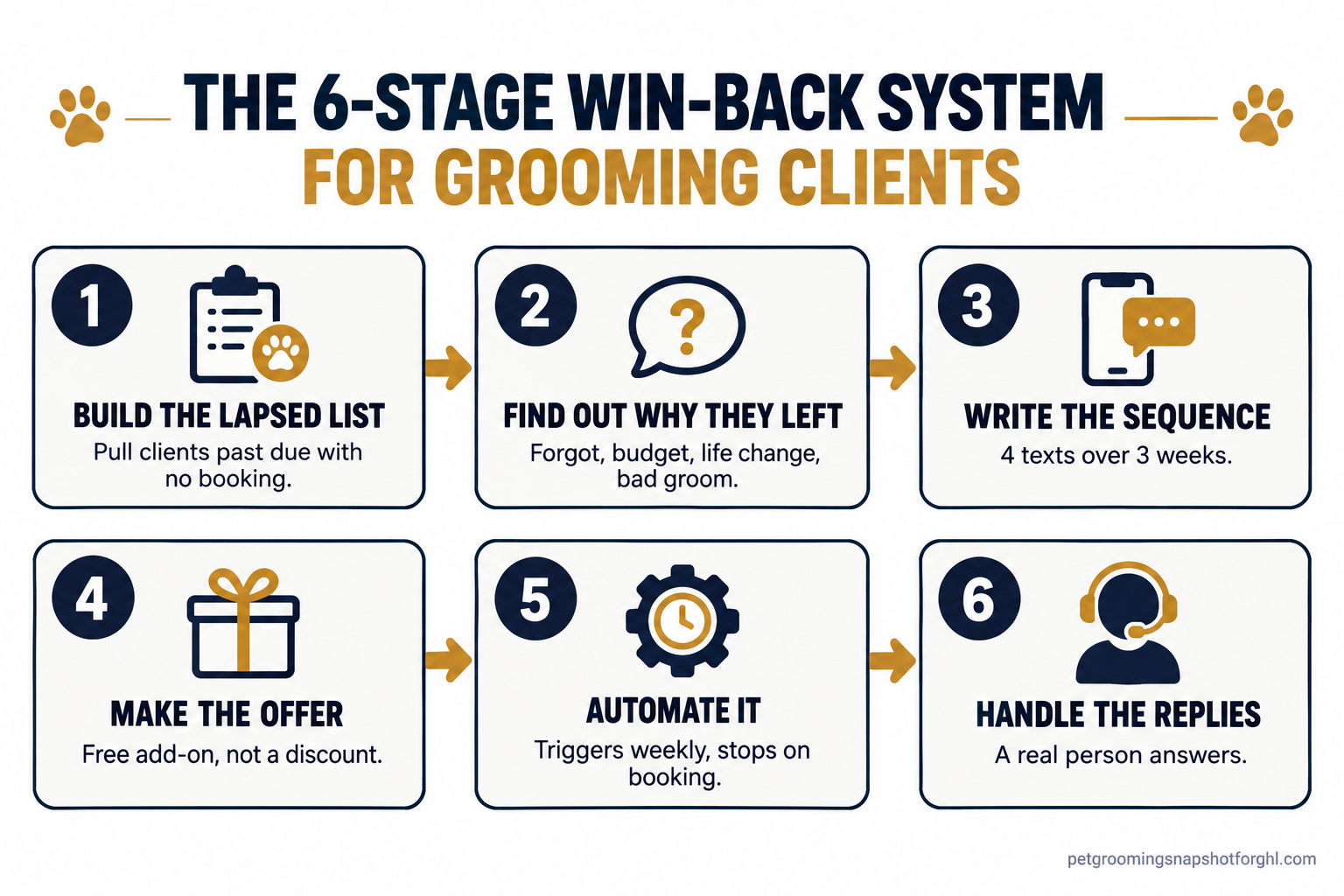
Here is the short answer. The cheapest bookings you will ever get are from clients you already had. A lapsed client is someone who used to groom on a rhythm and has now gone a cycle or two past due. Most of them did not leave for a competitor. They got busy, their card expired on the auto-reminder, the dog went to a doodle cut that hid the shag, or money got tight. Winning them back is a system, not a one-off text blast. This guide walks through all six stages, hands you the exact win-back copy to steal, keeps you on the right side of the texting rules, and runs the numbers for a solo van, a salon, and a small fleet.
Key Takeaways
- A lapsed client is a past regular who is now one to two grooming cycles overdue. For most coats that means roughly 10 to 16 weeks of silence.
- They are cheaper to win back than a cold lead is to find, because they already trust you with their dog. You are reminding, not convincing.
- The win-back is four messages over about three weeks, not one guilt-trip text. Warm first, offer second, last call third.
- A re-engagement text is marketing under the TCPA, so it needs prior express written consent and a working STOP. Confirmations and reminders do not. Keep the streams separate.
- Run the whole sequence on autopilot so overdue clients get pulled every week without you touching it.
What This Guide Covers
- Why lapsed clients are your best bookings
- What a lapsed client is actually worth
- Stage 1: Build the lapsed list
- Stage 2: Find out why they left
- Stage 3: Write the win-back sequence
- Stage 4: Make the offer that works
- Stage 5: Automate it so it runs without you
- Stage 6: Handle the replies and measure
- Steal this: the full win-back copy
- Solo van, salon, and fleet
- Objections
- FAQ
Why lapsed clients are your best bookings
The money has not left the market. The American Pet Products Association’s 2026 State of the Industry report put US pet spending at $158 billion in 2025, up 3.7 percent, and projects $165 billion for 2026. Grooming and boarding alone is roughly an $11.3 billion slice across about 199,000 businesses, according to IBISWorld’s 2026 figures. Your lapsed clients did not stop owning a dog. In almost every case they are still paying someone, or paying nobody and letting the coat mat, which is worse for the dog and an easy problem for you to fix.
So why chase the people who left instead of new ones? Because the sale is half-done. A cold lead has never met you. They do not know if you are gentle with a nervous dog, whether you run on time, or if your van is clean. A lapsed client already knows all of that and decided yes once. The classic retention research summarized by Harvard Business Review makes the same point across industries: holding on to an existing customer is far cheaper than acquiring a new one, and small gains in retention move profit hard. The exact multiple varies by business, so treat it as direction, not gospel. In grooming, the direction is obvious. You are not buying attention. You are tapping someone on the shoulder.
There is a trap in that comfort, though. “They already know us” is also why most shops never send anything. You assume a happy client will come back on their own. Plenty do not, and the longer the silence runs, the colder the relationship gets and the more likely they are to book the new place that texted them first.
What a lapsed client is actually worth
Run your own number before you decide this is not worth the effort. Take your average full-groom ticket and multiply by how many times a year that dog should be on your table. The AKC’s grooming guidance is clear that frequency depends on breed and coat, but most coats land on a four-to-eight-week rhythm, which is roughly six to nine grooms a year. Call it seven to keep the math honest.
Annual spend from one client at seven grooms a year. Visit frequency follows AKC coat guidance; the ticket prices are examples, so drop in your own average. Source: AKC grooming guidance, author’s calculation.
At a $90 average, one lapsed client who comes back is worth about $630 a year, and more once you add nail trims, teeth, deshedding, and the holiday rush. Lose ten of them a year and never win any back and you have quietly handed a competitor $6,000 of booked, trusting, repeat work. Now picture where that spending actually sits in the market.
APPA’s 2026 projected US pet spending by category, in billions of dollars. “Other services” is the bucket that holds grooming, boarding, training, and walking. Source: APPA 2026 State of the Industry.
Stage 1: Build the lapsed list
You cannot win back a list you have never pulled. Most shops have no idea who is overdue because the information is trapped in a calendar nobody reads backward.
Define lapsed by coat, not by a single number. A short-coat dog on a ten-week rhythm is not late at week eight. A doodle on a six-week cut is a problem at week ten. A simple rule that works for most shops: a client is lapsed when they are past their normal interval plus four weeks and have no future appointment on the books. In plain terms, if a dog that comes every six weeks has gone eleven weeks with nothing booked, pull it.
Then segment the list into three buckets, because you will talk to each one differently.
| Bucket | How overdue | What they need to hear |
|---|---|---|
| Recently slipped | 1 to 3 weeks past due | A friendly nudge, no offer. They probably just forgot to rebook. |
| Lapsed | 1 to 2 cycles past due | A warm reach-out plus a small reason to book now. |
| Gone cold | 3+ cycles, or 6 months silent | A real offer and a clean “are we still your groomer?” |
How this breaks: shops run one giant export, text all 200 names the same message, half of them already have an appointment next Tuesday, and now those loyal clients are confused and annoyed. Always exclude anyone with a future booking, and never send the gone-cold offer to someone who just slipped a week.
Stage 2: Find out why they actually left
Before you write a word, get honest about the five reasons grooming clients go quiet, because your message has to answer the real one.
- They forgot. No drama. They meant to rebook, life happened, and twelve weeks passed. This is the biggest bucket and the easiest win.
- Money got tight. The APPA report found 22 percent of pet owners spent less on their pets in 2025, a 10-point jump from the year before. Some of your lapsed clients stretched the interval to save, or started bathing at home.
- A life change. Moved, the dog passed, a new baby, a schedule that no longer fits your hours.
- Something went wrong. A cut they did not like, a wait that ran long, a nick, a price that surprised them. They did not complain. They just did not come back.
- A competitor got there first. Someone newer, cheaper, or closer texted them an offer while you stayed silent.
You cannot read minds, but you can ask. The best win-back message does not assume. It opens a door and lets them tell you. For the gone-cold bucket especially, a single honest question (“is there anything we could have done better?”) recovers more clients than any discount, because people who felt unheard the first time are won by being heard the second.
Stage 3: Write the win-back sequence
One text is not a system. People miss the first message, read it at a red light, or mean to reply and forget. A win-back is a short sequence spread over about three weeks, and it escalates: warm, then a reason, then a last call. Here is the cadence.
- 👋Day 0
The warm hello
No offer, no pressure. You noticed it has been a while and you miss the dog by name. The goal is a reply, not a booking.
- 📅Day 4
The soft reason
For anyone who did not reply. A gentle note that the coat is probably due, with a one-tap booking link.
- 🎁Day 12
The offer
A small, time-boxed reason to book this month. Only to the lapsed and gone-cold buckets, never to someone who just slipped.
- 🚪Day 21
The last call
Honest and clean. One final message that asks if they are still your client, and makes it easy to say yes or opt out.
Keep the voice human. These are texts from a person who knows their dog, not a marketing department. Use the dog’s name every time. Reference the last service when you can (“Bella’s last deshed was back in August”). Short sentences. No all-caps, no three emojis in a row, no fake urgency.
How this breaks: shops lead with the discount on day zero. That trains clients to wait for a coupon and it cheapens you. Lead with the relationship. The offer is the backup, not the opener.
Stage 4: Make the offer that works
Most of your recently-slipped and a good share of your lapsed clients will book with no discount at all, just a reminder. Save the offer for the people who need a reason, and make it an offer that protects your price.
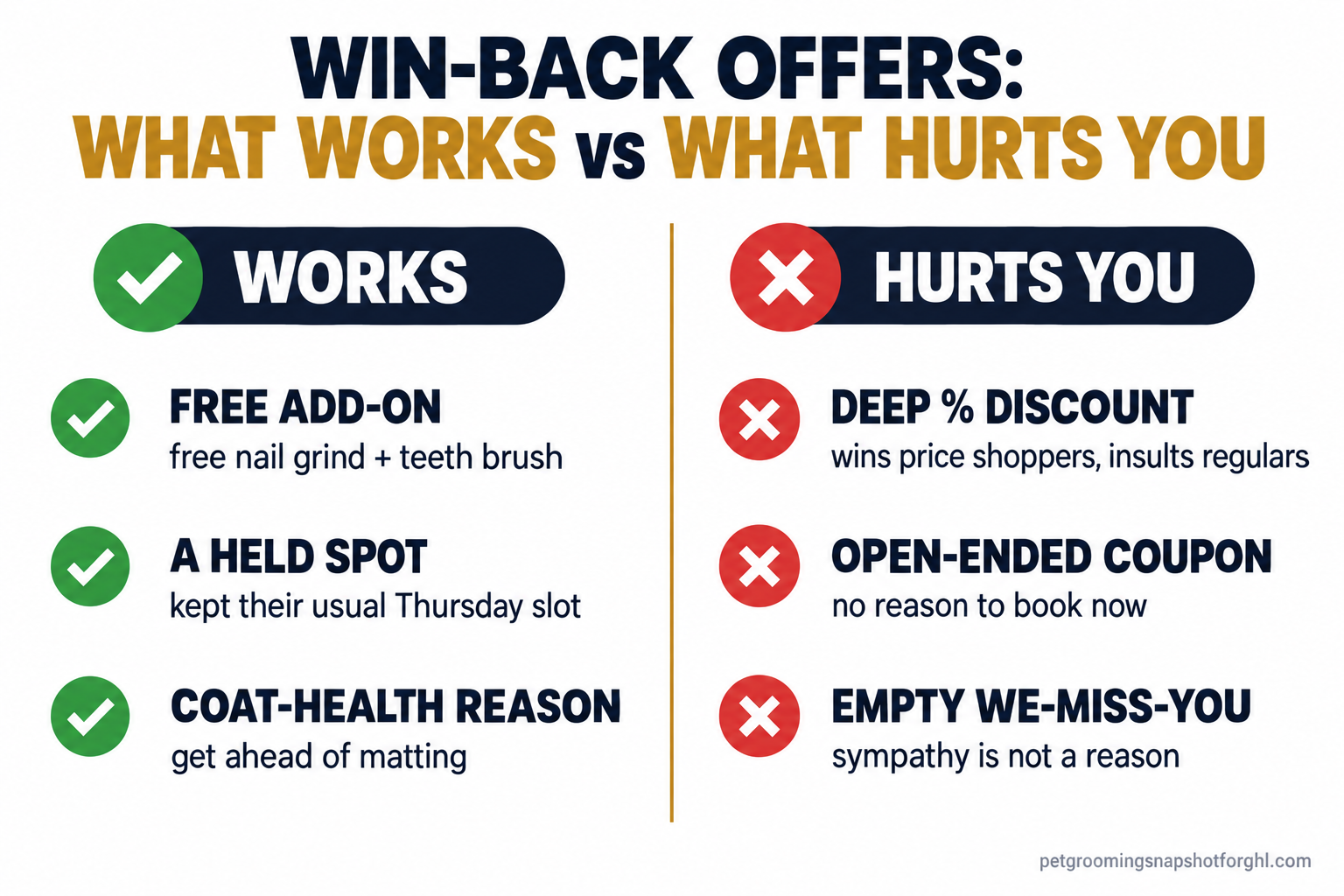
Good win-back offers for grooming:
- A free add-on, not a discount. “Book this month and I’ll add a free nail grind and teeth brush.” It feels generous, costs you minutes, and does not reset their sense of your price.
- A held spot. “I kept Bella’s usual Thursday 10am open through the end of the month.” Scarcity that is true, not invented.
- A coat-health reason. For the gone-cold matted ones, lead with the dog’s comfort, not a sale. “If it has been a while, the undercoat is probably packing in. Let’s get ahead of it before it mats.”
Offers that quietly hurt you:
- A deep percentage off. It wins the price shopper you did not want and insults the regular who paid full freight last month.
- An open-ended coupon with no deadline. It gives zero reason to book now.
- A “we miss you” with nothing behind it after the first message. Sympathy is not a reason to drive across town.
Stage 5: Automate it so it runs without you
Here is where most win-back efforts die. You pull a list in a burst of motivation, send twenty texts by hand between dogs, get busy, and never finish. Three months later the book is gappy again and you start over. A win-back only works when it is a machine, not a mood.
The logic is simple and runs on any decent platform. A client’s record carries a last-groom date. When today’s date passes their normal interval plus four weeks, and they have no future appointment, a tag flips to “overdue” and they drop into the sequence. The day-zero text fires. If they reply or book, the sequence stops cold and they are quietly moved back to active. If they do not, the day-four, day-twelve, and day-twenty-one messages go out on schedule, then they rest on the gone-cold list for a future seasonal push.
This is exactly the kind of quiet, branching, timed workflow a GoHighLevel setup handles well, and it is one of the core flows we build into the Pet Grooming Snapshot so a one-chair shop gets the same always-on win-back a big franchise runs. The point is not the brand of the tool. The point is that it triggers weekly, forever, without you remembering.
How this breaks: the automation keeps texting someone who already rebooked, because the “stop on booking” trigger was never wired. That is the single most embarrassing failure in win-back, and it makes you look like a robot. Test it on your own number first. Book a fake appointment and confirm the sequence halts.
Stage 6: Handle the replies and measure
Automation starts the conversation. A human finishes it. When someone replies “oh my gosh, yes, how is this week,” you do not want a bot answering. Route every reply to a real person and respond like one.
Have three quick responses ready so replies never sit:
- “Yes, book me.” Send the link or offer two specific times. Specific times beat “what works for you,” because a decision is easier than an open question.
- “We moved / the dog passed.” Warmth, full stop. “I’m so sorry. Thank you for letting me know, and give Bella a scratch from us if she’s still around.” No sale. These people refer you later if you are kind now.
- “You nicked her last time / I didn’t love the cut.” Own it, do not argue. “Thank you for telling me, I wish I’d known then. I’d love the chance to make it right. First groom back is on me for the extras.” You just turned a silent defector into a loyalist.
Then measure three numbers, not twenty. How many names you pulled, how many replied, and how many actually booked and showed. If you texted 120 overdue clients and 18 rebooked, that is 18 bookings you would not have had, from work that cost you an hour of setup. Track it per run so you can see the leak shrinking.
Steal this: the full win-back copy
Swap the names, keep the structure. These are written for text, short enough to read on a phone, and warm enough to sound like you. Shorten or lengthen to taste, and always send from a number a client recognizes.
Day 0, the warm hello (everyone):
Hi Dana, it’s Harper at [Shop]. I was looking at the book and realized it’s been a bit since we had Bella in. No rush at all, I just miss that goofy face. How’s she doing?
Day 4, the soft reason (no reply yet):
Hey Dana, Bella’s coat is probably about due for a tidy-up by now. If you want, I’ve got a few openings over the next two weeks. Here’s my booking link so you can grab whatever works: [link]. Happy to answer any questions too.
Day 12, the offer (lapsed and gone-cold only):
Hi Dana, quick one. I’d love to get Bella back on the table this month, so book any groom before the 30th and I’ll throw in a free nail grind and teeth brush, on me. Just reply here or use [link].
Day 21, the last call (no reply, gone-cold):
Hey Dana, I don’t want to keep filling up your phone. If we’re still Bella’s groomer, I’m always glad to have you both back, just reply anytime. And if something changed or we dropped the ball, I’d genuinely like to know so I can fix it. Either way, give her a scratch from me.
The matted-coat health reach (gone-cold, long-coat dogs):
Hi Dana, it’s been a few months since Bella’s last groom, so her undercoat is probably starting to pack in. Mats get uncomfortable fast once they set. Want me to get her in before it turns into a shave-down? I kept her usual Thursday slot open this week.
The win-back email (for clients who prefer email):
Subject: We saved Bella’s spot
Hi Dana, it’s been a little while since Bella’s last groom with us, and we wanted to reach out before her coat gets ahead of her. We’ve held her usual appointment window open through the end of the month, and if you book before then, we’ll add a complimentary nail grind and teeth brush. You can grab a time here: [link]. If anything changed, or if there’s something we could have done better last time, just hit reply, we read every message. Warmly, Harper and the team at [Shop].
Solo van, salon, and fleet
The system is the same. What changes is how you run it and how much it is worth.
Solo mobile groomer. You are the brand, the texter, and the hands. Your win-back is intensely personal, which is your edge. Keep the list small and tight, pull it every month, and send the day-zero text yourself so it is unmistakably you. Automate the day-four and day-twelve follow-ups so they do not depend on a free evening you never get. For a one-van operation, winning back even five lapsed clients a quarter at a $90 ticket is roughly $2,500 of recovered annual revenue, which can be the difference between a thin month and a full one.
One-to-three-chair salon. Now you have enough volume that a manual list is a real chore and loyal clients are easy to accidentally spam. This is the sweet spot for automation. Let the overdue tag build the list weekly, route replies to the front desk, and have one person own the follow-ups. Watch the “stop on booking” trigger like a hawk, because at this size a double-text goes to a lot of people. Your bigger lever is the segment split, keep the no-offer nudge and the real offer firmly separate.
Two-to-six-van fleet. Your win-back is a program, not a task. Each van has its own book and its own regulars, so lapsed clients should route back to their usual groomer and van, not a generic queue. Personalization at this scale only works with automation carrying the data, which is why fleets that still run this by hand leak the most. Track reactivation per van so you can see which routes drift and coach from real numbers. Across six vans, a steady win-back program routinely refills the equivalent of a van-day a week, which is serious money sitting in your existing database.
A fair warning across all three: do not let the win-back become an excuse to skip the rebooking at the chair. The cheapest win-back is the one you never need, because you booked the next groom before the dog left. Pair this with a tight rebooking system and a no-show policy that holds, and the lapsed list stays short.
Objections
“Won’t a win-back text feel spammy or desperate?” Only if you write it like a chain store. A text that uses the dog’s name, references the last visit, and leads with “I miss that face” instead of “20% OFF” reads as a person who cares, not a mass blast. The desperation comes from the discount-first approach and from texting people who already have an appointment. Fix those two things and it reads as thoughtful. Done right, clients reply to thank you for checking in.
“I already pay for MoeGo or Gingr. Doesn’t it do this?” Most grooming software sends reminders and can export a client list, but few run a true branching, multi-message win-back that stops the instant a client books and respects the marketing-consent line. If yours does, use it, this guide still tells you what to send. If it does not, that gap is exactly why operators build the sequence in a platform like GoHighLevel, where the logic and the texting live together. Check what your current tool can actually trigger before you assume it is covered.
“Do I need to be technical to set this up?” No. The thinking in this guide, who is lapsed, what to say, when to say it, is the hard part, and you just did it by reading. The wiring is a one-time setup, and it is the same four messages whether you build it yourself over a weekend or have it installed for you. The ongoing work is answering replies, which is the part you are good at.
“What if they left because I messed up?” Then the win-back is the best apology you can send. A client who felt ignored and gets a genuine “I’d like to make it right” often becomes more loyal than one who never had a problem, because you proved you listen. The only wrong move is silence, which lets a small grievance harden into a permanent switch.
FAQ
When is a grooming client considered lapsed?
Define it by coat, not a fixed number. A workable rule for most shops is: past the client's normal grooming interval plus four weeks, with no future appointment booked. For a dog that comes every six weeks, that is about week eleven of silence. Short-coat dogs on longer intervals should get more runway before you flag them.
How many times should I text a lapsed client before stopping?
Four messages over about three weeks works well: a warm hello on day zero, a soft reason on day four, a small offer on day twelve, and an honest last call on day twenty-one. Stop the moment they reply or book. If they never respond after the last call, rest them on a gone-cold list for a seasonal push rather than texting again soon.
Should a win-back offer be a discount?
Usually no. A free add-on like a nail grind or teeth brush, or a genuinely held appointment slot, wins clients back without resetting their sense of your price or training them to wait for coupons. Save real discounts for the gone-cold bucket only, and keep them off public channels so your full-price regulars never see them.
Do win-back texts need the same consent as appointment reminders?
No, and the difference matters. Reminders, confirmations, and pickup texts are transactional and ride on the consent a client gives by booking and sharing their number. A re-engagement or offer text is marketing, which under the FCC's rules needs prior express written consent and a working STOP. Keep the two streams separate and never message a number that opted out.
How do I win back a client who left because of a bad groom?
Lead with ownership, not a sale. A short, honest message that says you wish you'd known, you'd like the chance to make it right, and the extras are on them for the first groom back recovers more of these clients than any discount. People who felt unheard the first time are won by being heard the second.
Is it worth winning back clients or should I just find new ones?
Both, but win-back is cheaper per booking because the trust is already built. A lapsed regular at a $90 ticket and seven grooms a year is worth about $630 annually before add-ons. Recovering even a handful a quarter refills gaps for roughly an hour of setup, far less effort than acquiring the same number of cold leads.
The book has gaps because good clients drifted, not because the town ran out of dogs. Pull the list, send the four messages, keep it warm, and let it run on its own every week. The people who already trusted you with their dog are the easiest yes you will get all year. Start with the ten most overdue names in your phone, and send the first one today.
Related Reading
- The Rebooking System That Keeps Your Chairs Full
- How to Cut Grooming No-Shows (Without Nagging Pet Parents)
- 12 SMS Templates Every Grooming Salon Should Steal
- Texting Grooming Clients in 2026: A2P 10DLC, Consent, and Waivers
- Why You’re Losing Grooming Clients (and How to Capture Every Lead)
- Booked Solid but Broke: Why a Full Grooming Schedule Isn’t Making You Money