
It is 2:00pm on a Tuesday. The Doodle booked for a full groom is a no-show: no text, no call. You block ten minutes hoping the owner is stuck in traffic, then wipe down a table that did not need wiping. By 2:40 you have told yourself the usual thing: it happens, it is part of the job, move on. That sentence is the most expensive one in grooming, because it stops you from ever putting a number on the leak.
Here is the short answer. A no-show is not bad luck you absorb, it is a measurable cost with a formula, and once you see the annual figure it stops looking like a quirk and starts looking like a salary. This guide gives you the calculator, three worked scenarios (solo van, two-chair salon, four-van fleet), the five levers that move the number, and the exact texts and deposit wording to fix it this week.
Key Takeaways
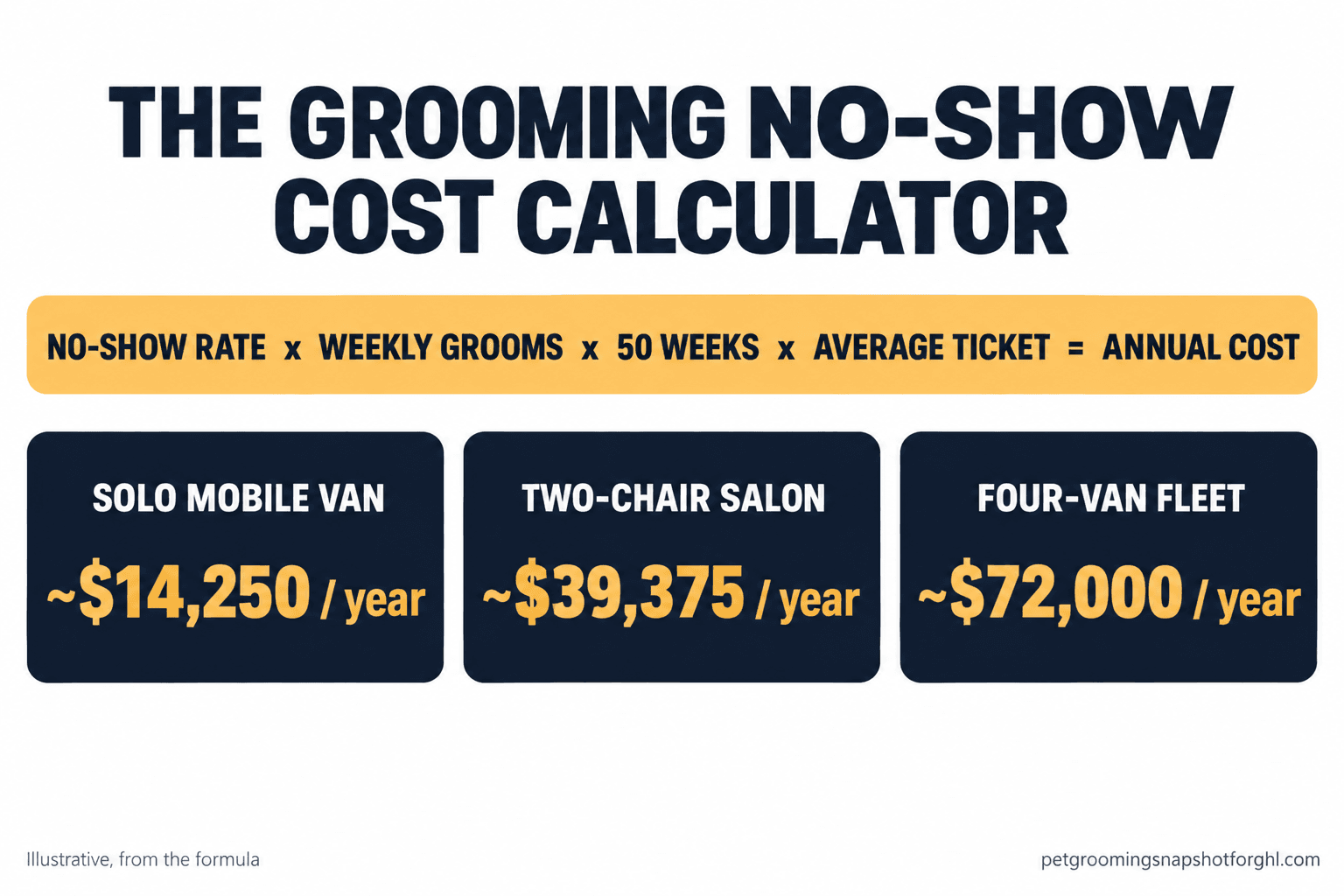
- No-shows have a formula. Your annual cost is your no-show rate times your weekly grooms times about 50 working weeks times your average ticket. Most owners have never done the sum, which is why the number stays invisible.
- The bill is bigger than the lost ticket. Missed appointments cost a service organization an estimated 3% to 14% of revenue, per a 2025 study of a primary care network, before the clients who drift elsewhere.
- Measure before you fix. Zocdoc’s method is simple: no-shows divided by scheduled appointments, over a rolling 30 days.
- Reminders and deposits each move the needle. A targeted second reminder text cut the chance of a no-show by about 7% in a Kaiser Permanente trial, and stacking confirmations, deposits, and a waitlist can roughly halve the rate.
- The money is real. Pet owners keep spending, with the US pet industry at $158 billion in 2025 and projected near $165 billion in 2026, so the client who no-shows on you is paying someone.
What This Guide Covers
- What a no-show actually costs you
- The no-show cost formula
- Solo van, two-chair salon, four-van fleet
- The five levers that cut the number
- Lever 1: Measure it first
- Lever 2: Reminders that confirm, not just notify
- Lever 3: A deposit or card on file
- Lever 4: A cancellation policy clients follow
- Lever 5: A waitlist that backfills the gap
- Steal this: the copy that stops no-shows
- Objections
- FAQ
What a no-show actually costs you
A no-show costs you in three layers, and most owners only feel the first. The first is the lost ticket: the booked groom did not happen, so its money did not come in. That is the bill you notice at 2:40 on a Tuesday.
The second layer is the dead chair. A groomer sells time, not product, so you cannot stockpile a Tuesday afternoon and sell it twice on Wednesday. If nothing fills the hole, you still pay the overhead that ran while nobody was in the chair: rent or the van payment, power, pay, all ticking during an empty slot.
The third layer is the slowest and biggest: the clients who leave. A matted dog whose owner forgot does not stay matted. They call the next shop, and if that groomer does a nice job, your spot in their routine is gone. You did not lose one groom, you lost a client worth a few hundred dollars a year plus their referrals. Missed appointments have been estimated to cost a service organization 3% to 14% of revenue, per a 2025 study of a primary care network, and while grooming is not healthcare, the shape is the same: a slow bleed nobody books.
The demand is there to replace you. IBISWorld counts US pet grooming and boarding at about $11.3 billion across nearly 198,600 businesses, a field the BLS projects to grow about 11% through 2034. Every no-show you shrug off is a chance for the shop down the road to take a client you trained.
The no-show cost formula
Run the number. The formula is boring on purpose, and a number you can act on beats a vague feeling.
If you do not know your no-show rate, that is the first problem, not the math. Zocdoc’s method is the one to use: count no-shows, divide by total scheduled appointments, over a rolling 30-day window. Grooming-specific no-show data is thin and mostly vendor-reported, so do not trust a figure you read in a blog, including this one. Measure your own shop, because the formula only works with your real inputs.
Solo van, two-chair salon, four-van fleet
The same formula gives wildly different answers by size, and the recoverable portion differs too: a salon can sometimes fill a gap with a walk-in, a mobile van in an empty driveway almost never can. Here are three illustrative shops built from the formula; swap in your own numbers.
| Shop | Weekly grooms | Avg ticket | Assumed no-show rate | Illustrative annual cost | Can you backfill? |
|---|---|---|---|---|---|
| Solo mobile van | 30 | $95 | 10% | ~$14,250 | Rarely, an empty driveway slot is gone |
| Two-chair salon | 70 | $75 | 15% | ~$39,375 | Sometimes, via walk-ins and a waitlist |
| Four-van fleet | 120 | $100 | 12% | ~$72,000 | Partly, by reshuffling routes |
The point is not the exact figure, it is the order of magnitude: even the solo van loses the price of a used grooming trailer every year to appointments that never happened.
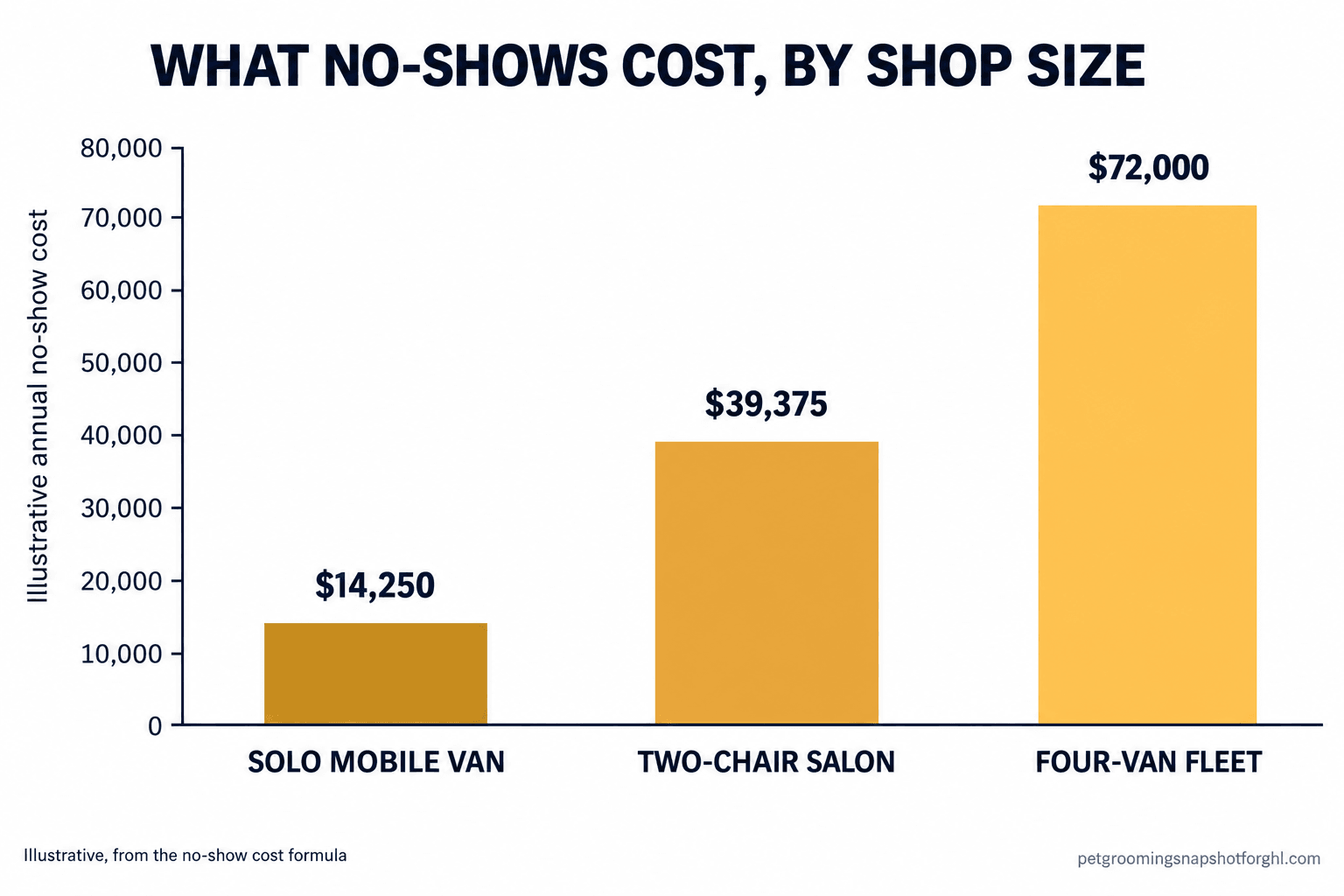
Illustrative annual direct no-show cost by shop size, from the formula: no-show rate x weekly grooms x 50 weeks x average ticket. Plausible inputs, not survey data. Method follows Zocdoc’s no-show cost approach.
Read the solo-van bar as a floor, not a ceiling. A van parked outside a no-show’s house with the generator running has no walk-in to pull forward, so the slot is pure loss, which is why a mobile groomer’s real cost per missed appointment runs higher than a salon’s even at a lower rate.
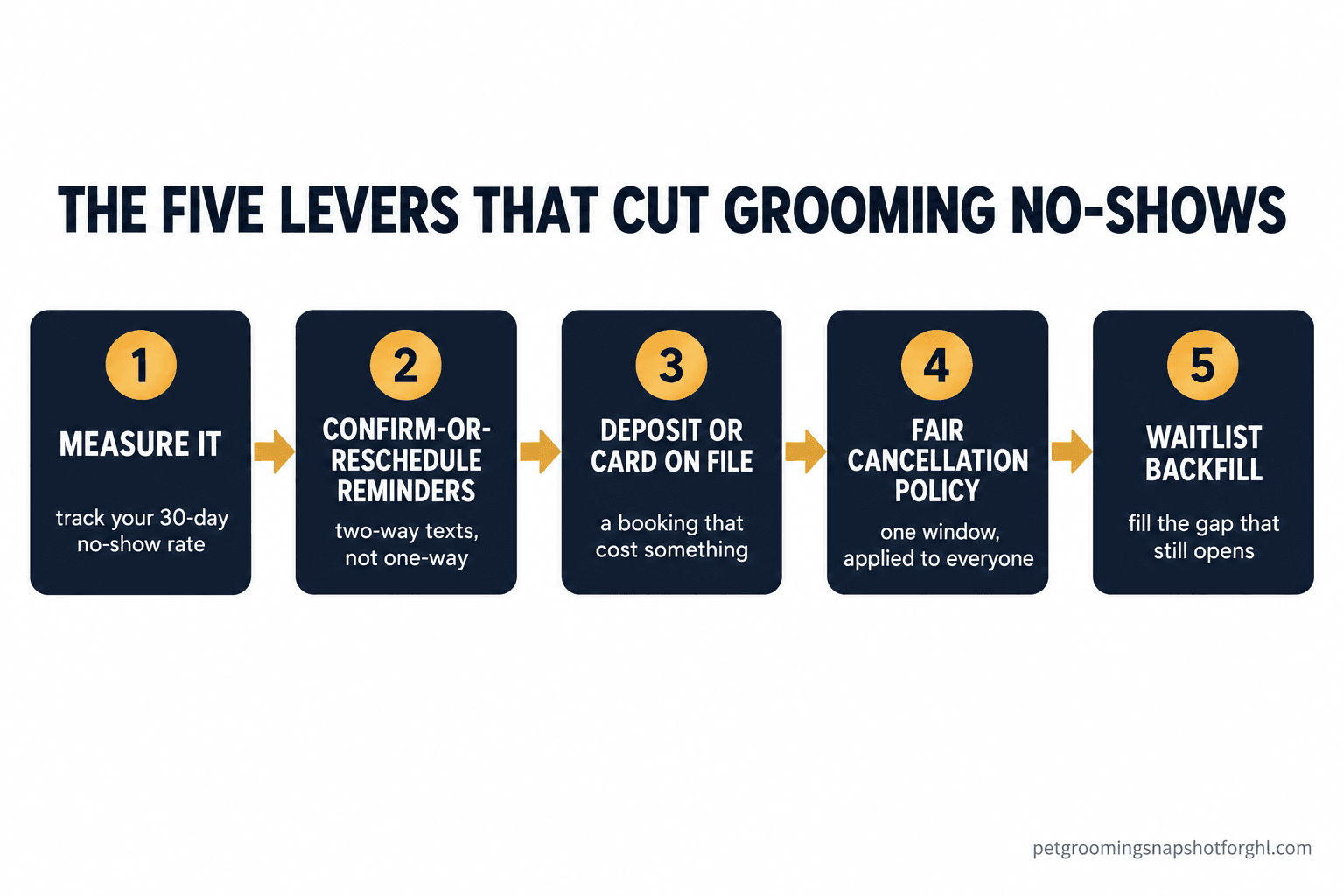
The five levers that cut the number
You do not need all five on day one. You need to measure, then add the levers in order of payback. Each one below comes with how it breaks in a real shop and the fix.
Lever 1: Measure it first
You cannot cut a number you refuse to count. Run the formula on your last 30 days for a baseline, then track it monthly. Measuring changes behavior on its own, because once you see $39,000 on a page you stop treating the Tuesday ghost as background noise.
How it breaks. You eyeball it: “we get a few no-shows a week.” That vague sense is always an undercount, because the late cancels that gave you no time to refill cost the same but do not feel like no-shows, so the problem stays small.
The fix. Count every no-show and every late cancel inside your window as the same thing, in one place, for 30 days. If your booking software tracks it, turn the report on; if not, a clipboard tally beats a feeling. For the deeper version, a full-book-but-broke audit shows where else the money leaks when the schedule looks full.
Lever 2: Reminders that confirm, not just notify
Most shops send one reminder and stop. One that only notifies is a courtesy; one that asks the client to confirm or reschedule with a tap is a lever. In a Kaiser Permanente trial, a targeted second reminder text cut the chance of a no-show by about 7%, and in a 2025 study of a primary care network, risk-based outreach to confirm the highest-risk appointments was associated with a 50.7% drop in no-shows, though that before-and-after design is directional, not proof.
How it breaks. The reminder is one-way. “Reminder: [Pet] is booked Tuesday 2pm.” The client reads it, means to reply, forgets, and ghosts. You gave them information, not a decision.
The fix. Make every reminder a two-way confirm on a cadence: one at booking, one 48 hours out asking for a YES or a tap to move it, one the morning of. If nobody confirms the 48-hour message, that is your early warning to backfill, not a surprise at 2:40. The exact wording is in the SMS templates every grooming salon should steal, and the broader system in the guide to cutting no-shows without nagging.
Lever 3: A deposit or card on file
This is the single biggest lever, and the scariest. A client who put $20 down, or whose card is on file with a clear policy, shows up at a different rate than one who booked for free. The money is not the point, the commitment is: a booking that cost something is harder to forget. Zocdoc notes an MGMA poll in which 25% of practices with a no-show fee saw their rate improve, versus 16% without one.
How it breaks. You announce a deposit policy but never collect, because asking feels awkward and your booking flow does not force it. Clients learn in a week that it has no teeth, and you are back where you started with a rule you do not enforce.
The fix. Build the deposit or card-on-file step into booking so it is a field, not a conversation. Start with new clients and long appointments if a blanket policy feels like too much. For the full policy and economics, see the deposit and cancellation policy clients actually follow.
Lever 4: A cancellation policy clients follow
A deposit without a policy is a fee people resent. A policy without a deposit is a suggestion. Together they are a system: the policy tells clients what counts as a late cancel and what happens if they no-show, applied the same way to everyone.
How it breaks. You apply the policy to the stranger and waive it for the regular, so it stops being a policy and becomes a mood. The ones you charged feel singled out, the ones you let off learn the rule is optional, and it erodes.
The fix. Write one short, fair policy: a clear window, usually 24 to 48 hours, and a specific consequence. Put it in the booking confirmation so every client agrees up front, and apply it consistently, with any grace stated out loud as a once-per-client courtesy rather than quiet favoritism.
Lever 5: A waitlist that backfills the gap
The first four levers lower how often a slot empties. This one turns the slots that still empty back into money: a waitlist of clients who want in sooner turns a cancellation at 10am into a filled 2pm instead of a dead chair.
How it breaks. The waitlist lives in your head or on a sticky note, so when a slot opens you are too busy grooming to work the phone, and the gap stays a gap. A waitlist you cannot activate fast is not a waitlist.
The fix. Keep a standing list of clients who said “sooner if anything opens,” and make the backfill a one-tap broadcast: “A spot opened Tuesday at 2pm, reply YES and it is [Pet]’s.” First reply wins. The same muscle fills a breakdown day or a slow week, which is why it sits at the heart of a rebooking system that keeps chairs full.
The payoff of stacking these is real. Take the two-chair salon at a 15% rate and $39,375 a year: cut the rate to 7% with confirmations, deposits, and a waitlist, and the cost drops to about $18,375, a $21,000 swing.
Illustrative annual no-show cost for the two-chair salon before and after cutting the rate from 15% to 7%. The size of the cut is consistent with studies showing reminders and fees each reduce no-shows (Kaiser Permanente; JMIR, 2025); your result depends on your inputs.
Steal this: the copy that stops no-shows
Write these once, save them where you can fire them fast, and keep names, times, and pets as merge fields. This is copy to adapt, not legal language, and your deposit and policy terms should fit your local rules.
That last message is the one owners skip, and it is the one that keeps a no-show from becoming a lost client. A warm, specific “let us rebook” reads as a pro, not a scold. People respect a business with clear rules more than one that quietly eats the loss.
Objections
“Won’t a deposit scare clients away?” It filters for clients who were going to show anyway, and the ones a $20 deposit scares off are the ones most likely to ghost. It is not an extra charge either, it comes off the groom, so a client who shows up pays the same total.
“My clients are loyal, they don’t no-show.” Run the formula on your real 30-day numbers first. Loyalty is real, and it still loses to a sick kid, a flat tire, and a calendar that did not remind anyone. The fix is not distrust, it is a confirm-or-reschedule text that makes it easy for a loyal client to tell you early.
“Isn’t 15% just the cost of doing business?” It is a cost you chose not to measure, which is different. Once you see it as a yearly figure next to your rent, “cost of doing business” stops being a shrug and starts being a line you can cut, and even halving it beats most price increases.
“I already pay for grooming software, doesn’t it handle this?” Most apps send a one-way reminder and stop there. Few run a true confirm-or-reschedule cadence, an enforced deposit, and a one-tap waitlist backfill as one connected system. If yours does, turn all three on. If not, that gap is the difference between knowing about a no-show and preventing it.
FAQ
How do I calculate my grooming no-show rate?
Count your no-shows and late cancels, divide by the total appointments you scheduled, and multiply by 100. Use a rolling 30-day window so one bad week does not distort the picture. For example, 9 missed out of 120 booked is a 7.5% no-show rate.
How much do no-shows really cost a grooming business?
Run the formula: no-show rate times weekly grooms times about 50 working weeks times your average ticket. A two-chair salon at a 15% rate, 70 grooms a week, and a $75 ticket loses roughly $39,000 a year in direct revenue, before the clients who drift elsewhere. Missed appointments have been estimated to cost a service organization 3% to 14% of revenue.
Do deposits actually reduce no-shows?
They help, because a booking that cost something is harder to forget than one that cost nothing, and a deposit that comes off the groom costs a client who shows up nothing. Zocdoc cites an MGMA poll in which 25% of practices with a no-show fee improved their rate versus 16% without one.
How far in advance should I send reminders?
Send one at booking, one about 48 hours out that asks for a one-tap confirm or reschedule, and one the morning of. The 48-hour confirm is the important one, because a client who does not confirm is your early warning to work the waitlist rather than a surprise empty chair.
Should I charge a no-show or late-cancel fee?
A fair, clearly disclosed fee applied consistently is reasonable and effective. Put the window and the consequence in the booking confirmation so every client agrees up front, and apply it the same way to everyone. A deposit that covers the fee is the least awkward way to enforce it.
It is 2:00pm on a Tuesday, and the same Doodle is booked. This time the 48-hour text went out, the owner tapped to move it to Thursday, and the slot went to a matted Aussie from the waitlist who put down a $20 deposit. Nobody ghosted. The chair stayed full. You stopped treating a measurable cost like bad luck, ran the number, and put a system between your schedule and the leak. The no-show did not disappear. You priced it, then you closed it.