
A woman calls at 8am. “How much to groom a golden retriever?” Your hands are wet, so you give her a number off the top of your head. She books. Three weeks later the dog rolls in with a blown coat, mats behind both ears, and a temper. The groom you quoted at 75 dollars takes two and a half hours and a second pair of hands. You made about 12 dollars an hour, and you smiled the whole time.
Here is the answer up front. Do not price grooming by breed. Price by the two things that decide how long a dog sits on your table: coat type and coat condition. Breed is just a fast way to guess the coat. Build your price in layers, a base rate by size, a coat multiplier, a condition surcharge, a handling fee, and an add-on menu, and quote from the layers instead of your gut. This guide walks the whole stack, the real numbers behind each layer, and the words to say when a client pushes back.
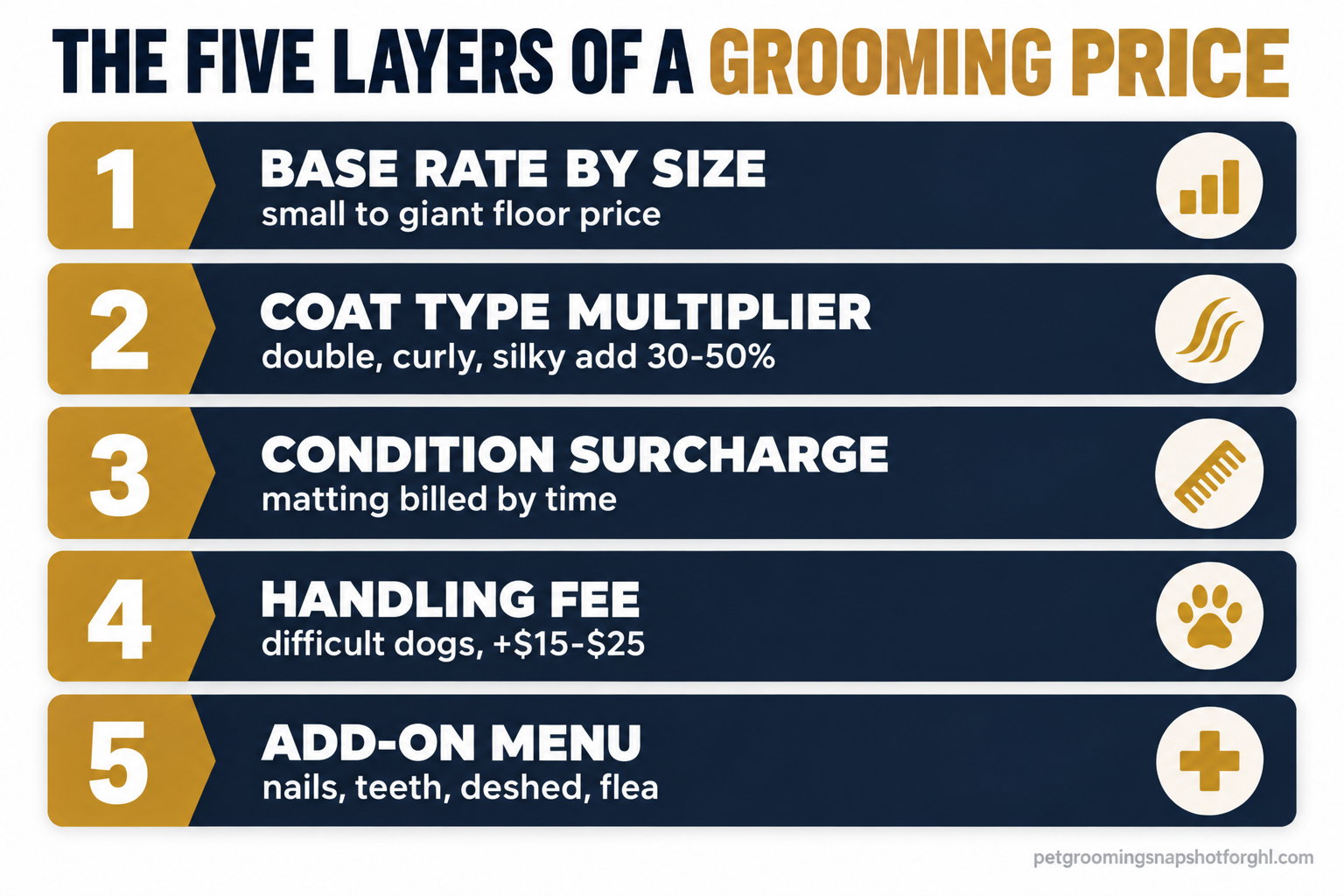
Key Takeaways
- Time is what you sell, not haircuts. Coat type and condition decide the time. Breed and size are just quick proxies for the coat underneath.
- A base rate by size is only the floor. Small dogs run roughly $25 to $100, and doubles and curly coats add 30 to 50 percent, per HomeGuide’s 2026 data.
- Matting is the single biggest variable. It can double your groom time, and the ASPCA warns badly matted coats cause strangulating wounds. Charge for the time and protect the dog.
- Quote from a form, not from memory. Capture breed, coat, weight, and last-groom date before you name a price, and the 8am phone quote stops costing you money.
- Raise prices on a schedule, not an apology. A short, warm, dated notice keeps almost everyone. Silence and guilt lose clients.
What This Guide Covers
- What underpricing actually costs you
- Breed is a proxy, coat is the truth
- Layer 1: The base rate by size
- Layer 2: The coat type multiplier
- Layer 3: The coat condition surcharge
- Layer 4: The handling and temperament fee
- Layer 5: The add-on menu
- Steal this: the pricing scripts
- Solo van, salon, and multi-van fleet
- The legal line on matting and waivers
- Objections
- FAQ
What underpricing actually costs you
Grooming margins are thin. More than half of dog owners, 51 percent, now groom their dogs at home, per the APPA, and salon, mobile, and boarding spend all softened in 2025 as owners looked for savings. That does not mean drop your prices. It means the people still paying you value skill, safety, and time they cannot give the dog themselves. Price like it.
The math is brutal. Quote 20 dollars low on six dogs a day, six days a week, and that is 720 dollars a week handed away, more than 37,000 dollars a year. You gave it back at the desk, one friendly guess at a time.
It is not just money, it is your body. A double coat you priced as a quick bath is 90 minutes of brushing that wrecks your shoulder. In a $15.4 billion market of roughly 193,000 US businesses, per IBISWorld’s 2026 data, the operators who last get paid for the hard grooms.
Breed is a proxy, coat is the truth
Clients think in breeds. You should think in coats. A “goldendoodle” tells you almost nothing: one is a wavy fleece on a three-week schedule, the next is a matted felt blanket that has not seen a brush since spring. Same breed, same size, wildly different groom. Price the word and you will be wrong half the time.
Five coat families drive your time. Short and smooth, like a beagle or boxer, is fast. Double coats, like a husky, golden, or shepherd, are slow because of the undercoat and drying. Curly and wool, like poodles and doodles, mat easily and need real scissor work. Wiry, like most terriers and schnauzers, needs hand-stripping or careful clipping. Silky and long, like a shih tzu, Yorkie, or Maltese, tangles fast and takes patience. Breed is just your shortcut to the family, and the AKC’s guidance on double-coated dogs shows why undercoat work is a different job than a smooth-coat bath.
How it breaks, and the fix. Price by breed name and a mixed-dog owner argues “he’s mostly lab” for the cheap rate. Instead, price the coat: your menu says “double coat,” “curly/wool,” “silky/long,” not “golden retriever.” Answer a breed question with a coat question: what does it feel like, and when was he last groomed?
Layer 1: The base rate by size
Start with a floor by size. It covers the bath, dry, nails, ears, and a basic tidy on an average, well-kept dog, and it is the least you will charge before coat and condition move it up. Size is a fair proxy because a bigger dog is more shampoo, more water, and more drying.
Real market ranges give you a sane band. Per HomeGuide’s 2026 price data and Dogster’s 2026 cost guide, small dogs run about 25 to 100 dollars, medium about 35 to 120, large about 50 to 140, and giant breeds about 60 to 180, with metro areas often 30 to 50 percent above small-town pricing. Set your floor at the lower-middle of your local band and let the next layers earn the rest.
Typical full-groom price by dog size, US, 2025 to 2026, midpoint of reported ranges in dollars. Source: HomeGuide 2026 dog grooming prices, a marketplace estimate.
How it breaks, and the fix. One flat “grooming price” makes a Great Dane and a Yorkie pay the same, and one loses you money every time. Post three or four size floors, small, medium, large, giant, with a weight range on each. The floor starts the conversation.
Layer 2: The coat type multiplier
Now apply the coat. Two dogs the same size can be an hour apart because of what grows out of them. HomeGuide’s data puts the premium for specialty coats at roughly 30 to 50 percent over a smooth coat of the same size.
Set your multipliers once and apply them every time. Smooth is your base. Silky or long adds about 20 to 25 percent, wiry 25 to 35, a double coat 30 to 40 for the deshed and dry, and curly or wool 40 to 50 for the finish work.
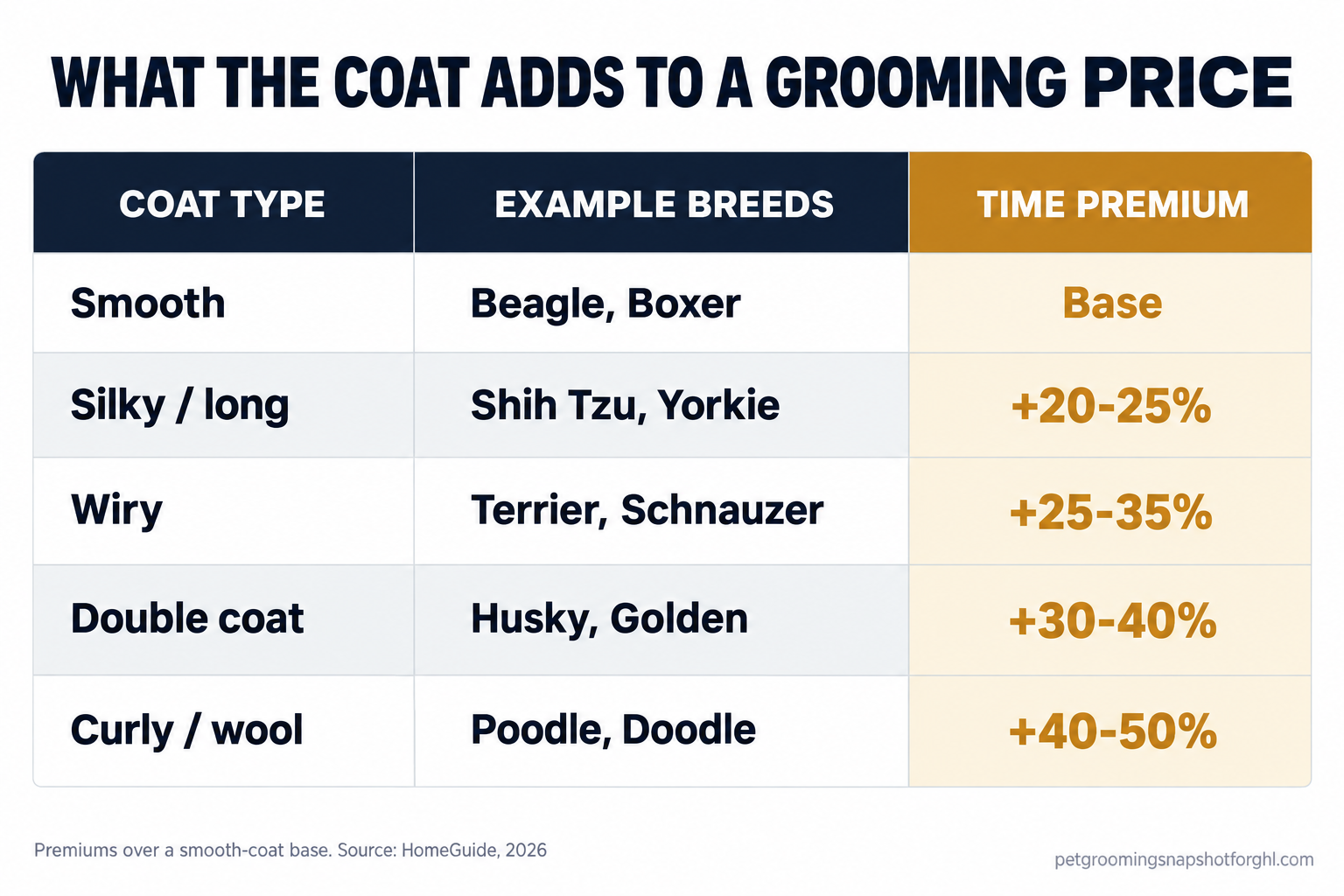
How it breaks, and the fix. Charge the same for a smooth-coat lab and a wool-coat doodle and the doodle’s extra 45 minutes of scissor work is subsidized by every lab. Apply the coat multiplier before you quote, every time. It is the single change that fixes the most underpricing.
Layer 3: The coat condition surcharge
Coat type is the potential. Condition is what actually walked in. A curly coat on a four-week schedule is a clean, quick groom. The same coat left twelve weeks is a matted job that can take double the time and hurts the dog to work through. This layer is the difference between getting paid and donating your time.
Matting is the big one. The ASPCA is blunt about the stakes: even mild mats cause skin irritation that turns into infected lesions, and severe mats create strangulating wounds that cut off blood supply, sometimes badly enough to need surgery. A de-matting fee is not a punishment. It prices a slower, riskier, more skilled job, and often steers the dog to a humane shave-down. Charge by time, commonly starting around 100 dollars for a bad coat, or price the shave-down separately.
How it breaks, and the fix. Quote the clean-coat price, the dog arrives matted, and you eat two hours or fight about it at the desk. Instead, name the surcharge before the appointment: your booking confirmation says matting is billed by time and quotes a range, so it is a policy the client already agreed to. Tie it to your deposit and no-show policy so the money talk happens first.
Layer 4: The handling and temperament fee
Some dogs take two people, a muzzle, frequent breaks, and twice the time for half the coat. A dog that bites or fights every step is a real cost in time, in risk to your hands, and in stress across your day. Most operators fold this in as a special-handling fee, commonly 15 to 25 dollars and up.
This is not a fee for a nervous first-timer who settles in ten minutes. It is for the genuinely difficult dog that doubles your labor or needs a second groomer. Flag it on the pet record after the first visit so every future quote includes it.
How it breaks, and the fix. Never charge for handling and the hardest, most dangerous dogs become your worst-paying jobs, the ones you dread and rush until one bites you for 60 dollars. Add a handling fee to any dog that needs a second set of hands, a muzzle, or extra time. Difficult dogs are welcome. They are just not free.
Layer 5: The add-on menu
The last layer is the menu of extras that ride on top of the groom, where the average ticket grows without a hard sell because these are real services the dog needs. Put the menu in the booking form so the client chooses before they arrive.
| Add-on service | Typical price | Why offer it |
|---|---|---|
| Nail grind (over basic trim) | +$3 to $10 | Smoother finish, better for the dog and your table |
| Teeth brushing | $10 to $15 | Real health need, easy yes for owners |
| Anal gland expression | $10 to $15 | Routine care most owners will not do themselves |
| Deshedding treatment | $20 to $40 | Priced by coat, big value on double coats |
| Flea and tick bath | $15+ | Necessary, and protects your shop |
| De-matting (by time) | $100+ typical | Skilled, slow work, price it honestly |
Typical US add-on pricing, 2025 to 2026, from HomeGuide and Dogster’s 2026 guide. Marketplace estimates. Set your own against your local market.
How it breaks, and the fix. Add-ons that live only in your head get offered when you remember and skipped when you are busy, so the ticket is random and the dog misses care. Put the menu in the booking form as checkboxes and let the client pick, so the upsell happens before the appointment.
Steal this: the pricing scripts
Lift these and adjust the bracketed parts.
The 8am phone quote (a range, not a guess):
Great question. For a [breed/size] the groom usually runs [$X to $Y], and the exact price depends on the coat. Send me a quick photo or tell me when [Pet] was last groomed and I will lock in the number. Want me to hold a spot for [day]?
The booking-form line on matting and condition (set it in writing):
Grooming is priced by time. If [Pet] arrives matted or in poor coat condition, de-matting is billed by the time it takes, from [$X], and for a pet’s safety we may recommend a short shave-down instead of brushing out severe mats. We will always call you before doing extra work.
The at-the-desk matting explanation (kind and firm):
His coat is matted close to the skin. Brushing that out would hurt him and take hours, so the safe option is a short clip to reset it, then we get him on a schedule so it never gets here again. The clip is [$X]. Does that work?
The price-increase announcement (dated, warm, no apology):
Hi [Name], a heads up that our grooming prices rise slightly on [date], the first change in [time]. [Pet]’s groom will be [$new price], and your standing [day] slot stays exactly the same. Thank you for trusting us with [Pet]. Book ahead any time at [link].
Pair these with a full library of SMS templates every grooming salon should steal so the whole client conversation runs without you.
Solo van, salon, and multi-van fleet
The five layers are the same at every size. What changes is keeping pricing consistent when more than one person quotes.
The solo mobile groomer, one van. You are the price grid. Your risk is the gut-quote while driving or elbow-deep in a dog. Build the grid once, keep it on your phone, and name no firm number until you know the coat and condition. Your base rate also has to cover the drive and setup between stops, which is the point of route-smart mobile booking.
The 1-to-3 chair salon, 2 to 4 staff. Consistency is the game. If three groomers quote three prices for the same doodle, clients shop you against yourself. Put the grid on the wall and in the booking system so everyone quotes the same cells, and standardize how matting and handling get flagged so the price follows the dog.
The multi-van fleet, 2 to 6 vans. Your risk is drift. One van undercharges doubles, another skips the handling fee, and you cannot see it until the numbers come in soft. Lock the grid into the booking form so every van quotes identically, and review your average ticket by coat type monthly. This is what separates a booked-solid-but-broke shop from a profitable one.
The legal line on matting and waivers
Two honest notes so you price with your eyes open. First, licensing. Almost no US state licenses individual groomers, so there is no license fee to build into your price. A few states license grooming facilities or the staff inside them, not the person, so check your state and city for a facility or business rule. But do not believe anyone who says your state licenses you personally as a groomer. It almost certainly does not.
Second, waivers. An intake and consent form that spells out the matting and shave-down policy prices the hard grooms in advance and documents that the owner understood the risk. It will not cover true negligence, so groom safely and carry insurance. But the clinical reason to shave rather than brush a pelted coat is documented by vet sources like VCA on coat care, and putting that in your form turns a surcharge into an agreed-upon safety call.
Objections
“Won’t clients balk at coat and matting surcharges?” Only if they hear them for the first time at the desk with the dog on the table. Put every surcharge in the booking form so the client agrees before they arrive. A surprise fee feels like a trap. A policy you both signed off on feels like a pro.
“My prices are already higher than the shop down the road.” Some clients will leave, and let them. More than half of owners now groom at home to save money, and those are not your clients anyway. The ones who still pay a pro would rather pay you right than watch you burn out and quit.
“I’ve quoted by breed for years and it’s fine.” It is fine until a matted doodle eats your afternoon for a smooth-coat price. Breed is not meaningless, it just stops one layer too early. Keep it as your fast guess, then finish with coat, condition, and handling. It is not a spreadsheet project, it is one grid you build once.
FAQ
Should I price dog grooming by breed or by coat type?
Price by coat type and condition, and use breed only to guess the coat. Two dogs of the same breed can be an hour apart depending on whether the coat is double, curly, silky, or smooth, and whether it is clean or matted. Build a grid with size down the side and coat type across the top, then adjust for condition, handling, and add-ons.
How much does dog grooming cost by size in 2026?
Marketplace data from HomeGuide and Dogster puts small dogs at roughly $25 to $100, medium $35 to $120, large $50 to $140, and giant breeds $60 to $180, with metro areas often 30 to 50 percent higher. The bands are wide because coat and condition move a dog within them, so set your floor against your local market.
How should I charge for a matted dog?
Charge by the time it takes, commonly starting around $100 for a badly matted coat, and price a humane shave-down as its own service. The ASPCA warns that severe matting causes skin infections and strangulating wounds, so put the policy in your booking form and never spring the surcharge at the desk.
Is it fair to charge more for doodles and double-coated dogs?
Yes, because those coats take more time and skill. Industry data puts the premium for specialty coats at roughly 30 to 50 percent over a smooth coat of the same size, for the deshedding, drying, and scissor work. You are not charging for the breed, you are charging for the time the coat requires.
How do I raise grooming prices without losing clients?
Announce the change in writing, with a date, warmly, and without apologizing. Give the new price for their pet, reassure them their standing slot is unchanged, and give a few weeks of notice. Most clients stay. Silence and guilt lose more clients than a clear price change ever will.
Related Reading
- Booked Solid but Broke: Why a Full Grooming Schedule Isn’t Making You Money
- How to Cut Grooming No-Shows (Without Nagging Pet Parents)
- 12 SMS Templates Every Grooming Salon Should Steal
- The Rebooking System That Keeps Your Chairs Full
- MoeGo vs Gingr vs PetExec: What Grooming Software Really Costs in 2026