
It is a Tuesday morning and your best groomer asks if you have a minute. You already know. She has been quiet for two weeks, and now she is standing by the tub with her coat still on. Two weeks’ notice. She found a shop across town that pays commission and closes on Sundays. By Friday you are doing her dogs on top of yours and staring at a hiring post you have no time to write.
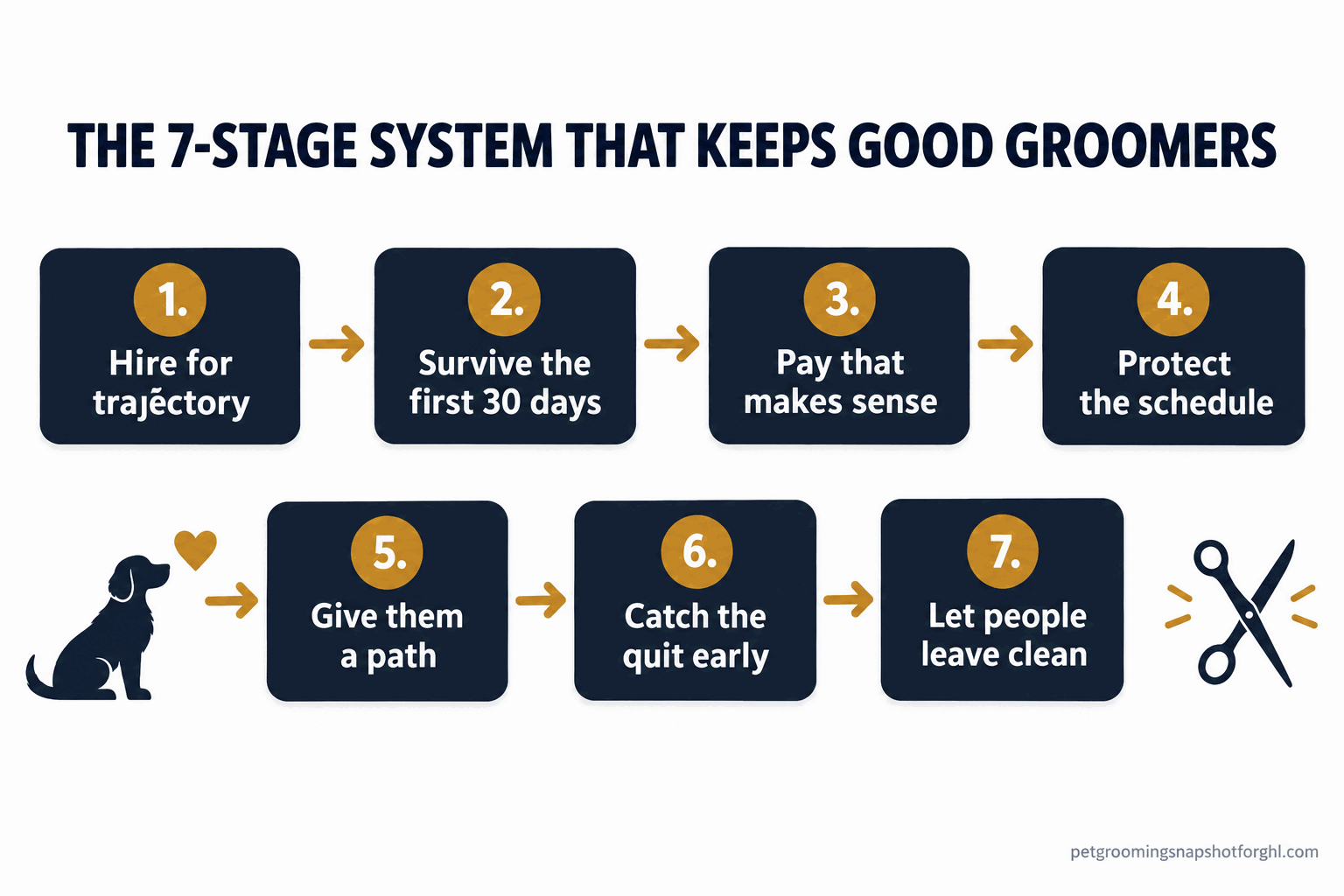
Here is the short answer. Good groomers rarely quit over one thing, and almost never over pay alone. They quit because the job slowly stops being worth it: no path, no backup when a dog is a nightmare, a schedule that punishes them, and a boss who only talks to them when something goes wrong. Keeping them is not about being the highest payer in town. It is a system with seven stages, and most small shops run only two. This guide walks through all seven, hands you the copy to hire and to keep people, runs the numbers for a solo operator, a salon, and a van fleet, and covers the legal part that quietly sinks shops that pay commission.
Key Takeaways
- Pay is the reason they give, not the reason they go. Most groomers leave over workload, no advancement, and feeling invisible. Fix those and a fair wage holds people.
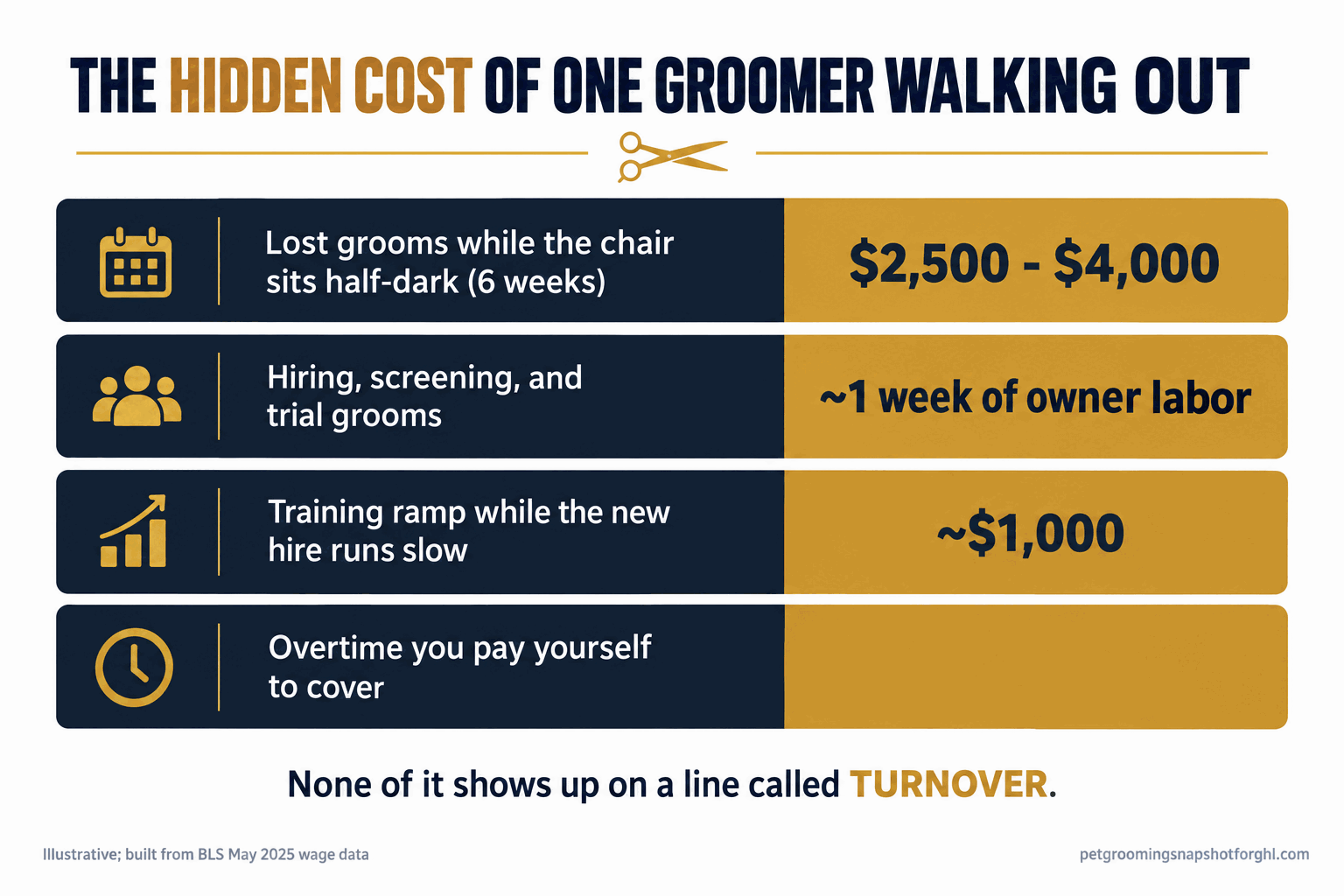
- Turnover is the most expensive line item you never see. A departed groomer takes weeks of lost grooms, hiring time, and training ramp, plus the overtime you pay yourself to cover.
- The labor market is tight. Animal care work is projected to grow 11% from 2025 to 2035, per the BLS, faster than average, so trained groomers have options.
- Your pay model is a retention decision. Hourly, commission, and hybrid each change who stays and who burns out. Pick on purpose.
- The schedule is a retention tool. No-show churn and back-to-back hard dogs drive good groomers out faster than a low rate does.
- Misclassifying a groomer as a 1099 contractor is a real legal risk. The IRS looks at who controls how the work gets done, not what you call the arrangement.
What This Guide Covers
- Why your best groomer is your most fragile asset
- What losing a groomer actually costs you
- The seven stages of a grooming team that stays
- Stage 1: Hire for trajectory, not just a portfolio
- Stage 2: Make the first 30 days survivable
- Stage 3: Pay in a way that makes sense
- Stage 4: Protect them from the schedule
- Stage 5: Give them somewhere to go
- Stage 6: Catch the quit before it happens
- Stage 7: Let people leave clean
- Steal this: the hiring and retention copy
- Solo, salon, and multi-van fleet
- The legal part nobody wants to read
- Objections
- FAQ
Why your best groomer is your most fragile asset
A grooming business runs on a handful of trained hands. You cannot stockpile grooms the way a shop stockpiles inventory. If a groomer walks, that chair is dark until you find, hire, and train a replacement, and the regulars attached to that person start shopping the moment they hear.
That fragility is getting worse. The wider market is healthy: the US pet industry reached $158 billion in 2025 and is projected near $165 billion in 2026, per the American Pet Products Association. The problem is on the supply side. The BLS counts about 413,000 animal care and service workers in 2025, with employment projected to grow 11% through 2035, well above the all-jobs average. When a field grows that fast, the people who are good at it can move whenever they want. A groomer who can fill a book is never short of somewhere to go, so the owner who treats one as replaceable is playing a game they will lose.
What losing a groomer actually costs you
Owners underprice turnover because most of the cost is invisible. You see the hiring ad. You do not see the weeks of grooms the chair did not do, the regulars who drifted, or the hours you worked for free to cover.
Put rough numbers on it. Say a groomer bills $900 to $1,200 a week. If their chair runs at half capacity for six weeks while you hire and train, that is a few thousand dollars in grooms that never happened, before a dime of hiring cost. The median pay for animal caretakers was $35,360 a year in May 2025, per the BLS, so the gap between keeping and replacing is stark: a small raise or a better schedule is almost always cheaper than a vacancy.
Frame a $2 an hour raise or a four-day week against the true cost of a vacancy, and the math usually says keep the person.
The seven stages of a grooming team that stays
Retention is not a vibe. It is seven stages, each with its own failure mode. Most shops run stage one and stage three and wonder why people still go. The stages that hold a team are the quiet middle ones.
Stage 1: Hire for trajectory, not just a portfolio
The best long-term hire is rarely the flashiest groomer who walks in. It is the person whose attitude and trajectory fit your shop. Skill can be taught. Showing up, patience with a scared dog, and taking feedback without sulking cannot.
How it breaks. You hire fast because you are drowning, skip the trial groom, and take a polished portfolio at face value. Two months in you learn they are slow, rough with anxious dogs, or allergic to the front desk.
The fix. Write an honest post that screens for fit, not just years, and always do a paid trial groom or two before an offer. Watch how they handle a nervous dog and a tricky coat, not a cooperative one. Hire for how someone learns and treats animals, and you can build the skill around a person who will stay.
Stage 2: Make the first 30 days survivable
Most grooming turnover happens early. A new hire who feels lost and gets thrown twelve matted dogs on day three decides within a month that this shop is chaos, and starts looking before they have unpacked their shears.
How it breaks. There is no onboarding. You are too busy to train, so you hand over a full book immediately and correct them only when a client complains. They never learn your standards, so they invent their own.
The fix. Protect the first 30 days on purpose. Start with a lighter book and simpler dogs, pair them with a senior groomer for the first week, and give one short check-in at the end of each day for two weeks. The steal-this section has a checklist. A groomer who feels set up to win stays; one who feels dropped in the deep end is already half gone.
Stage 3: Pay in a way that makes sense
Pay does not have to be the highest in town, but it has to be fair, predictable, and understandable. Groomers talk to each other. A model that feels arbitrary, or that quietly shrinks their check in a slow week, drives people out even when the headline rate looks fine.
You have three honest options. Straight hourly is predictable but does not reward a fast producer. Commission, usually 40% to 60% of the groom price, rewards production but punishes the groomer in slow weeks and winter, which is when they start shopping. A hybrid, a modest hourly base plus commission above a threshold, is what most shops that keep people land on: a floor in slow weeks, upside in busy ones.
Illustrative weekly take-home for a groomer billing $1,800 in a normal week, under three common pay models. Commission wins in a strong week; the hybrid floor protects the groomer in a slow one. Your real numbers depend on your prices and hours.
How it breaks. Pure commission with no floor looks generous in summer and brutal in January, so your best producer leaves right when you can least afford it. Or you never put the model in writing, so every raise is a tense negotiation.
The fix. Put the model in writing, show a groomer exactly how their check is built, and build in a floor so a slow week does not send them across town. For the economics behind slow-season pay, see why a full book can still leave you broke.
Stage 4: Protect them from the schedule
This is the stage almost nobody runs, and it burns good groomers out the fastest. The schedule is not neutral. A book packed with back-to-back hard dogs, constant no-shows that kill the rhythm, and zero buffer is a resignation letter writing itself.
How it breaks. You book whatever comes in, in whatever order it lands. Your senior groomer gets every matted doodle and aggressive dog because they can handle it, so they carry the most draining work all day. No-shows leave ragged holes that make the day feel pointless.
The fix. Spread the hard dogs across the team instead of dumping them on your best person, and build small buffers around known-tough grooms. Kill the no-show churn too, because an empty chair you staffed for is a loss, not a break. A reliable reminder and deposit flow protects your groomers’ time as much as your revenue, and a steady rebooking rhythm means fewer frantic days chasing fill-ins. When nobody is drowning in booking calls and reminder texts between dogs, the whole shop breathes.
Stage 5: Give them somewhere to go
A groomer who can see no future in your shop will find one somewhere else. This is quietly the biggest driver of avoidable turnover. Grooming-industry staffing work, including DaySmart’s “Beyond the Shears” retention research, keeps landing on the same theme: people leave when the job feels like a dead end.
How it breaks. The role is flat. A groomer does the same job for the same rate for three years, watches newer hires get the same deal, and concludes the only way to grow is to leave.
The fix. Build a visible path even in a small shop: a skill ladder (junior, groomer, senior, lead) tied to clear raise steps, a budget toward certification, or a cut of the shop for someone who wants to run a second van. The path does not have to be huge. It has to be real and named, so a good groomer can picture next year and see it beats this one.
Stage 6: Catch the quit before it happens
By the time a groomer gives notice, the decision is weeks old. The owners who keep people notice the drift early and fix the cause while it is still fixable, instead of being blindsided by the coat-still-on conversation by the tub.
How it breaks. The only time you talk to your team one on one is when something goes wrong. Small resentments (the schedule, a pay question, a client who treats them badly) pile up silently until they become a done decision.
The fix. Run a short one on one with each groomer on a schedule, even fifteen minutes a month. Ask what is working and what is grinding them down, and actually fix one thing. Once or twice a year, run a stay interview. The scripts are below. The point is to hear the problem while it is a comment, not a resignation.
Stage 7: Let people leave clean
Some people will leave anyway, and that is fine. How you handle the exit decides whether it costs you one groomer or several, because the rest of your team is watching how you treat the person walking out.
How it breaks. You take the notice personally, go cold for the last two weeks, and make the exit ugly. The departing groomer tells their regulars and their grooming friends exactly how it felt, and your remaining team quietly updates their resumes.
The fix. Keep it professional and warm. Thank them, run a quick exit conversation, hand off their regulars cleanly, and leave the door open. A groomer who leaves on good terms sends referrals, sometimes comes back, and never becomes the person warning other groomers away from your shop.
Steal this: the hiring and retention copy
Here is the copy to run the parts most owners improvise. Adapt the words to your voice, but keep the structure.
Solo, salon, and multi-van fleet
The seven stages are the same at every size, but the answer changes. Run them for your shape.
Solo operator adding a first hire. Your biggest risk is hiring in a panic and training badly. Start part-time, protect the first 30 days, and pay a simple hourly or low base plus commission so the math is clear. Stages two and four do the work: do not drop them in the deep end, and do not hand them only the dogs you did not want. Make the role a groomer, not a groomer-plus-receptionist-plus-dispatcher, because that bundle burns people out fastest.
1-3 chair salon with 2-4 staff. Stages three, five, and six carry the load. Put the pay model in writing, because your groomers compare checks. Build a named skill ladder so your senior person has a reason to stay instead of opening their own shop. Run monthly one on ones to catch drift, and share the hard dogs evenly, because resentment spreads fast in a small room.
2-6 van fleet. You manage people you do not see daily, so systems replace line of sight. Standardize onboarding, and make pay and the advancement path formal and identical across vans, because perceived unfairness between drivers is poison. Lead groomer becomes a real rung, and route discipline is now a retention issue: a driver stuck with the worst routes and the most no-shows will quit. See route-smart booking for mobile groomers.
The legal part nobody wants to read
Read this once. The most common mistake small grooming businesses make is paying a groomer as a 1099 independent contractor when the law would call them an employee. Owners do it to save on payroll taxes. It is also where audits and back-tax bills come from.
The test is not what you call the arrangement. The IRS looks at who controls how the work actually gets done: if you set the hours, assign the dogs, require your methods, and the person works only for you, they look like an employee no matter what the agreement says. A true booth renter who sets their own hours, uses their own tools, and keeps their own clients is a different story.
None of this should scare you off hiring. It should push you toward the clean version: classify correctly, pay on a model you have written down, and keep the records.
Objections
“I can’t afford to pay more right now.” You may not need to. Most groomers who leave do not go for a dollar more an hour, they go because the job wore them down. A protected schedule, a named path, and being heard in a monthly one on one cost almost nothing and hold people better than a raise you resent. Fix the free stuff first.
“Groomers are just transient. They always move on.” Some movement is real, but “they all leave” is often a shop telling on itself. When one owner keeps groomers for years where another cannot keep anyone six months, the difference is not the labor market, it is the system.
“I don’t have time for one on ones and stay interviews.” A fifteen-minute monthly check-in is a fraction of the time you spend hiring and retraining after someone quits. You are not finding time for one on ones, you are choosing between fifteen minutes now and a half-dark chair later.
“If I automate the admin, won’t my staff feel replaceable?” The opposite, done right. Automating the phone, the reminders, and the booking back-and-forth does not replace a groomer, it removes the unpaid, draining work burning them out between dogs. Your team did not train for years to chase no-show texts.
FAQ
Why do good groomers quit even when I pay well?
Pay is rarely the real reason. Groomers usually leave over workload, a chaotic or unfair schedule, no path to grow, and feeling invisible. A fair wage holds people only when the rest of the job is worth it.
Should I pay groomers hourly or commission?
Most shops that keep people use a hybrid: a modest hourly base plus commission above a threshold. Straight hourly does not reward a strong producer; pure commission punishes the groomer in slow weeks, which is when they start shopping. A base plus upside gives a floor and a ceiling worth chasing.
Can I pay my groomers as 1099 independent contractors?
Usually not, if they work like staff. The IRS looks at who controls how the work gets done, not what you call it. If you set the hours, assign the dogs, and require your methods, they look like an employee. Misclassifying staff exposes you to back taxes and penalties, so get a CPA's read when in doubt.
How much does it really cost to replace a groomer?
More than the hiring ad. Count the weeks a chair runs half-dark, the regulars who drift away, the hours you work for free to cover, and the slow pace of a new hire. For a groomer billing about a thousand dollars a week, a six-week gap alone can cost several thousand dollars.
What is a stay interview?
A conversation you run while a valued groomer is still with you: ask why they stay, what would make them think about leaving, and what would make the job better, then act on an answer. Unlike an exit interview, the information comes in time to actually keep them.
Related Reading
- Booked Solid but Broke: Why a Full Grooming Schedule Isn’t Making You Money
- How to Handle an Aggressive or Biting Dog Without Losing the Client
- The Rebooking System That Keeps Your Chairs Full
- How to Cut Grooming No-Shows (Without Nagging Pet Parents)
- The Grooming Business Year: A Season-by-Season Checklist to Stay Booked
Your best groomer standing by the tub with her coat still on is not the start of the problem. It is the last step of one that began weeks ago, in the quiet stages you were too busy to run. Run the seven stages on purpose, and that Tuesday conversation happens a lot less often. When it does, you will have heard it coming.