
The nail grind is almost done. The dog has been fine all morning, nothing you have not handled a thousand times. Then you touch the back paw. He goes stiff, the lip curls, and his teeth are on your thumb. Now you are bleeding into the sink, the owner is in the waiting area, and the dog is shaking on the table, as scared as you feel. What you do next decides whether you keep the client and stay out of a lawsuit.
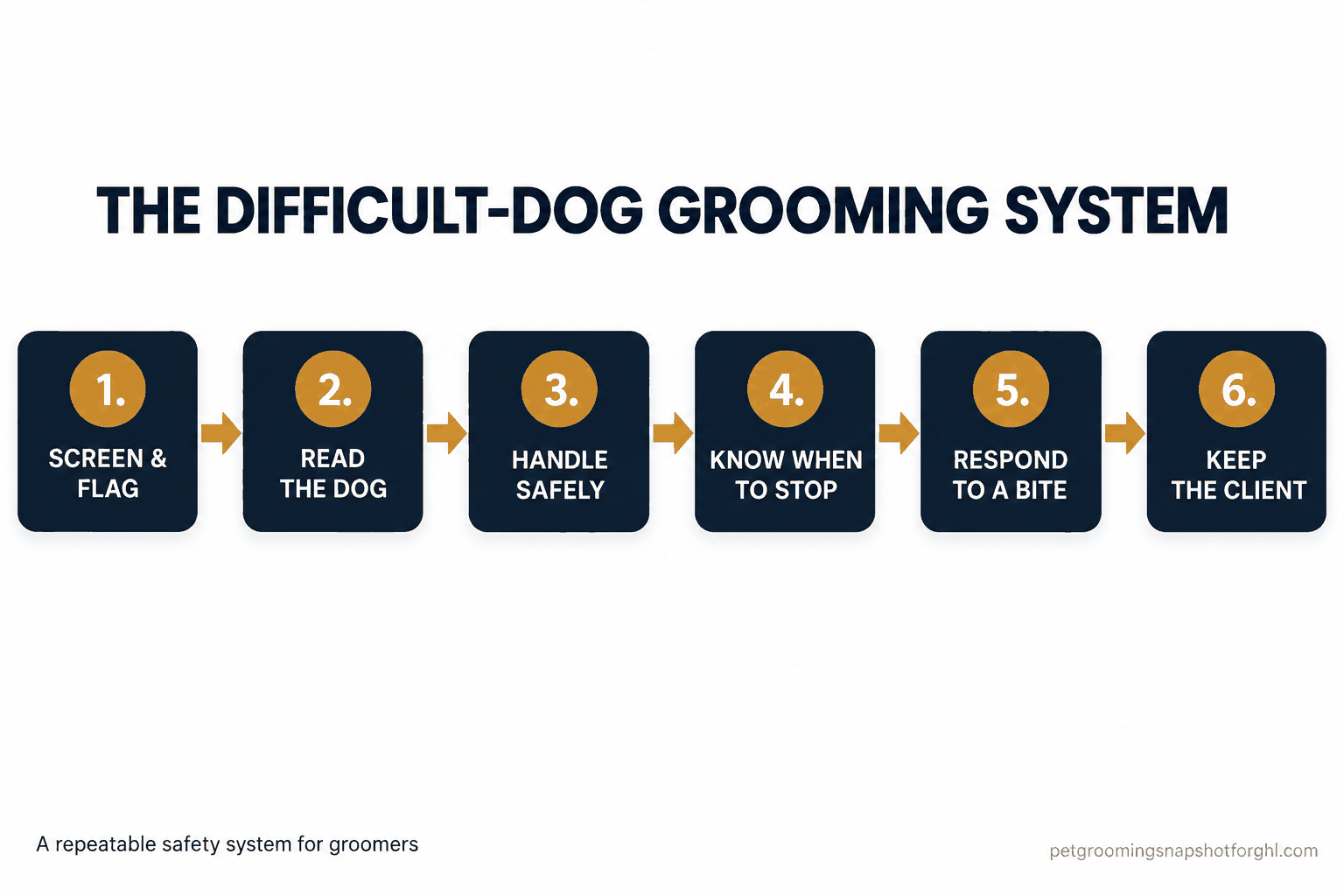
Here is the answer up front. You do not have to choose between safety and keeping the booking. You handle a difficult dog with a system: screen before you book, read the dog the second it walks in, muzzle and get a second set of hands without apology, stop the moment it stops being safe, and document everything. This guide walks the whole path, the failure points, and the liability facts that decide how bad the bad days get.
Key Takeaways
- A bite is a business risk, not just a bad day. US insurers paid $1.57 billion in dog-related injury claims in 2024, per Triple-I and State Farm, at an average of $69,272 a claim.
- Screen before you book. Two intake questions, a bite history and how the dog handles feet and nails, surface the risk before the dog is on your table.
- The dog tells you first. Whale eye, a frozen body, lip licking, and a hard stare come before teeth. The AKC lists these stress signals plainly.
- Muzzle and stop rules are the job, not cruelty. A basket muzzle and a firm stop rule protect the dog and you.
- Keep the client with honesty. A calm call explaining what happened keeps most owners. Hiding a bite loses them and can cost far more.
What This Guide Covers
- Why a biting dog is a business problem
- Stage 1: Screen and flag before the dog arrives
- Stage 2: Read the dog the moment it arrives
- Stage 3: Handle safely on the table
- Stage 4: Know when to stop the groom
- Stage 5: When a dog actually bites
- Stage 6: Keep the client, or let them go
- Steal this: the difficult-dog scripts
- Solo van, salon, and multi-van fleet
- The liability, insurance, and licensing facts
- Objections
- FAQ
Why a biting dog is a business problem
Dog bites are common, and groomers sit in the blast radius. The CDC estimates about 4.5 million dog bites happen in the US each year, and roughly 800,000 need medical care. You spend your day with your hands inches from teeth, holding the paws and ears most dogs guard. A career groomer will get bitten. The question is how often, how badly, and whether it costs you a client or a claim.
The money side is not small. In 2024, US insurers paid out $1.57 billion on dog-related injury claims, per the Insurance Information Institute and State Farm, and the average claim jumped to $69,272, up about 86 percent over the decade.
The average dog-injury claim has climbed steadily, which is why your process matters more every year.
Average cost per US dog-related injury claim, dollars. The ~2014 figure is derived from Triple-I’s reported 86 percent rise over the decade. Source: Insurance Information Institute / State Farm, 2024 data.
There is a body cost too. A serious hand bite can put a solo groomer out of work for weeks.
Stage 1: Screen and flag before the dog arrives
Most bites are predictable, and prediction starts at booking. Before the dog is ever on your table, you want two things: whether it has a bite history, and how it handles the parts dogs hate most, nails and feet. Ask both on the booking form (the exact wording is in the scripts below). Owners tell the truth when you ask early, before a dog is on the table and there is pressure to downplay.
A “yes” does not mean you refuse the dog. It means you prepare. Flag the pet record so the note follows the dog to every future appointment and every groomer. Then set expectations in the confirmation: say warmly that you may use a muzzle, may need extra time, and may reschedule if the dog is having a hard day. That tells a defensive owner a muzzle is standard, not an insult, and documents that they agreed.
How it breaks, and the fix. No screening means every difficult dog is a surprise, and a flag that lives only in your head vanishes the day someone covers your book. Make the two questions required fields, store the flag on the pet record, and tie the muzzle note to the confirmation text.
Stage 2: Read the dog the moment it arrives
The dog will tell you it is about to bite, if you are watching. Bites almost never come out of nowhere. They come after a ladder of warnings a busy groomer misses because their hands are full and their eyes are on the coat. The AKC lists the stress signals clearly: whale eye, where the dog shows the whites of its eyes, lip licking with no food, yawning when not tired, a stiff or frozen body, pinned-back ears, and a hard, still stare. ASPCA guidance on canine body language walks the same ladder, from discomfort to a freeze to a snap. A freeze is the loudest warning: a dog that goes completely still is not calming down, it is deciding.
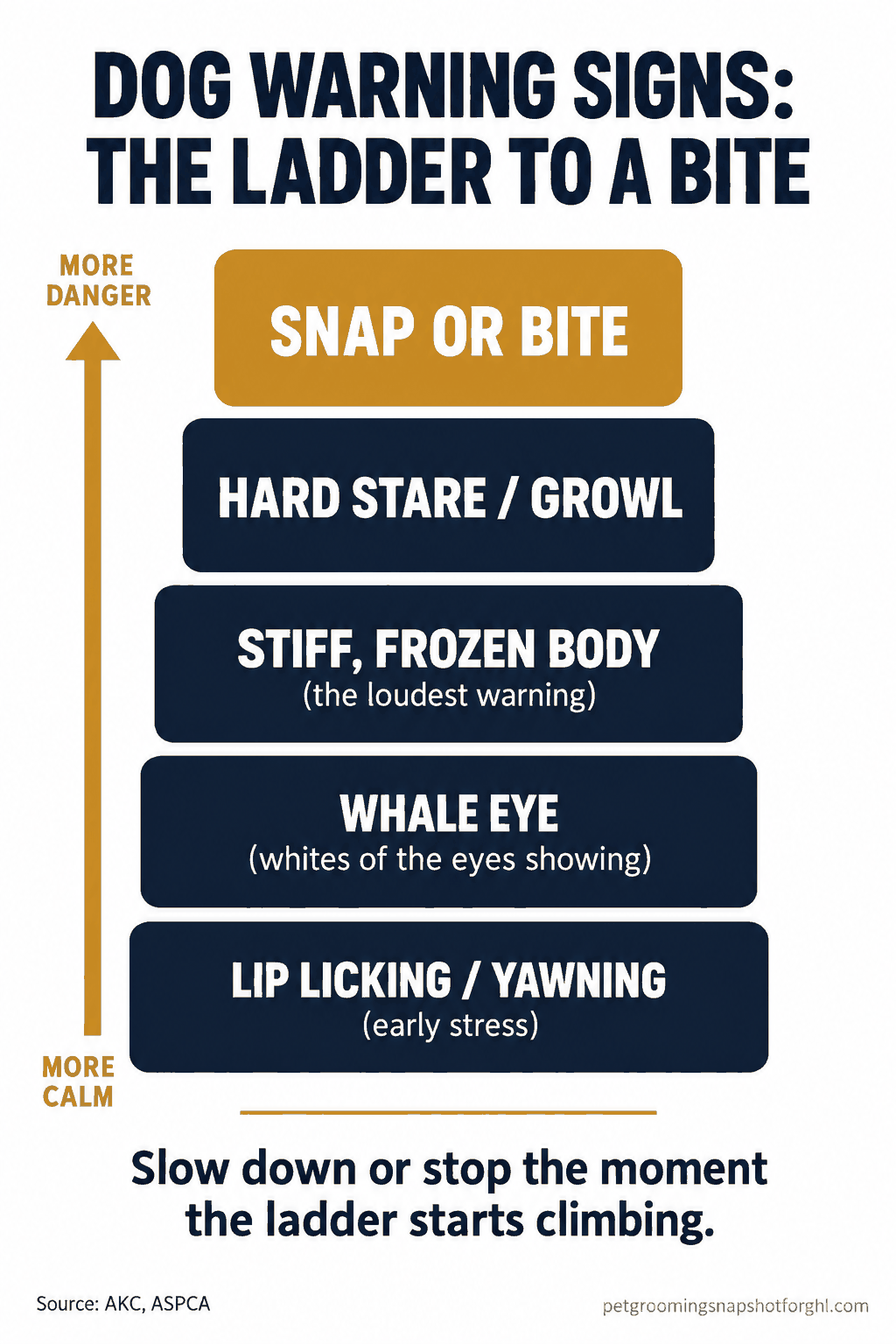
Watch at three moments: when the owner hands the dog over, when you lift it to the table, and every time you move to a sensitive area. Under time pressure, groomers tune out the early signals and only notice at the growl. Build a two-minute settle into every flagged dog’s groom.
Stage 3: Handle safely on the table
For a dog that guards its feet or has a bite history, the tools are not optional: a properly fitted basket muzzle, a grooming loop so the dog cannot leap or hang, a non-slip surface, and a second set of hands for the hard parts. A basket muzzle lets the dog pant, breathe, and take a treat, which a fabric sleeve does not, so it is the safer and kinder choice.
Handling is also sequence and pace: do the parts the dog tolerates first, save feet and face for when you have help, and take breaks before the dog needs one. That is the core of the Fear Free grooming approach, a certification launched in 2016 that trains groomers to use desensitization and choice instead of force. A calm dog is a safe dog.
How it breaks, and the fix. Skipping the muzzle “because he seemed fine today” is the classic famous-last-words bite, because fine this minute is not fine when you touch the back paw. Muzzle every flagged dog for the known trigger, and let it earn a lighter approach over many visits.
Stage 4: Know when to stop the groom
The hardest skill is stopping. A dog escalating past your ability to keep it safe does not get finished today, and you are not failing when you stop. Set a clear stop rule: we stop when the dog can no longer be handled safely, even with a muzzle and a second person. When you hit that line, secure the dog, tell the owner plainly, finish what you safely can (many dogs accept a bath but not a full trim), and offer a plan: a shorter goal next time, a vet-prescribed calming aid, or a referral for sedated grooming. Charge for the time you spent. Groomers push past this line to avoid the awkward conversation, and that is exactly when bites happen. Decide your stop rule in daylight, not with your adrenaline up. A stopped groom costs one appointment. A bad bite can cost a client, a claim, and your ability to work.
Stage 5: When a dog actually bites
Sometimes you do everything right and still get bitten. Have a plan so you are not improvising while bleeding. Secure the dog so it cannot bite again, wash and treat the wound, and get medical attention for anything more than a shallow nick. Then document it while fresh: what you were doing, what the dog did, the warning signs, who was present, and photos.
Tell the owner the same day, calmly and factually. Do not assign blame and do not hide it. If the bite broke skin on a person, know your local rules, because many jurisdictions require a bite report and a rabies observation period. The dog is not “bad,” and the owner is not the enemy.
How it breaks, and the fix. The instinct is to downplay a bite to keep the peace, but an undocumented one turns into a fight later. Fill out the incident form every time.
Stage 6: Keep the client, or let them go
Most owners of difficult dogs know it, and they are braced for you to fire them. Handle a hard groom or even a bite with calm honesty and you become the groomer who did not give up on their dog, a client for life. The move is a straight, warm conversation: here is what happened, here is what I did, here is what we change so [Pet] is safe next time.
Sometimes the right answer is to stop working with a dog. If it is a genuine danger even with every precaution, say no, kindly, and refer the owner to a vet or a groomer set up for sedated grooming. Firing a client is not a failure of nerve, it is a limit that protects your hands, your team, and your business. The trap is the middle ground: groomers either ghost the client, which invites a bad review, or keep taking a dangerous dog out of guilt until someone gets hurt. Decide which dogs you can safely serve, and hand the owner a real next step.
Steal this: the difficult-dog scripts
Lift these and fill in the brackets.
The intake screening questions (put these on the booking form):
- Has [Pet] ever bitten, snapped at, or tried to bite a person or animal?
- How does [Pet] handle having his nails trimmed and his paws, face, and tail touched?
- Anything else we should know to keep [Pet] safe and comfortable?
The flagged-dog confirmation text (set expectations before arrival):
Hi [Name], we’re set for [Pet] on [day] at [time]. Because [Pet] can be nervous about [nails/feet], we may use a soft basket muzzle and take extra breaks to keep him safe and calm, this is normal and for his comfort as much as ours. If he’s having a hard day we’ll call first. See you [day]!
The post-bite call (same day, factual):
Hi [Name], I want to let you know [Pet] nipped me during his nail trim today when I touched his back paw. I’m okay, I’ve cleaned it up, and [Pet] is fine, he was just scared. I’d love to keep working with him with a muzzle and a slower plan. Can we talk about what that looks like?
Pair these with your full library of grooming SMS templates, and price the extra work with a handling fee from your breed-and-coat pricing grid.
Solo van, salon, and multi-van fleet
The system is the same at every size. What changes is who has your back and how the flags travel.
The solo mobile groomer, one van. You are alone in a small box with the dog, the highest-risk setup in grooming. No second set of hands means your stop rule has to be stricter, not looser. Screen hard, muzzle early, and never talk yourself into finishing an escalating dog because rescheduling costs you a stop. Keep an incident form and a first-aid kit in the van, and build the extra time a flagged dog needs into your route-smart booking.
The 1-to-3 chair salon, 2 to 4 staff. Your advantage is a second person, so use it. Make it a rule that flagged dogs get help for feet and face, no exceptions, and that everyone reads the same body-language ladder. Keep flags on shared pet records, not in one person’s memory.
The multi-van fleet, 2 to 6 vans. Your risk is inconsistency. One van muzzles and documents, another skips it, and you cannot see the gap until someone gets hurt. Standardize the whole system and require the incident report every time. A dog that bit in one van needs flagging in every van. This is the discipline behind a well-run shop rather than a booked-solid-but-broke one.
The liability, insurance, and licensing facts
Three honest notes so you handle the risk with your eyes open.
First, insurance. Carry your own business liability, and workers’ comp if you have staff. Do not assume the owner’s homeowner policy has you covered. Those policies typically cover dog-bite liability up to $100,000 to $300,000, but that is the owner’s exposure, not yours.
Second, waivers. A signed grooming release stating the dog may be muzzled, that you may stop for safety, and that the owner disclosed any bite history documents that they understood the risk. It will not shield you from true negligence, but it turns a vague dispute into a signed agreement. If you text clients, your consent language also has to match our texting and waivers guide.
Third, licensing, because the internet is full of wrong information here. Almost no US state licenses individual groomers, so there is no personal grooming license to worry about. A few states regulate grooming facilities or their staff, not the person: Connecticut licenses grooming facilities and their staff through its Department of Agriculture, and Colorado licenses facilities under its Pet Animal Care and Facilities Act, again the facility. New Jersey’s “Bijou’s Law,” a bill to license individual groomers, has been reintroduced since about 2014 and never enacted. Check your state and city for a facility or business rule, but do not believe anyone who says your state licenses you personally as a groomer.
Objections
“Won’t a muzzle upset the owner and make me look like I can’t handle dogs?” The opposite, when you frame it right. A calm “this is routine, it keeps [Pet] safe,” set in the confirmation a day early, reads as professional, and it beats getting bitten because you did not want to seem soft.
“If I turn a dog away, won’t I lose the client and get a bad review?” You lose more by getting hurt or hurting a dog than by an honest, kind decline with a real referral. Bad reviews come from surprise and silence, not from a groomer who was straight.
“Isn’t getting bitten just part of the job?” Small nips, sometimes. But a serious bite that costs you weeks of work or lands in a claim is not something to shrug at, not in a trade where the median groomer earns about $35,800 a year. For a solo operator, one $69,272-average claim or a hand injury can end a one-van business. Treating every bite as preventable is how career groomers keep working.
FAQ
How do you groom an aggressive dog safely?
Screen for a bite history at booking, flag the pet record, and set expectations before arrival. On the day, read the dog's stress signals, use a basket muzzle and a second set of hands for triggers like nails and feet, take breaks early, and stop the moment the dog can no longer be handled safely. The goal is a calm, predictable process, not forcing a scared dog through a groom.
What are the warning signs a dog is about to bite?
Dogs climb a ladder of stress signals first. The AKC and ASPCA list whale eye (the whites of the eyes showing), lip licking with no food, yawning when not tired, a stiff or frozen body, pinned-back ears, and a hard, still stare. A full freeze is the loudest warning: a dog that goes completely still is deciding, not calming down. Slow down or stop the moment the ladder starts climbing.
Should I use a muzzle when grooming a difficult dog?
Yes, a basket muzzle for known triggers like nails or feet. It lets the dog pant, breathe, and take treats, unlike a fabric sleeve muzzle, so it is both safer and kinder. A muzzle prevents a bite, but it is never permission to force a terrified dog through a groom. If a muzzled dog is still fighting every second, stop.
What should I do if a dog bites me while grooming?
Secure the dog, clean and treat the wound, and get medical attention for anything more than a shallow scratch, since bite wounds infect fast. Document it the same day: what you were doing, the warning signs, who was present, and photos. Tell the owner calmly, and check your local rules, since many places require a bite report and a rabies observation period.
Can I refuse to groom an aggressive dog?
Yes. If a dog is a genuine danger even with a muzzle and a second person, decline kindly and refer the owner to a vet who offers sedated grooming or a groomer set up for it. Firing a client is a limit, not a failure, and it protects your hands, your team, and your business.
Related Reading
- Booked Solid but Broke: Why a Full Grooming Schedule Isn’t Making You Money
- How to Price Dog Grooming by Breed and Coat Type
- How to Cut Grooming No-Shows (Without Nagging Pet Parents)
- 12 SMS Templates Every Grooming Salon Should Steal
- Texting Grooming Clients in 2026: A2P 10DLC, Consent, and Waivers