
It is 7:50 on a Saturday and the doodle on your table is worse than the owner let on. The coat is pelted to the skin and the only humane move is to take it short. You text a photo. No reply. You make the call any groomer makes and shave the dog. At pickup the owner sees a different dog, spots a small nick over a hidden skin tag, and the word “lawyer” comes out before the leash is clipped on. You did everything right. You just have nothing on paper that says so.
Here is the short version. A grooming intake form is the cheapest insurance you will ever buy. It costs a signature and it decides who holds the risk when a groom goes sideways: it captures health and vaccination status, records the owner’s disclosures about behavior and matting, gets consent for the photos and texts you already send, and documents that the client agreed to the real risks of grooming a difficult animal. This guide walks every section with copy you can lift, tells you where each breaks, and answers whether a waiver holds up in court.
Key Takeaways
- The intake form is documented consent, not busywork. Its job is to put the client’s own disclosures and agreement in writing before a blade touches the dog.
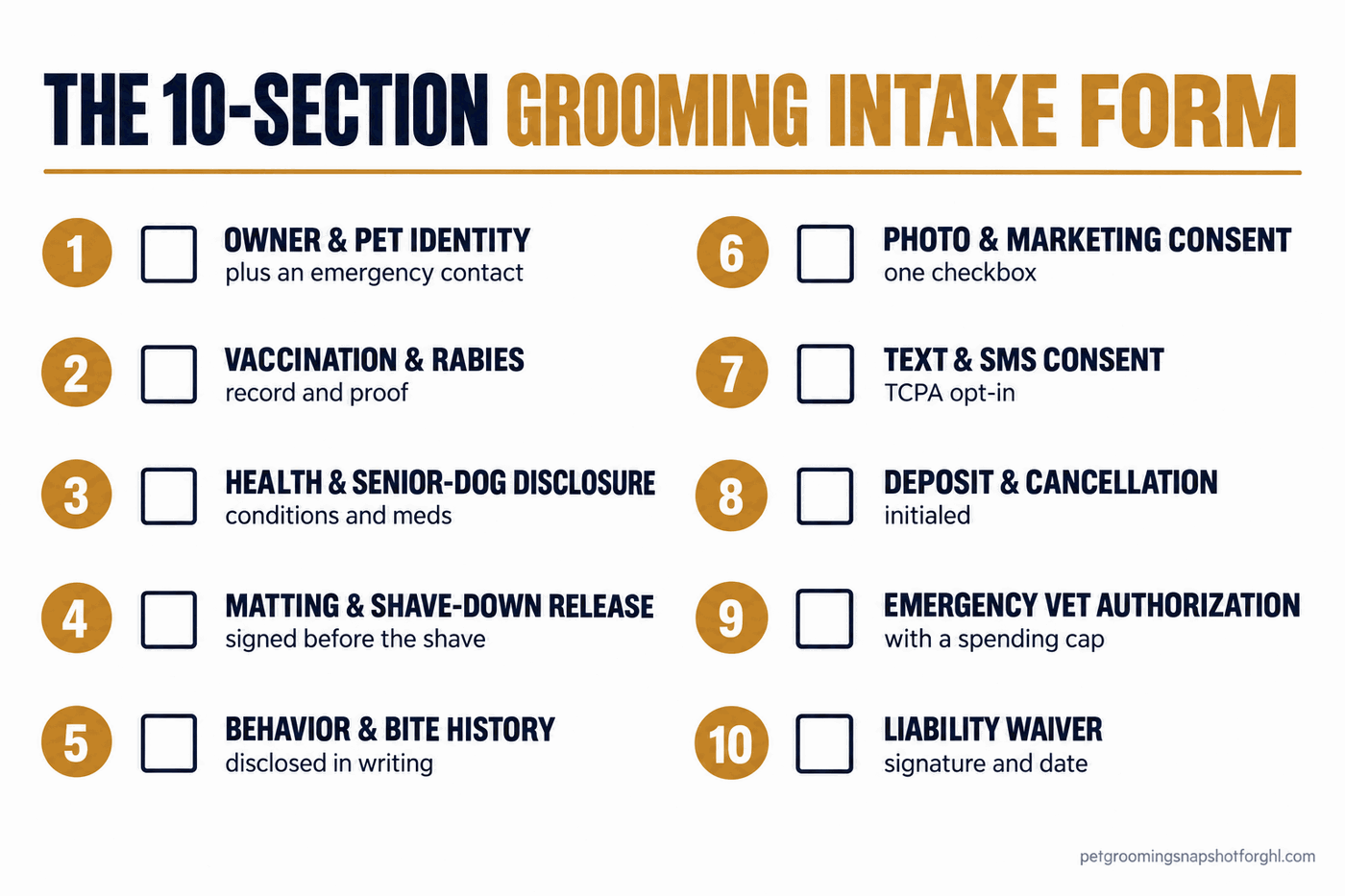
- Ten sections carry the weight: owner and pet identity, vaccination, health and senior-dog disclosure, matting release, behavior and bite history, photo consent, text consent, deposit and cancellation, emergency vet authorization, and the waiver with a signature and date.
- Get the matting release signed before you shave, not after. A release signed at pickup, once the owner has seen the result, is close to worthless.
- A waiver helps but does not make you bulletproof. It documents informed consent, never excuses gross negligence, and enforceability varies by state, so have a local attorney review it.
- Insurers paid $1.86 billion on dog-related injury claims in 2025. The form keeps a bad afternoon from becoming your liability.
- Almost no state licenses individual groomers. A few license the facility. Your intake form, not a license, is your main line of defense.
What this guide covers
- What a missing form actually costs you
- The ten sections every intake form needs
- Section by section, with copy to steal
- Does a grooming waiver actually hold up?
- How the intake form breaks
- Solo van, salon, and multi-van fleet
- Objections
- FAQ
What a missing form actually costs you
Start with the number. Insurers paid about $1.86 billion on dog-related injury claims in 2025, per the Insurance Information Institute and State Farm, up 18.6 percent in a year across 28,450 claims. Those are mostly homeowners claims, not groomer claims, but the point stands: dogs cause expensive, litigated injuries, and you handle other people’s dogs all day.
Dog-related injury liability claims paid by US insurers, in billions. Source: Insurance Information Institute and State Farm, 2025.
Three disputes eat most of a groomer’s year, none needing a courtroom: the matting job, where a pelted coat comes off short and the owner is furious or blames you for a nick found under the mats; the senior dog, where a sick or elderly animal struggles with the groom and the owner points at you; and the plain refund demand, the “you cut my dog,” where there is no real injury but a confident customer and no record of what was agreed.
The industry keeps adding first-time clients who have never signed anything, with US pet spending at $158 billion in 2025, projected at $165 billion in 2026 per the American Pet Products Association, and animal care jobs projected to grow 11 percent through 2034. A signed form turns your word against theirs into a document they signed, agreeing to the exact thing they are now upset about.
The ten sections every intake form needs
Every section below defends against a specific, common dispute, mapped to the risk it takes off your plate.
| Section | What it defends against |
|---|---|
| Owner and pet identity, emergency contact | Reaching someone fast when a decision cannot wait |
| Vaccination and rabies status | The bite that becomes a public-health problem |
| Health and senior-dog disclosure | The pre-existing condition blamed on your groom |
| Matting and shave-down release | The “why is my dog shaved” and hidden-nick dispute |
| Behavior and bite history | The bite your staff takes from an undisclosed biter |
| Photo and marketing consent | A privacy complaint over a before/after post |
| Text and SMS consent | A consent complaint over your reminder texts |
| Deposit, cancellation, late pickup | The no-show and the dog left until 7pm |
| Emergency veterinary authorization | The call you cannot reach the owner to make |
| Liability waiver, signature and date | Documented, informed consent to the real risks |
Section by section, with copy to steal
This is the part to bookmark. Each sample is a starting point, not legal advice, so have an attorney confirm it for your state.
1. Owner and pet identity, plus an emergency contact. Full name, phone, email, address, and a second contact who can decide if you cannot reach the owner. For the pet: name, breed or mix, age, weight, spay or neuter status, and the vet’s name and number.
2. Vaccination and rabies status. Ask for the rabies vaccination date at minimum, and the vet record on a first visit. If a dog bites a person during a groom and its rabies status is unknown, you have turned a nip into a public-health event with quarantine rules attached, which is what the CDC’s guidance on rabies and animal bites is about.
3. Health and senior-dog disclosure. Ask about medical conditions, medications, allergies, seizures, heart or breathing issues, and any lumps or sensitive spots. Add a specific senior acknowledgment, usually from around age eight or ten, because an older or compromised dog can struggle with the handling, dryer, and standing. You are not diagnosing anything, just recording what the owner tells you, so a pre-existing condition does not become your fault.
4. Matting and shave-down release. This is the most important clause in the form, and the one most groomers get signed too late. A severely matted coat often cannot be brushed out without hurting the dog, so the humane choice is to clip it short with a blade that runs close to the skin. That close work is exactly where nicks happen and where moles and skin folds hidden under the mats get caught. Get it signed before you start.
Charging a matting or de-shed surcharge? Line it up with your pricing by breed and coat type so the fee is no surprise.
5. Behavior and bite history. Ask it plainly: has your pet ever bitten, snapped, or shown aggression, and is there anything that frightens it. Owners minimize this constantly, and an undisclosed biter is how a groomer ends up in urgent care. The disclosure protects your staff and it protects you, because a client who wrote “no history of biting” cannot credibly blame you for muzzling a dog that lunged.
See also how to handle an aggressive or biting dog without losing the client.
6. Photo and marketing consent. You post before-and-after shots, but some owners do not want their pet online. One checkbox settles it.
7. Text and SMS consent. You text constantly: confirmations, reminders, “your dog is ready,” rebooking nudges. Under the Telephone Consumer Protection Act, how you collect the number decides whether you are allowed to text it, with statutory damages that start at $500 per message under 47 U.S.C. 227. The form is the natural place to capture that consent, once.
Texting has its own rulebook beyond this line, in the full breakdown of A2P 10DLC registration, consent, and waivers for groomers.
8. Deposit, cancellation, and late pickup. This is where your money policy gets acknowledged, not just posted on a wall. State the deposit, the cancellation window, the no-show charge, and the late-pickup fee, and have the client initial it.
No policy worth acknowledging yet? Build one with a deposit and cancellation policy clients actually follow.
9. Emergency veterinary authorization, with a spending cap. If a dog has a medical emergency on your table and you cannot reach the owner, you need written permission to act and a dollar figure so you are not guessing. It saves dogs, and saves groomers a fight about the bill.
10. The liability waiver, signature, and date. The waiver clause pulls the form together into informed consent, and the client signs and dates it. Keep it specific and honest. Do not try to waive gross negligence, because courts generally will not enforce that anyway and an overreaching waiver reads as a red flag.
Now the question every groomer wants answered.
Does a grooming waiver actually hold up?
Straight answer: a well-written waiver helps, but it is not a shield. Think of it as documented, informed consent. When a senior dog with a heart condition stresses on the table, a specific signed release shows the client knew the risks and agreed to reasonable professional judgment. That is the difference between a defensible position and no position at all.
What makes a waiver more likely to stand up is boring and consistent. It is signed before the service, not at pickup. It names the real risks in plain language, so the consent is informed rather than buried. It does not try to waive gross negligence, which most courts will not enforce. And it is specific, which is why the matting release and behavior disclosure matter so much: they tie the signature to the exact dispute.
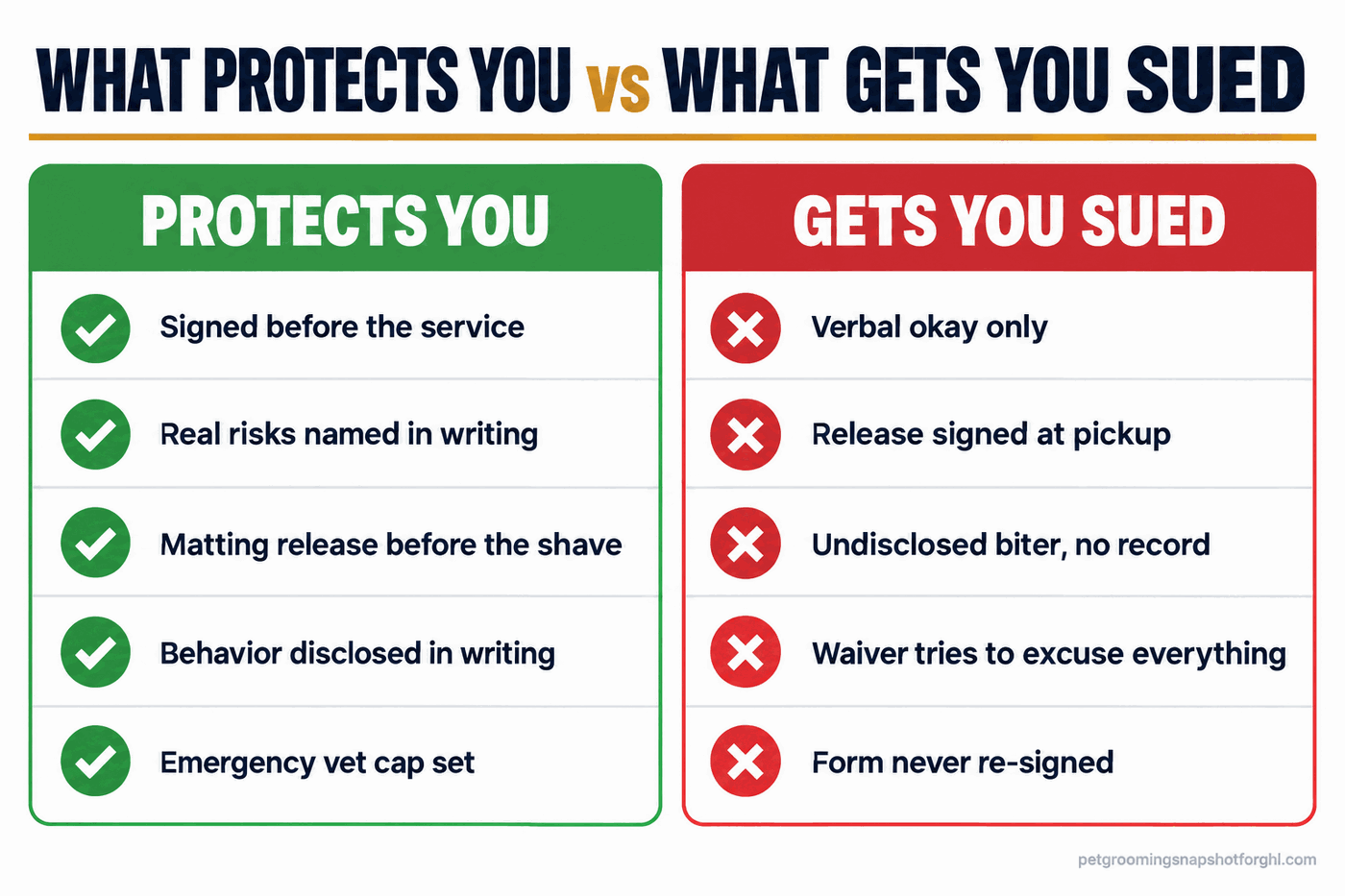
Two honest caveats. First, enforceability varies by state, so this is the one place you want a local attorney on your exact wording. Second, a groomer is still expected to meet a reasonable standard of care. The waiver documents consent to the inherent risks of the job. It does not give you permission to be careless.
Here is what the form, not a license, does for you. Almost no US state licenses individual groomers. A few license the facility instead, like Connecticut through its Department of Agriculture and Colorado under its Pet Animal Care and Facilities Act. No personal credential proves you handled a dog responsibly, so your signed intake record is the closest thing you have. This is not legal advice, so treat every sample here as a draft for counsel.
How the intake form breaks
Here is how a good form turns into a false sense of security.
The release signed at pickup. A matting release the owner signs after seeing the shaved result is close to worthless, because the point is consent before the risk is taken. Get it signed before the blade comes out, every time.
The verbal disclosure that never made it to paper. The owner mentions on the phone that the dog “gets a little nippy,” and nothing is written down. If it is not on the form in their hand, it did not happen as far as a dispute is concerned.
The form that is three years old. A dog that was calm at two can be arthritic and anxious at nine. A form signed once, forever, stops reflecting the animal in front of you. Re-sign annually, and any time the pet’s health or behavior changes.
The paper form nobody can find. A signed waiver that lives in a drawer is a waiver you cannot produce when you need it. Digital capture with a timestamp and a typed signature solves the “prove it” problem paper creates.
Solo van, salon, and multi-van fleet
The ten sections are the same at every size. How you run them is not.
The solo mobile groomer, one van. Go digital from day one. Send the form as a link at booking so it is signed before you pull up, and re-send it once a year. Your risk is larger than a salon’s, not smaller, because you are often alone with the dog, so the emergency vet and behavior clauses carry extra weight.
The 1-to-3 chair salon, 2 to 4 staff. Your problem is consistency. Every groomer has to pull the same form and refuse to start without it, because one person waving clients through undoes the system. Centralize the records so anyone can see the matting and behavior notes on a dog they have never handled, and make check-in the moment the form gets signed.
The multi-van fleet, 2 to 6 vans. You are running a process now, not a form. Standardize one digital form across every van so a client who books with any van is on file once, and audit that each active client has a current one. The fix at this scale is one owned system, the logic behind choosing one owned platform over per-seat software as you grow.
Objections
“My clients will hate filling out a form.” Not if it is short, digital, and arrives before the appointment. What clients hate is a surprise fee or a shaved dog they did not expect, and the form prevents both by setting expectations. A two-minute link beats a ten-minute argument.
“I’ve groomed for fifteen years and never needed one.” You have never needed it the way you have never needed the fire extinguisher in the van. It is cheap and quiet until the one afternoon it is the only thing between you and a refund demand, a chargeback, or worse. Fifteen clean years is luck, not evidence.
“Isn’t a verbal okay enough?” No. A verbal agreement is real, but it is your word against theirs, and at pickup an upset owner remembers it differently. A signature is a record that does not depend on anyone’s memory of a hard moment.
“Do I need to pay a lawyer for this?” Have one review your final wording. It is worth the one-time cost, because enforceability is a state question and a template off the internet was not written for your state.
FAQ
What should a dog grooming intake form include?
Owner and pet identity with an emergency contact, vaccination and rabies status, a health and senior-dog disclosure, a matting and shave-down release, a behavior and bite-history disclosure, photo and text consent, your deposit and cancellation policy, emergency veterinary authorization, and a liability waiver with a signature and date.
Does a pet grooming liability waiver actually hold up in court?
A specific, signed waiver can help, but it is documented consent, not a shield. It does not excuse gross negligence, and enforceability varies by state, so have a local attorney review it. It works best signed before the service and tied to the risks disclosed on the form.
When should the matting release be signed?
Before you start, never at pickup. The point is to record informed consent to a shave-down and its risks before you take the coat off. A release signed after the owner sees the result carries almost no weight.
Do I need to collect vaccination records?
At minimum, record rabies status, and ask for the vet record on a first visit. If a dog bites someone and its rabies status is unknown, you have a public-health problem with quarantine rules, so this section is not optional.
Can I use one intake form for every client?
Yes, use one standardized form, but re-sign it at least once a year and any time a pet's health or behavior changes. A form signed once years ago no longer describes the animal in front of you, and digital capture gives you a timestamp and a record you can actually find later.