
Someone in a mobile grooming Facebook group asks what software to run the van on, and two names come back fast: MoeGo and Time To Pet. You open both pricing pages in two tabs and within a minute you are more confused than when you started. One talks about vans and routes. The other talks about visits and dog walks. The prices do not line up, and nobody notices they are recommending two tools built for different jobs.
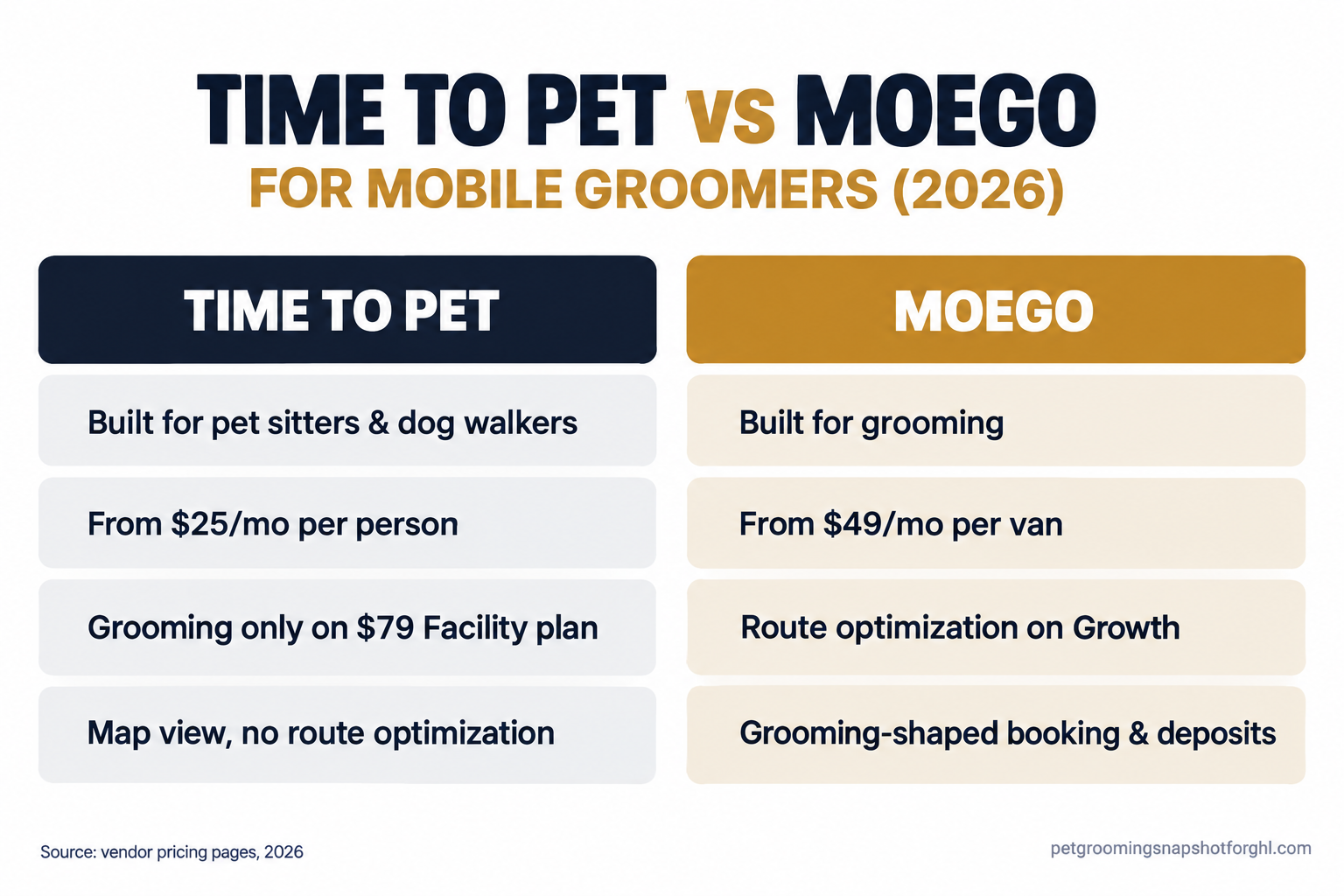
Here is the short answer first. MoeGo is grooming software, priced per van, with real route optimization and reminder texting built around a groom. Time To Pet is pet-sitting and dog-walking software, now owned by DaySmart, and grooming only shows up on its top Facility tier. For a van that grooms all day, MoeGo fits the work and Time To Pet mostly does not, unless you also sit or walk dogs. Below is the real 2026 pricing from both pages, the eight things that decide it, and which one is right for a solo van, a groomer who also sits, and a small fleet.
Key Takeaways
- They are built for different jobs. MoeGo is grooming-first and sold per van. Time To Pet is pet-sitting and dog-walking software, with grooming only on its $79 Facility plan. Compare fit before price.
- MoeGo starts at $49 a van, Time To Pet at $25 a person. On paper Time To Pet looks cheaper, but the plan a groomer needs is not the $25 one.
- Routing is the real split. MoeGo adds genuine route optimization on its $99 Growth plan. Time To Pet gives you a map view, not a tool that reorders your day to cut driving.
- Texting is capped on both, and A2P 10DLC sits on top. MoeGo Basic includes 200 texts a van. Reminder and pickup texts need carrier registration whichever tool you pick.
- Time To Pet makes sense if you also sit or walk. A groomer who walks or boards dogs gets more from it than a pure-grooming van does.
What This Comparison Covers
- Why these two keep getting compared (and why that is a trap)
- What Time To Pet and MoeGo actually cost in 2026
- The eight things that actually decide it
- What each type of operator should do
- How this choice goes wrong
- Steal this: the trial questions and the texts that fill a van
- Common objections
- FAQ
Why These Two Keep Getting Compared (and Why That Is a Trap)
Both tools serve people who drive to the pet, which is why they land in the same thread. A mobile groomer and a dog walker both live out of a vehicle, text clients all day, and hate paperwork, so the software for one gets recommended to the other and the labels blur. They should not. MoeGo is grooming software, built around a groom: booking a service by breed, blocking the right van time, taking a deposit, and nudging a rebooking on the dog’s coat cycle. Time To Pet describes its core plans as being “for pet sitters, dog walkers, pooper scoopers, and other professionals” who serve clients at home. Its strengths are visit scheduling, walker GPS tracking, visit report cards, and recurring routes. Grooming is not the center of that product. It appears only on the Facility tier, with boarding and daycare.
There is an ownership wrinkle too. In February 2024, DaySmart acquired Time To Pet. DaySmart also owns DaySmart Pet, the grooming tool formerly called 123Pet, which we tore down in what a grooming shop actually pays for DaySmart Pet. So inside one company you have a pet-sitting product (Time To Pet) and a grooming product (DaySmart Pet). That tells you where the grooming muscle lives, and it is not in Time To Pet.
What Time To Pet and MoeGo Actually Cost in 2026
Now the numbers, straight from each vendor’s own pricing page. Verify before you sign, because both move tiers around.
MoeGo, mobile (billed per van, per month): Basic is $49, Growth is $99, and Ultimate is $159, with a custom Enterprise tier, per MoeGo’s pricing page. Salon plans, billed per location, are reported at roughly $79, $149, and $239. Texting is capped: Basic includes 200 SMS a van, Growth 900, and unlimited automated messages only on Ultimate. Route optimization starts on Growth.
Time To Pet (billed per plan, per month): Lite is $25 for a one-person business, Solo is $50 and marked most popular, and Team is $40 base plus a per-active-staff fee (the page’s example works out near $16 a staff member). The Facility plan, the only one that lists “boarding, daycare and grooming services,” is $79, per Time To Pet’s pricing page.
So the headline “$25 vs $49” is misleading. Lite is a solo sitter’s entry point, not a grooming plan. The honest comparison for a van that grooms is MoeGo Growth at $99 against Time To Pet Facility at $79, and even then you are comparing a grooming tool against a boarding tool that also grooms. Here is what a one-van groomer who texts pays on each plan.
Monthly price by plan for a one-van operator, from each vendor’s 2026 pricing page. TTP = Time To Pet. Card processing and A2P 10DLC fees are extra on both. Prices change, so confirm before you buy.
The gap narrows once you line up the plans that can actually run a grooming van, and MoeGo’s extra money buys route optimization and grooming-shaped booking the cheaper Time To Pet plans do not include.
The Eight Things That Actually Decide It
Price is one input. Here is the full scorecard a mobile groomer should run before picking.
1. What the tool is built for
The first and biggest filter. MoeGo’s defaults (service menus, breed and coat notes, deposit rules, the rebooking nudge) all assume you are grooming a pet. Time To Pet is built for recurring visits at a client’s home, so its defaults assume a walk or a sit on a schedule. You can bend it toward grooming on the Facility plan, but you work against the grain. If the whole job is grooming, pick the tool designed for it.
2. Your day on the road (routing)
A mobile groomer’s profit leaks out the tailpipe. Minutes between stops are unpaid, and fuel is real money. MoeGo includes Smart Schedule on Basic and adds genuine route optimization on Growth, which reorders stops to cut driving. Time To Pet’s Team plan gives you a “geo schedule” map view of your day plus GPS tracking of staff, which is not the same as a tool that rebuilds your route for the least driving. For a van, this gap is worth more than the price difference. We go deeper in route-aware booking for mobile grooming.
3. Online booking and deposits
No-shows hurt a van more than a salon, because a gap in the route is an hour you cannot refill on the fly. MoeGo supports online booking with deposits and card-on-file inside the grooming flow, so a new client books and leaves a deposit in one go. Time To Pet handles client requests and invoicing well for sitting work, but deposit-gated grooming booking is not its native shape. Our deposit and cancellation policy guide has the wording that makes deposits stick.
4. Two-way texting, reminders, and A2P 10DLC
Groomers text more than almost any small business: confirmations, on-my-way texts, “your dog is ready,” and rebooking nudges. Both tools text, and both cap it on the lower tiers. MoeGo includes 200 SMS a van on Basic and 900 on Growth, with unlimited automated messages only on Ultimate. Time To Pet adds text messaging from the Solo plan up. Whichever you choose, there is a fee no pricing page quotes: A2P 10DLC carrier registration. Reminder, pickup, and promo texts are separate registered campaigns, and plenty of operators wrongly assume pickup texts are exempt. They are not, and unregistered traffic gets quietly filtered until reminders stop landing. The mechanics are in our A2P 10DLC and consent guide.
5. Client and pet records
Both tools keep solid profiles. The difference is the shape of the notes. MoeGo’s pet record is grooming-shaped: breed, coat type, last service, matting history, behavior flags for a dog that hates the dryer. Time To Pet’s is sitting-shaped: feeding instructions, medication schedules, lockbox codes, vet contacts. Ask which set of fields you will fill in every day, and pick the one that matches.
6. Payments and invoicing
MoeGo has integrated payments with card-on-file, in person and online, so a groom is charged at the van without a side app, with reported rates around 2.6% plus $0.10 in person. Time To Pet also does integrated payments and automatic charging, built for recurring sitting invoices. For one-off grooms, MoeGo’s flow is closer to how the money moves at a van.
7. Moving your data in and out
What keeps groomers stuck on the wrong tool is fear of losing years of client and pet history. Before you commit to either, find out exactly how you would export everything in CSV if you left: clients, pet notes, appointment history, and balances. A tool that makes leaving hard is telling you something. The full playbook is in switching grooming software without losing your client history.
8. Where automation and marketing stop
This is the ceiling nobody mentions on a trial. Both tools book and remind. Neither is a marketing engine. Missed-call text-back, a win-back that runs on its own, review harvesting after pickup, and Instagram or Messenger auto-replies that turn before-and-after fans into booked grooms are all past what either was built to do. That is the gap a system you own, rather than rent per van, is meant to fill.
What Each Type of Operator Should Do
The right answer changes with the shape of your business.
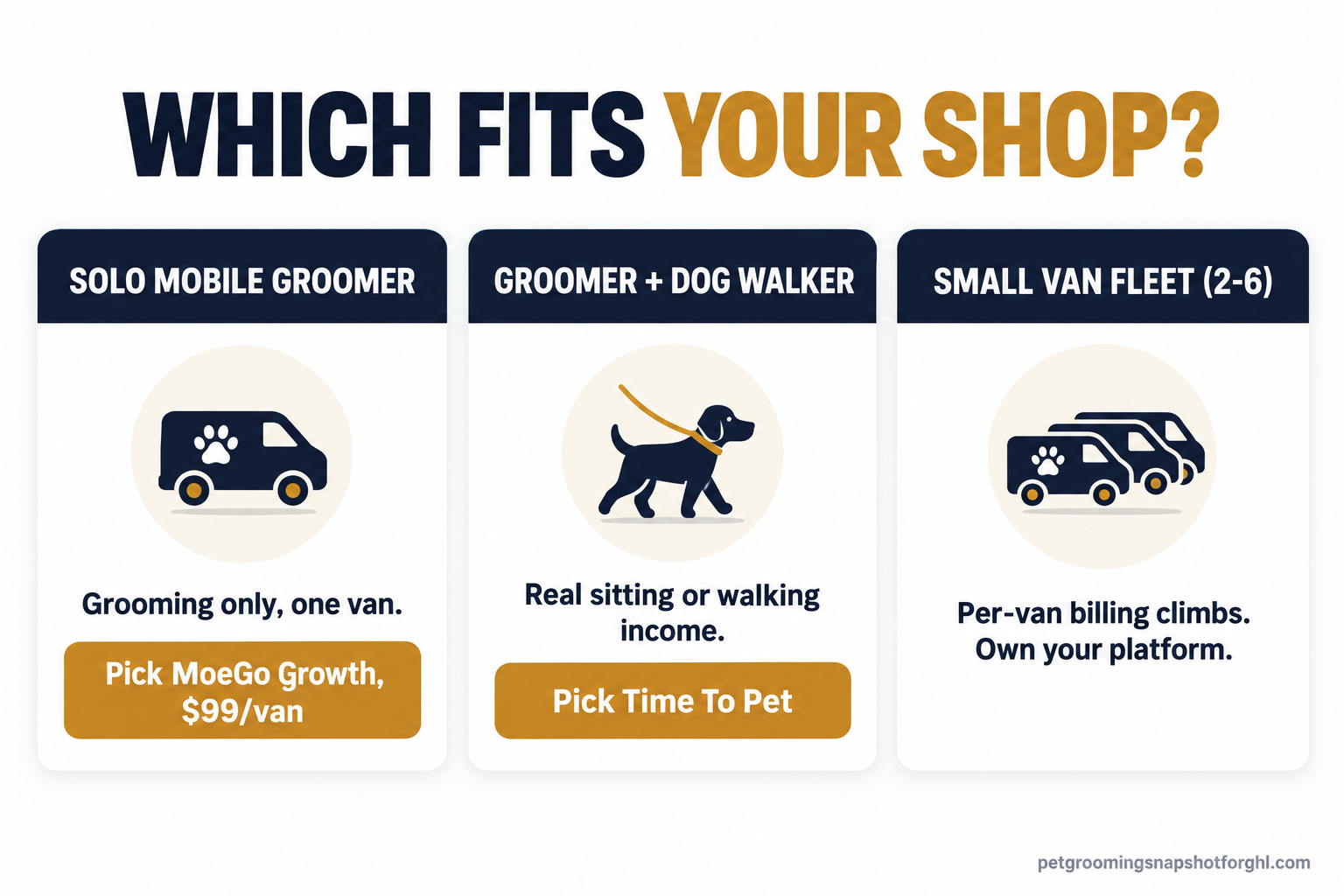
The solo mobile groomer, one van, grooming only. You groom all day and text everything. MoeGo is the natural fit: Growth at $99 a van gives you route optimization, 900 texts, deposits, and grooming-shaped records. Time To Pet’s cheaper plans look tempting, but they are sitting plans, and its grooming lives on the $79 Facility tier that is really a boarding product. If budget is the whole concern, price grooming-first tools against each other instead, the way we do in MoeGo alternatives for mobile groomers.
The groomer who also sits, walks, or boards. This is where Time To Pet earns its keep. If a real slice of your week is overnight sits, drop-in visits, or dog walks between grooms, its recurring-visit billing and GPS tracking beat MoeGo on the sitting side. Many hybrid operators run Time To Pet for the sitting book and a grooming tool for the grooms, which is fine if sitting is big enough to justify it.
The small van fleet, two to six vans. Now the billing model is the story. MoeGo charges per van, so three vans on Growth is three times $99, and the number climbs with every van you add.
MoeGo Growth monthly cost by number of vans, billed per van at $99 (MoeGo’s 2026 pricing page). Card processing and A2P 10DLC fees are extra.
At three or four vans, per-unit software is a line item that grows with the business rather than flattening out. That is where many operators stop renting per van and move booking, deposits, reminders, and rebooking onto a platform they pay for once, no matter how many vans run. The math is in our rebooking system for groomers.
How This Choice Goes Wrong
Each of these has a fix, and each has cost a real shop a month.
You buy the sitting tool for a grooming job. You pick Time To Pet because a dog-walker friend loves it and it looked cheaper, then spend three months forcing grooming into a product built for visits. The fix: match the tool to your main job first, price second. If 90% of your revenue is grooms, start with grooming software.
You pick the plan that is too small to text. You sign up for MoeGo Basic or a lower Time To Pet tier, then blow through the text cap by mid-month and watch reminders stop sending. The fix: count your real monthly texts (confirmations plus reminders plus pickup plus rebooking, times your appointments) and buy the tier that covers it. For most vans that is Growth, not Basic.
You skip A2P 10DLC and blame the software. Your reminders quietly stop landing, no-shows climb, and you assume the tool is broken. It is not. Your 10-digit number is unregistered and carriers are filtering it. The fix: register your business and separate your reminder, transactional, and marketing campaigns before you lean on texting.
Steal This: The Trial Questions and the Texts That Fill a Van
Two things are worth more than any feature chart: the questions that flush out the real cost on a trial, and the texts that keep a van full.
The trial interrogation (run it on both tools before you pick):
- What is my total monthly price with the texting volume I actually send, in writing, including any per-staff or per-van fee?
- Is route optimization included on this plan, or only a map view, and which plan adds true route reordering?
- How are deposits and card-on-file handled for a new online booking, start to finish?
- What is the card processing rate in person and online, and are there any added gateway fees?
- How does the tool handle A2P 10DLC registration and keep reminder, pickup, and promo texts separate?
- If I leave, how do I export all clients, pet notes, appointment history, and balances in CSV, and is that free?
The core text set for a mobile van (steal and adapt):
Reminder, day before: “Reminder: [pet]’s groom is tomorrow [date] at [time]. Please have [pet] ready and a parking spot clear for the van if you can. Reply R to reschedule.”
On my way: “Hi [firstname], [groomer] is on the way now and should arrive in about [minutes] minutes for [pet]’s groom. See you soon.”
Done, with photos: “All done. [pet] looked great today and was a star. Your invoice is on its way and photos are coming to your phone. Thank you for trusting us with [pet].”
Rebooking nudge, on the coat cycle: “Hi [firstname], [pet] is about due for the next groom to stay on top of the coat. Want the same day and time in [weeks] weeks? Reply YES and we’ll hold it.”
Those texts are the spine of a full book, whichever software sends them. What matters is that the reminder lands before the no-show and the rebooking nudge fires on the dog’s cycle instead of waiting for the owner to remember.
Common Objections
“Time To Pet is cheaper, so why not just use it?” The $25 Lite plan is a solo sitter’s entry point, not a grooming plan. The plan that lists grooming is Facility at $79, a boarding product. Compare like for like and the price gap mostly disappears, and MoeGo Growth still adds grooming-shaped booking and route optimization the cheaper tiers do not.
“I do grooming and a bit of dog walking, so which one?” If walking or sitting is a real part of your income, Time To Pet is better at that side, and some hybrid operators run both tools. If walking is an occasional favor and grooming pays the bills, pick the grooming tool and do not over-engineer the sitting.
“Is MoeGo not just a booking calendar? I need marketing too.” That is the honest limit of both. They book and remind. Neither runs missed-call text-back, automated win-back, review harvesting, or social DM replies. For that you want a system that owns the whole follow-up, not a booking tool with marketing bolted on. See the math on our pricing page.
FAQ
Is Time To Pet good for mobile groomers?
Only partly. Time To Pet is built for pet sitters and dog walkers, and grooming appears only on its $79 Facility plan, which is really a boarding and daycare product. A pure grooming van is better served by grooming-first software like MoeGo. Time To Pet fits only if sitting or walking is a real part of your week.
How much does MoeGo cost for a mobile groomer in 2026?
MoeGo's mobile plans are billed per van per month: Basic at $49, Growth at $99, and Ultimate at $159, with a custom Enterprise tier, per MoeGo's pricing page. Route optimization starts on Growth, and texting is capped at 200 messages a van on Basic and 900 on Growth.
How much does Time To Pet cost in 2026?
Time To Pet lists Lite at $25 a month for one person, Solo at $50, Team at $40 base plus roughly $16 per active staff member, and Facility at $79, per its pricing page. Grooming services are listed only on the Facility plan.
Did DaySmart buy Time To Pet?
Yes, in February 2024. DaySmart also owns DaySmart Pet, formerly 123Pet, a grooming tool. So within one company, Time To Pet covers pet sitting and dog walking while DaySmart Pet covers grooming, a useful signal about where the grooming features live.
Which has better routing for a mobile grooming van?
MoeGo. It includes Smart Schedule on Basic and adds true route optimization on Growth, which reorders your stops to cut driving. Time To Pet offers a geo schedule map view and staff GPS tracking on its Team plan, which shows your day on a map but does not rebuild your route.
Do I need A2P 10DLC registration with either tool?
Yes, if you text US clients from a 10-digit number. Carriers require you to register your business and separate campaigns by purpose, so reminders, pickup texts, and promotions register separately. This applies whichever software sends the texts, and skipping it causes messages to be quietly filtered.
Related Reading
- MoeGo Alternatives for Mobile Groomers: 6 Tools Compared for 2026
- MoeGo vs Gingr vs PetExec: What Grooming Software Really Costs in 2026
- DaySmart Pet (123Pet) Pricing in 2026: What a Grooming Shop Actually Pays
- How to Switch Grooming Software Without Losing Your Client History
- Texting Grooming Clients in 2026: A2P 10DLC, Consent, and Waivers
- Route-Aware Booking for Mobile Grooming Vans