
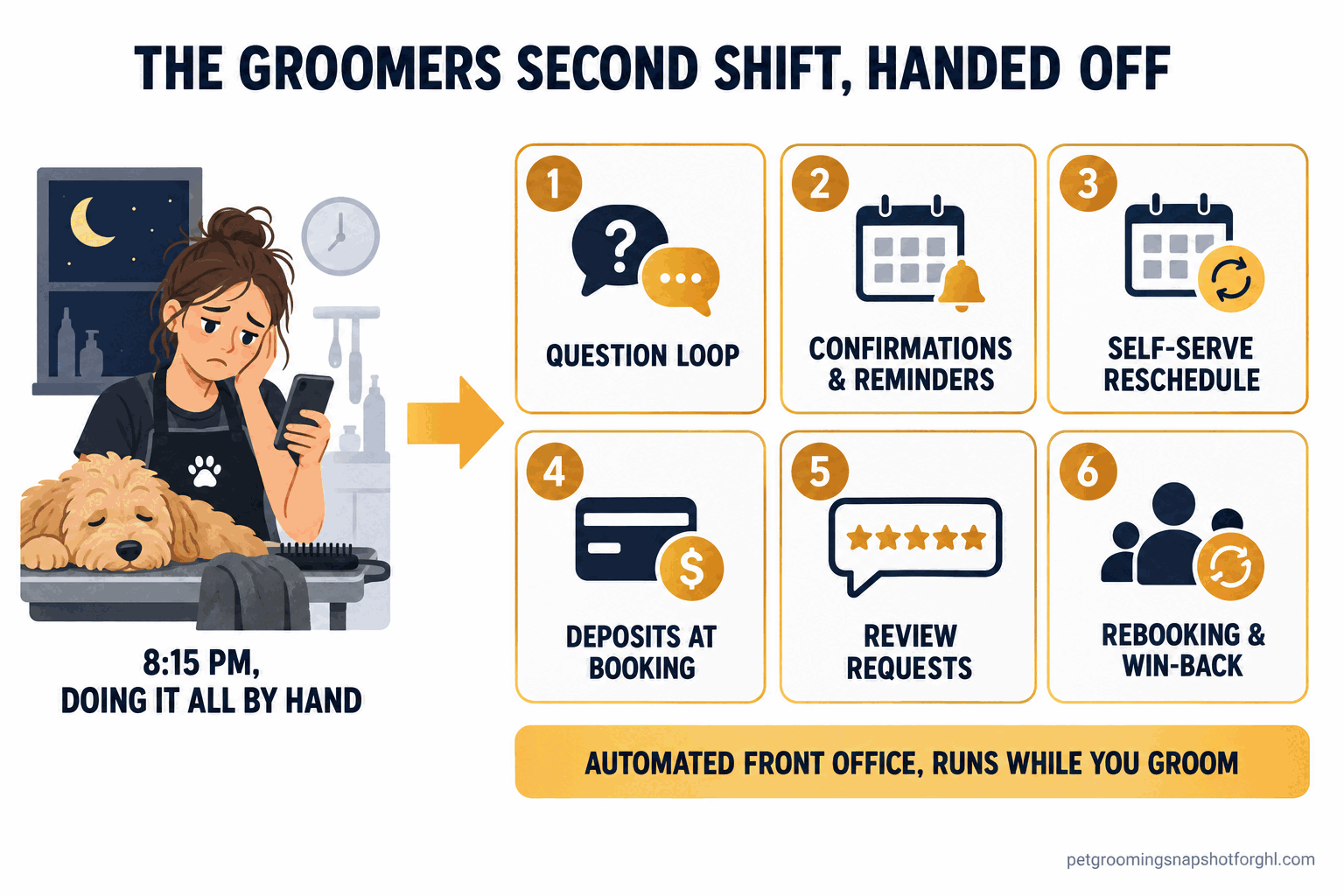
It is 8:15 at night. The last dog went home two hours ago. You have eaten standing up and you are on the couch with your phone, thumbs going. Confirming tomorrow’s dogs. Answering the woman who wants to know if you do doodles and how much. Moving the Thursday 10am because someone’s kid has a recital. Reminding yourself to ask the Hendersons for a Google review. Texting the client whose dog you have not seen since July.
None of it is grooming. Nobody pays you for it. And it happens every single night.
That is the second shift, the quiet reason so many good groomers feel busy, broke, and burned out at the same time. This guide walks through where those hours go, the six tasks that eat your evenings, and the system that hands each one off so your day ends when the last dog leaves.
Key Takeaways
The second shift is not a character flaw or a time-management problem you can hustle away. It is six repeatable tasks the business hands back to you every day because nothing is set up to catch them. Automate the six and the evening texting stops, not because you work faster, but because you stopped doing work a system should do. This guide names all six, with the copy to steal for each.
What the second shift is really costing you
The demand is not your problem. Americans spent $158 billion on their pets in 2025, projected to reach about $165 billion in 2026, and dogs need grooming on a cycle regardless. The problem is that every booking drags a tail of little admin jobs that land on the owner after hours.
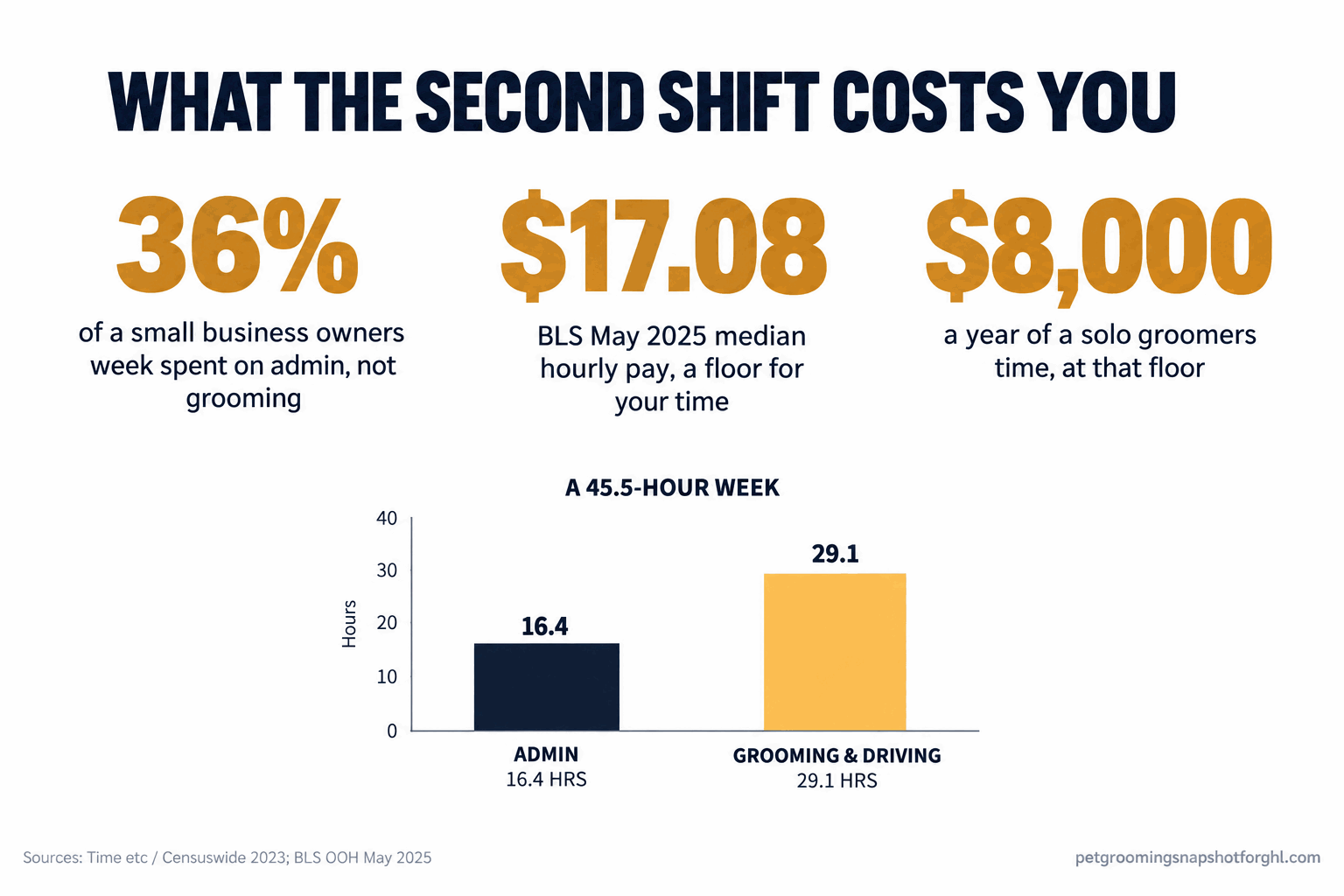
How big is the tail? A 2023 survey of US business owners by Time etc, run through Censuswide, found owners of growing businesses spend about 36% of a 45.5-hour week on administrative tasks, more than sixteen hours a week on work clients do not pay for. For a groomer who is also booker, cashier, front desk, and marketer, the share is often worse, because the admin cannot be done with a wet dog on the table. So it waits for the couch.
Hours in a 45.5-hour work week, split by the 36% admin share reported in the Time etc / Censuswide 2023 survey. For a solo groomer, admin cannot overlap with grooming, so most becomes an unpaid evening shift.
Now put a number on it. The Bureau of Labor Statistics puts the May 2025 median pay for animal care and service workers at $35,530 a year, or $17.08 an hour, and projects 11% growth through 2035. That $17.08 is the floor, what it would cost to hire someone to do the texting, and your own hour is worth far more. At even that floor, a solo groomer doing ten admin hours a week gives away roughly $8,000 a year of time.
The fix is not to text faster or stay up later. It is to make each of these six tasks get caught by a system before it ever reaches your thumbs.
The six tasks that make up the second shift
Here is the whole second shift, broken into its parts. Every one is a job you do by hand today, and every one can be handed to an automated front office that runs while you groom and while you sleep.
Task 1: The question loop
The same four questions, over and over. Do you do doodles. How much is a shih tzu. Are you open Saturday. Do you take new clients. You answer each one by hand, often after hours, and a slow reply is a lost booking because they already texted two other shops.
How it breaks. You answer when you can, so a Sunday-night question sits until Monday afternoon, by which point they booked elsewhere. Or you answer fast and it eats the ten minutes between dogs.
The fix. Put an instant auto-reply on every inbound channel, missed call, website chat, Instagram DM, so the first response is immediate and carries your menu and a booking link. The person books while you never touch the phone.
Task 2: Confirmations and reminders typed by hand
Every night you look at tomorrow and text each client to confirm. It feels responsible. It is also an hour a week of copy-paste that collapses the moment you get busy, which is when the no-shows return.
How it breaks. You do it manually, so on your busiest days, the exact days a reminder matters most, you forget. Or you send a one-way “see you tomorrow” that the client reads, means to answer, and never does.
The fix. Set a reminder sequence that runs itself: one confirmation at booking, one about 48 hours out, one the morning of, every one two-way so the client can confirm or move the time with one tap. The cadence and templates are in our SMS templates every grooming salon should steal, and the full no-show playbook is in how to cut grooming no-shows without nagging.
Task 3: The reschedule ping-pong
A client needs to move Thursday. Now you are trading six texts: what days work, let me check, no that’s gone, how about. One schedule change can cost fifteen minutes of back-and-forth, almost always after hours.
How it breaks. You are the only one who can see the calendar, so every change routes through you, one text at a time while you eat dinner, times the five clients a week who move.
The fix. Give the client a self-serve reschedule link in every reminder. They see your real open slots, pick one, and the calendar updates itself. You find out it happened instead of making it happen. It is the biggest evening-time saver for solo groomers.
Task 4: Chasing deposits and payments
You meant to take a deposit. You felt weird asking, so you let it slide, and now you are texting to remind someone about a balance, or eating the cost of a chair that sat empty because the booking was free to break.
How it breaks. Deposits live in your head as a policy you never actually collect, so nothing stops a no-show and there is nothing to chase except your own good nature. It is the most awkward second-shift task of all.
The fix. Collect the deposit at booking as a required step, and keep a card on file with a clear policy, so the system handles the money and you handle the dog. The economics and wording are in the deposit and cancellation policy clients actually follow.
Task 5: Asking for reviews and posting the photos
The shepherd looked incredible and you meant to ask for a review, but by pickup you were onto the next dog and it slipped. Your Google profile has nineteen reviews, three competitors have two hundred, and the gap is costing you new clients.
How it breaks. Review requests depend on you remembering, at pickup, on your busiest days, to do one more thing. The asks end up random and rare, and the one-star from an angry client sits unanswered on top.
The fix. Trigger a review request automatically a few hours after every completed groom, routing happy clients to Google and unhappy ones to a private reply so you hear it first. Full setup in how groomers get more 5-star Google reviews on autopilot.
Task 6: Rebooking and win-back from memory
You try to keep a mental list of who is due: the poodle every six weeks, the lab twice a year, the client who vanished after one visit. You cannot hold it in your head, so grooms slip to eight and ten weeks and lapsed clients quietly stop existing.
How it breaks. Rebooking lives in your memory and your memory is full. Nobody gets nudged on a schedule, so your calendar depends on clients remembering to call you, which they do not, and the lost ones are never worked at all.
The fix. Automate the rebooking nudge at the right interval for each dog, and run a standing win-back sequence for clients who have not been in for sixty or ninety days. This is the task that most directly fills next month’s book. The playbooks are in the grooming rebooking system that fills next month and how to win back lapsed grooming clients.
The compliance piece you cannot skip
Every one of those steal-this texts is business messaging, which in the US runs over the carrier system known as A2P 10DLC: you register your brand and campaigns and get consent before you send automated reminders, review requests, or win-back texts. Groomers text more than almost any small business, so this matters more here.
The trap most groomers fall into is assuming a “your dog is ready” pickup text is exempt because it is helpful, not marketing. Carriers do not see it that way. Confirmations, pickup texts, and win-back messages are different campaign types, and all need consent and registration. Collect a clear opt-in at booking, keep the proof, and compliance is built in rather than bolted on after a carrier blocks you. The FCC’s guidance on texting, the federal TCPA statute, and GoHighLevel’s A2P 10DLC use-case guide lay out the rules, and our full A2P 10DLC and consent guide for groomers turns them into plain steps. One note: a ten-thousand-dollar-per-message fine gets quoted in vendor blogs, it is unverified, so do not let it scare you into bad decisions.
How this plays out: van, salon, and fleet
The six tasks are the same for everyone. What changes is how much of your week they eat.
The solo mobile van
You are the whole company, so the second shift lands entirely on you. The biggest wins are the missed-call text-back (you cannot answer the phone in a driveway with a dog on the table) and the self-serve reschedule link. Turn those on first, with two-way reminders and deposits on every new client, and you reclaim six to eight hours a week, a full evening back, while you stop losing the Sunday-night booker.
The one-to-three-chair salon
The admin is spread across a couple of groomers and maybe a part-time front desk, but it still routes through the owner at night, because that is who holds the calendar. Automate confirmations and reminders so your front desk stops doing them by hand, put the review request on every groom to close the gap with bigger competitors, and run the rebooking cadence so chairs stay full. A salon this size typically reclaims ten to fifteen hours a week across the team.
The two-to-six-van fleet
At fleet scale the second shift is a structural cost across every van, and a manual reminder habit does not survive six calendars. Automated reminders and deposits per van, review requests per groom so each van builds its own local reputation, and rebooking and win-back per route so no client goes cold. A fleet reclaims twenty-plus hours a week, and runs the same whether the owner is on the couch or on vacation.
Objections groomers raise before they automate
“Won’t automated texts feel cold and impersonal?” Only if you write them that way. The steal-this copy above sounds like you because you wrote it once, in your voice. Clients cannot tell a well-written automated reminder from one you typed, and they far prefer a reminder that arrives on time to a personal one that never comes because you were slammed. The personal touch belongs on the grooming table, not in copy-pasting confirmations at 9pm.
“I do not have time to set all this up.” That is the exact trap. The reason you have no time is the second shift, and the setup is what ends it. Build it in stages: the missed-call text-back and reminders this week, the reschedule link and deposits next, reviews and rebooking after. Each piece pays back its setup fast, or you skip the build and have it installed for you.
“I already pay for MoeGo or another tool.” Then you likely own some of these pieces and have never switched them on. Most groomers who pay for scheduling software never configured deposits, the automated review ask, or a real win-back sequence. Audit what you pay for against these six tasks. If the gaps are real, our guide to switching software without losing client history covers moving, though you may just need to finish the setup.
“I am not technical.” You do not have to be. You already run a business and hold a book in your head, which is harder than this. The decisions are yours (your menu, your deposit amount, your wording); the wiring is a weekend of following guides or a job you hand off. Being non-technical is a reason to get it done for you, not a reason to keep the second shift.
“My clients want to hear from me personally.” Some do, and nothing here stops that. Automation handles the repetitive confirmations and reminders so your personal attention goes where it counts: a worried first-timer, a note about a senior dog, a thank-you to a loyal client. You get more room to be personal, not less.
Your day can actually end
Go back to the couch at 8:15. In the version where the six tasks are handed off, the phone is quiet. The missed call got a text back with your menu and a booking link. Tomorrow’s dogs confirmed themselves. The recital family moved their own appointment. The Hendersons got their review request and left five stars. The client you had not seen since July is booked for next week. None of it touched your thumbs.
That is the whole point. You did not get faster at admin, you stopped doing admin a system should do, so your grooming day ends when the last dog leaves and your evening is yours again. The craft is yours. Let the business run the rest.
Your questions, answered
Why do groomers spend so much time on admin after hours?
Because a small grooming shop bundles the booker, cashier, front desk, and marketer into one person who is also doing the grooming. Those admin tasks cannot be done with a wet dog on the table, so they pile up for the evening. Surveys put admin at roughly a third of a small business owner's week, and for a solo groomer much of that becomes an unpaid night shift.
What grooming admin tasks can actually be automated?
Six repeatable ones: instant replies to missed calls and inbound questions, two-way confirmations and reminders, self-serve rescheduling, deposits taken at booking, post-groom review requests, and the rebooking and win-back cadence. These are rules-based and repetitive, exactly what automation does well. Your judgment stays on the grooming and the tricky client conversations.
Will automating my client texts get me in trouble with the carriers?
Not if you do it right. US business texting runs over A2P 10DLC, so you register your brand and campaigns and collect consent before you text. Confirmations, pickup texts, and marketing are separate campaign types, and pickup texts are not exempt. Collect a clear opt-in at booking, keep the proof, and automated reminders are both legal and reliable.
Do I need to switch grooming software to stop the second shift?
Often not. Many groomers already pay for a tool that can send reminders, take deposits, and request reviews but never finished the setup, so the tasks still land on them by hand. Audit what you own against the six tasks first. Finishing the setup you already paid for is usually the faster win than moving.
Is automated client communication worth it for a small grooming business?
Yes, because the cost is mostly your own time, and the time is substantial. Valued at even the BLS May 2025 floor of $17.08 an hour, ten admin hours a week is around $8,000 a year of a solo owner's time, and your billable hour is worth more. Automating the repetitive back office pays for itself quickly and fills next month's book at the same time.
Related reading
- How to cut grooming no-shows without nagging pet parents
- SMS templates every grooming salon should steal
- The deposit and cancellation policy clients actually follow
- The grooming rebooking system that fills next month
- How groomers get more 5-star Google reviews on autopilot
- Booked solid but broke: why a full schedule isn’t making you money