
You are at the counter about to run a full groom for the same $70 you charged in 2021. Your shampoo costs more, your fuel costs more, the kid who answers the phone costs more. You know the number should be higher. But the second you imagine telling Mrs. Patterson that Biscuit’s groom is now $85, your stomach drops and you run the $70 again. That is the whole problem. Not the price, the fear of the conversation.
Here is the short answer: you raise grooming prices without losing clients by doing it on purpose, not by accident. Work out your real cost per hour, pick a number that covers it, tell clients before the change with a calm reason, and handle the handful who push back with a script instead of a flinch. Done right, you lose almost nobody, because your regulars are not paying for a price. They are paying for you and not having to find a new groomer. This guide walks it stage by stage, with the scripts to steal.
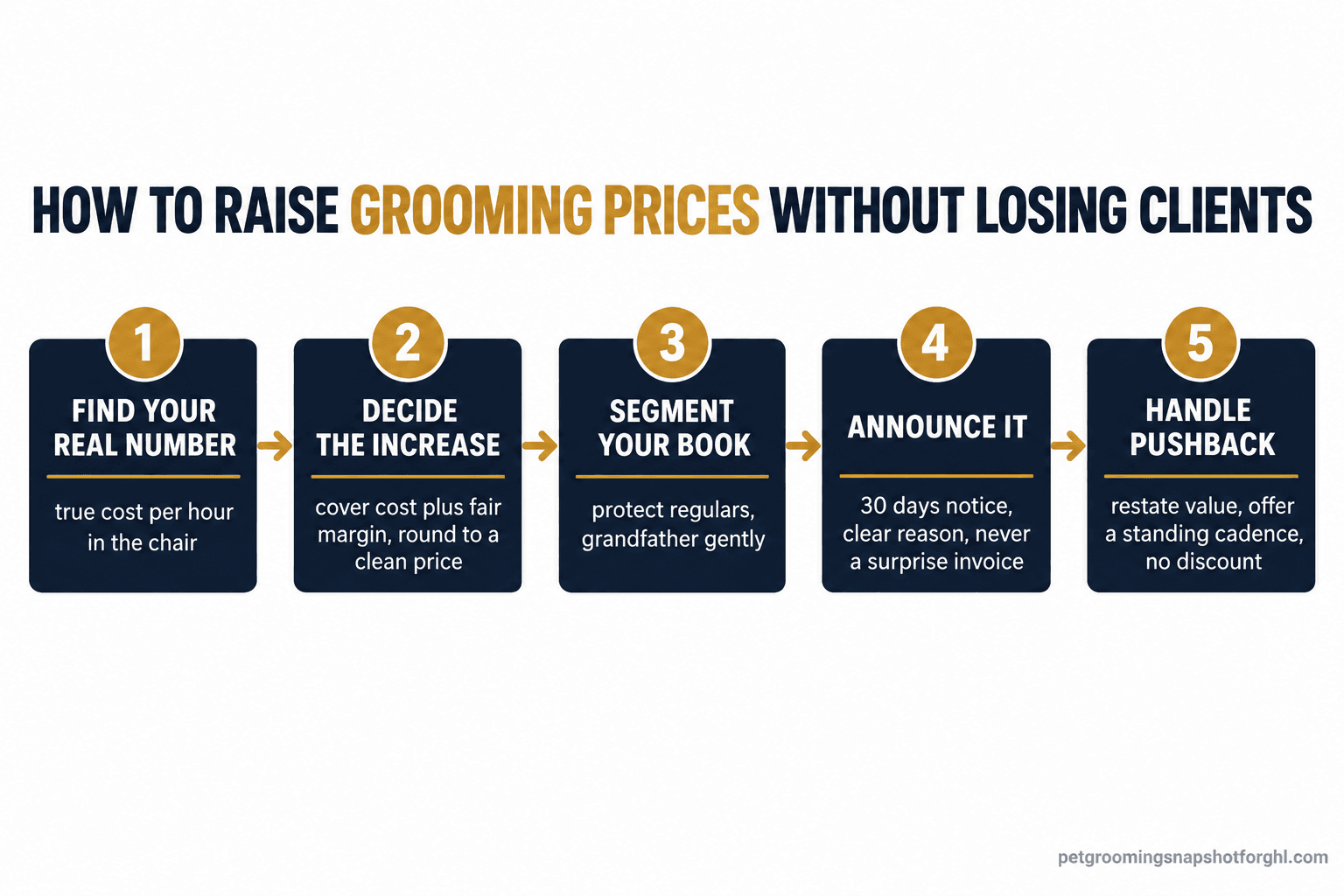
Key Takeaways
- Most groomers are not overpriced. They are frozen. Costs climbed for five years while your menu sat still, so a raise is a correction, not a grab.
- The number comes from your chair time, not the shop down the road. Price off your true cost per hour or you just work harder for the same money.
- The clients you fear losing are the least likely to leave. Regulars churn over surprise, not over a fair, well-announced increase.
- It lives or dies on the announcement. Clear reason, enough notice, calm tone, and a script for pushback turn a raise into a quiet day.
What This Guide Covers
- Why you are almost certainly underpriced
- Stage 1: Find your real number
- Stage 2: Decide how much to raise
- Stage 3: Segment your book first
- Stage 4: Give notice the right way
- Stage 5: The announcement, word for word
- Stage 6: Handle the pushback
- Stage 7: When someone leaves
- What each type of shop should do
- Texting the whole list
- Common objections
- FAQ
Why You Are Almost Certainly Underpriced
Start with the part nobody says out loud: a flat price is a slow pay cut.
The numbers back it up. Prices for pet services have climbed about 33% over five years, and 5.3% in the last year alone, per Consumer Price Index data from the US Bureau of Labor Statistics. That is shampoo, clipper blades, fuel, rent, and wages. If your groom price has not moved 30% in five years, your margin has been eaten alive. Meanwhile the BLS puts the median wage for animal caretakers at $35,360 a year as of May 2025, for a trade that handles teeth, nails, and frightened animals all day.
Demand is not the problem. The pet industry hit $158 billion in US spending in 2025, projected to reach $165 billion in 2026, per the American Pet Products Association. The same research found 51% of dog owners now groom at home, and spending on salon and mobile grooming declined in 2025. That sounds like a reason to stay cheap. It is the opposite. The clients still coming to you will never attempt a double-coat deshed or a matted doodle at the kitchen sink; they pay for skill they cannot replace. Price for the client who stays, not the one who was always leaving for YouTube.
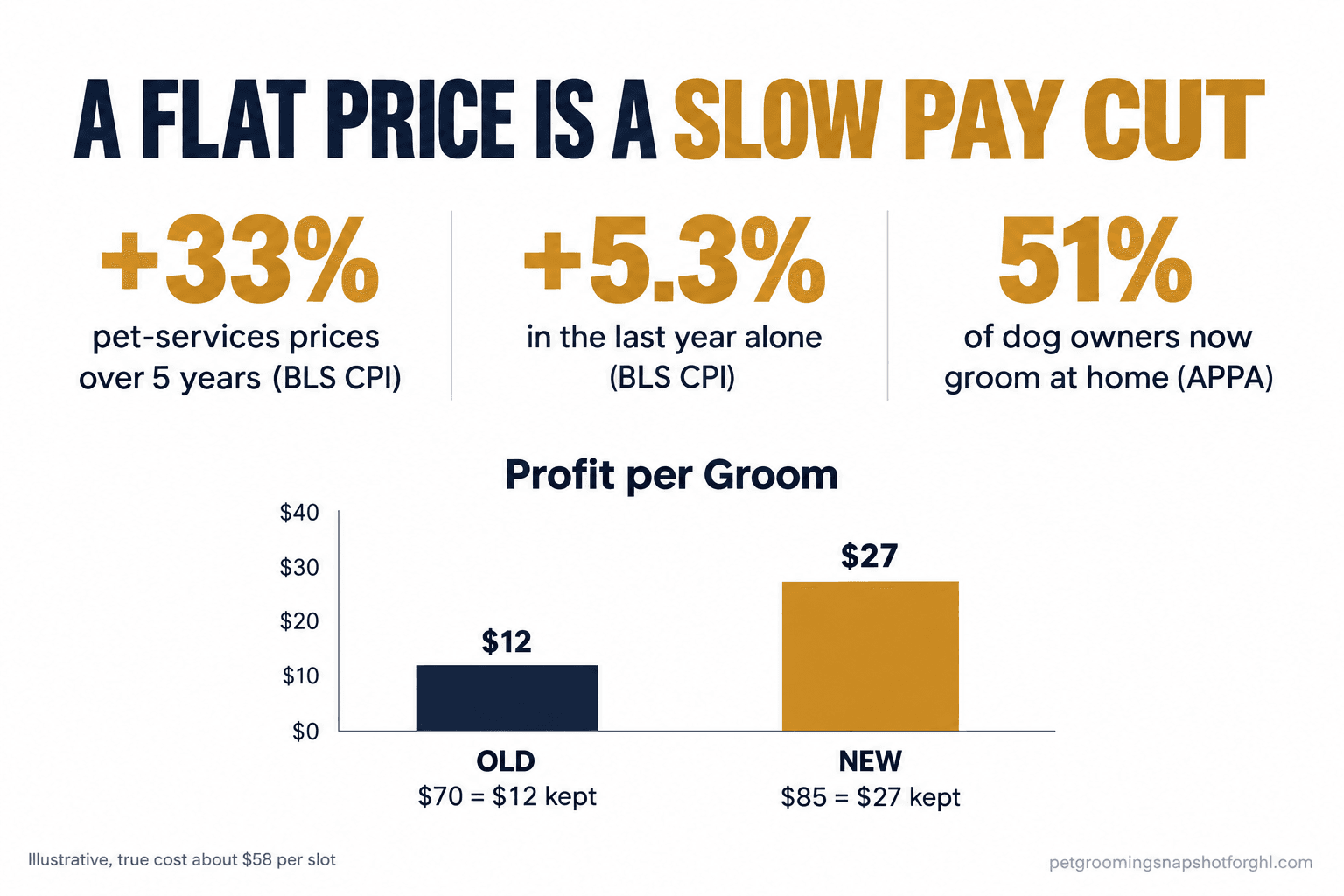
Price data from officialdata.org, BLS CPI; home-grooming share from APPA. Profit illustrative at a $58 true cost per slot.
Stage 1: Find Your Real Number
You cannot set a new price until you know what an hour in your chair costs.
Do the math once. Add up everything it costs to keep the doors open for a month: rent or van payment, insurance, supplies, software, phone, your own pay, and staff wages. Then count the hours a dog is actually on the table, not the hours you are open. Divide cost by groomable hours for your true cost per hour. Most solo groomers are shocked how high it is once drive time, no-shows, and cleanup stop counting as free.
Now price each service off the time it takes. A 90-minute schnauzer and a three-hour matted Great Pyrenees should never cost the same, or the big dog is subsidized by the little one. That is the logic behind pricing dog grooming by breed and coat type. The gap between your current price and your real cost is why the book stays full while the bank account stays flat, the trap in why a full grooming schedule is not making you money.
Stage 2: Decide How Much to Raise
Once you know your real number, the increase almost picks itself: cover your cost plus a fair margin, not a feeling. The art is the presentation.
A small, regular increase beats a big, rare one. A shop that nudges prices 5 to 8% every year trains clients to expect it, like the vet does. A shop that holds flat for four years and then jumps 30% creates a shock, and shock makes people leave. A stealth hike is worse: they always notice, and quiet feels like a trick.
Round to clean, confident numbers. $85, not $82.50. A price figured to the dollar reads nervous; a round number reads decisive. And raise the add-ons, not just the base groom. Nail grinds, teeth brushing, deshedding, and specialty shampoo are where real margin hides, and clients rarely price-shop an $8 add-on. At a true cost of roughly $58 per slot, raising a $70 groom to $85 more than doubles what you keep, from about $12 to $27.
Stage 3: Segment Your Book Before You Touch a Price
Not every client gets the same treatment, and pretending they do loses the wrong people. Sort your list into three groups first.
Your core regulars book on a steady breed-driven cadence, show up, tip, and never haggle. Protect them: most notice, warmest message, and many shops grandfather them over their next two visits. Your occasional clients come in a few times a year; they get the standard notice and the new price next booking. Your price-driven clients only appear for a coupon; they get the increase with no special handling, and if they leave, your schedule just got more profitable.
One more group: brand-new inquiries. The easiest increase is the one you never announce. Quote every new client at the new price today. With no old number to compare, there is nothing to defend.
Stage 4: Give Notice the Right Way
Timing and tone keep more clients than the price itself. Three things make a notice land.
Give enough runway. Thirty days is the floor for regulars. Announce it the day it takes effect and even loyal clients feel ambushed; give them a month and they feel respected. Lead with the reason, not the apology. Rising costs are real, so a confident one-line reason beats hand-wringing. Pick the right channel. Core regulars get a personal heads-up before any mass message; the general list gets one clean announcement by text and email.
Protect one thing above all: never let a client find out from the invoice. The surprise charge is the fastest way to turn a happy regular into a one-star review. If they know it is coming, the higher number is just a number; if not, it feels like a trick.
Stage 5: The Announcement, Word for Word
The message is short, warm, and specific. Here is the one you send your general list four weeks out.
“Hi [Client], a quick heads-up from [Shop]. Starting [date], our grooming prices are going up a little to keep pace with rising supply and labor costs. [Pet]’s full groom will be [new price]. It is the first increase we have made in [time], and it lets us keep giving [Pet] the same careful, unrushed groom. Nothing else changes, same team, same schedule. Your next appointment on [date] is all set. Thank you for trusting us with [Pet].”
That message does four jobs: the date, the real number so there is no invoice surprise, a calm reason, and reassurance that what they value is not changing. For core regulars, say it in person:
“Before you go, quick thing: we are adjusting our prices starting [month], first time in a while. [Pet]’s groom will be [new price]. You are one of our regulars so I wanted you to hear it from me, not off an invoice. Everything else stays exactly the same.”
For brand-new clients there is no announcement; you just quote the new price. For online bookers, update your menu before the effective date, and make sure the new number flows through your automated confirmations and reminder cadence too. Notice what the scripts never do: apologize, over-explain, or ask permission. Clients take their cue from your tone. Sound calm and the price is a fact; sound guilty and you have made it negotiable.
Stage 6: Handle the Pushback Without Flinching
Here is the truth that makes this easier: the pushback is tiny. A clean 10 to 20% increase draws a complaint from a small handful; the rest never say a word. But you need a script, because one flustered reply can cost a client you wanted to keep.
When someone says “that’s a big jump,” do not defend and do not discount. Acknowledge, restate the value, and stop.
“I hear you, and I get it, nobody loves a price going up. It is the first time we have raised in [time], and it keeps us able to give [Pet] the full, careful groom without rushing. I would love to keep [Pet] on the schedule.”
When someone asks “can you do anything on the price,” give a soft no with a real alternative, never a caved-in yes. A discount tells everyone who paid full price they were a sucker, and teaches this one to keep haggling.
“I can’t move the groom price, but here is what I can do: if you go to a regular eight-week schedule, I can lock your spot and keep the price steady for the year. A lot of folks find that works out better than a longer gap.”
That answer swaps a discount for a commitment, and a client on a tighter cadence is worth far more over a year than the few dollars you did not discount. If they want to stretch a budget, the honest move is a prepaid package or membership, not a margin-bleeding price cut.
Stage 7: What to Do When Someone Leaves
Some clients will leave. Not many, and usually not the ones you feared. Do the math on who you can afford to lose: raise a $70 groom to $85, a 21% bump, and you can lose roughly one in six clients and still bank the same revenue. A client walking over fifteen dollars is not a loss; it is a slot that just opened for someone who values the craft.
When a longtime client does leave, let them go warmly and leave the door open. A graceful exit protects your reputation and often wins them back.
“Totally understand, and no hard feelings at all. [Pet] has been a joy. If anything changes, you are always welcome back, and your spot is here whenever you want it. Take care.”
Then backfill the open slots on purpose. A raise only pays off if you fill the freed slots at the new price, so turn your reactivation and referral flows back on and work your win-back sequence for lapsed clients. A raise plus a full book is the whole point.
What Each Type of Shop Should Actually Do
The playbook holds; execution changes with the shape of your business.
The solo mobile groomer. You are the brand and the relationship, so loyalty runs deep and churn runs low. Raise in a personal, direct message to each regular, and remember your costs (fuel, van, generator, water) ran up faster than a storefront’s. You have the most room to raise and the least to fear. Pair the increase with a standing-cadence ask so a tighter schedule offsets any drop.
The three-chair salon with a small team. Consistency is the challenge. Every groomer and front-desk person must quote the same prices with the same calm confidence, or clients find the softest touch. Write the scripts down, walk the team through them once, and update the booking menu and reminders together.
The multi-van or multi-location operation. Uniformity is the whole game. Prices, scripts, and the effective date must match across every van and location, or clients chase the cheapest unit. At this scale operators usually move off per-seat tools to a single platform they own, so a change pushes everywhere at once. That is the model behind a route-smart mobile booking setup.
Illustrative share of clients who push back on a well-announced 15 to 20% increase, by shop type. Solo mobile sees the least, thanks to the personal relationship. Modeled from operator reports, not a survey.
A Note on Texting a Price Change to Your Whole List
Groomers text more than almost any other small business, and a price announcement blasted to your whole list counts as a mass message under US carrier rules. Business texting here runs through a registration system called A2P 10DLC, and broadcast messages need a registered campaign with real consent on file. A notice to people who opted in to your reminders is generally fine; messaging a bought or scraped list is the fastest way to get your number flagged and your reminders blocked. Keep messages transactional, make opting out easy, and only text clients who gave consent. The plain-English version is in A2P 10DLC, consent, and texting compliance for groomers, and the Federal Communications Commission’s guidance on text and call consent is the backstop. None of this is legal advice; ask a local attorney if unsure.
Common Objections
“If I raise prices, won’t I lose a bunch of clients?” A few, and almost never the ones you value. A well-announced 15 to 20% increase typically loses a small single-digit share, mostly price-driven clients who were barely profitable, so you end up ahead on revenue and time.
“What if a competitor is cheaper?” Someone is always cheaper, and usually busier and more burned out. Your clients are buying a careful groom and a groomer who knows their pet, not the lowest price. Even the software you both run keeps raising prices and stacking per-staff fees, from MoeGo to Gingr, so your flat groom price is the only cost in the chain that never went up. Compete on skill.
“Should I just change the prices quietly?” No. The silent increase earns the one-star review and the angry text. The announcement is not a courtesy, it protects the relationship. Clients forgive a higher price; they do not forgive feeling tricked. It helps to have the new number flow through your menu, confirmations, and reminders automatically, where a pre-built SMS and booking setup earns its keep.
FAQ
How much can I raise my grooming prices at once without losing clients?
A well-announced 10 to 20% increase typically loses only a small single-digit share, mostly price-driven clients who were barely profitable. Give at least 30 days of notice, lead with a clear reason, and never let clients find out from the invoice. If you are badly behind, stage a big catch-up across two increases six to nine months apart.
How do I tell clients about a grooming price increase?
Send a short, warm message about four weeks out with the effective date, the new price for their pet, a one-line reason (rising supply and labor costs), and a reassurance that the service and team stay the same. Tell core regulars in person first; quote new clients at the new price with no announcement.
How do I figure out what to charge for grooming?
Work out your true cost per hour: total monthly costs including your own pay, divided by the hours a dog is actually on the table. Then price each service off the time it takes, so a three-hour matted dog never costs the same as a 90-minute groom, plus a fair margin rounded to a clean number.
What do I say when a client complains about the higher price?
Acknowledge it, restate the value, and stop talking: 'I hear you, it is the first raise in a while and it keeps us able to give your dog the full, careful groom.' Never discount on the spot, which teaches clients to haggle. Instead offer a standing cadence that locks their price.
Is it legal to text my whole client list about a price change?
Texting clients who opted in is generally fine, but US business texting runs through the A2P 10DLC registration system, and broadcast messages need a registered campaign with consent on file. Keep messages transactional, make opting out easy, and do not message anyone who never opted in. Not legal advice; check with a local attorney if unsure.
Should I raise prices for my loyal regulars too?
Yes, but gently. Regulars are the least likely to leave, because they value you, not the price. Give them the most notice and warmest message, tell them in person first, and if you like, grandfather them over their next two visits.